
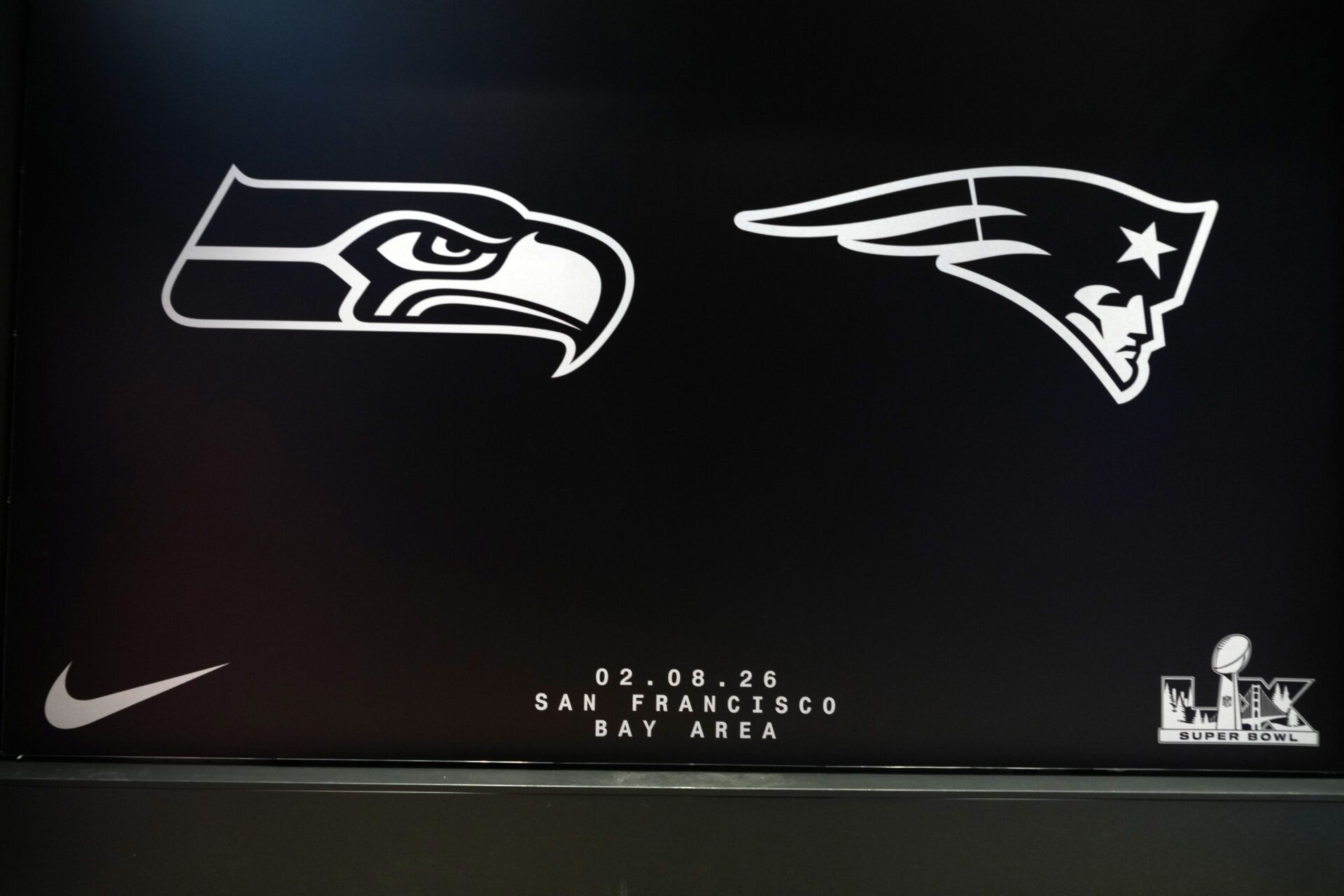
Millions of people across the globe will be tuning in to watch Super Bowl 60 between the Seattle Seahawks and New England Patriots on Sunday night. The annual football spectacle is a date circle on the calendar, and watch parties will be happening across the world.
For many, the whole day is devoted to the big game, with hours and days of buildup to the main event. But how long does the actual Super Bowl game go on for?
How Many Hours Is an Average NFL Game?
A football game is played over 60 minutes and is split into four 15-minute quarters. However, a game lasts much longer than the hour set aside for the action itself, with games lasting between three and four hours on average.
That’s because the NFL rules mandate stoppages in the game clock, whether that be for the action on the field or commercial breaks.
The clock only continues to run when the ball is in play, for a run or a completed catch. Whereas, in some instances, such as if the ball goes out of bounds or there is an incompletion, the clock will stop.
The average time to complete a down is four seconds, and a 2010 report by the Wall Street Journal found that the average amount of live action in an NFL game is just 11 minutes.
Average Super Bowl Game Length
While the time does vary, the average length of the Super Bowl is three hours and 44 minutes, according to a study by The Verge that averaged how long six Super Bowls lasted. In contrast, the average length of a regular-season NFL game is three hours and 12 minutes.
When considering the halftime show and extended commercial breaks, an extra 30 minutes or so is to be expected.
MORE: How Long is the Super Bowl Halftime Show?
Halftime shows usually extend the break to between 20-30 minutes, with the average performance lasting 13 minutes.
Commercials also have to be factored into how long the Super Bowl lasts. A report by Vivvix, an advertising intelligence media partner, found that the average commercial time on a Super Bowl broadcast between 2010 and 2019 was 49 minutes and 27 seconds.
The report also estimates that the Super Bowl contains an average of seven more minutes of advertising than a typical NFL game.
Furthermore, a New York Times study found that there is an average of 20 commercial breaks during a regular-season NFL game, consisting of over 100 ads. More are expected during the Super Bowl.
Around four hours are generally put aside for the Super Bowl game. That’s because the longest-ever game was Super Bowl XLVII between the Baltimore Ravens and San Francisco 49ers, which lasted four hours and 14 minutes! However, that was in large part due to a power outage at the Superdome in New Orleans, which delayed the game for 34 minutes.
Even when the Super Bowl has gone to overtime, it only lasted roughly three hours and 47 minutes.
Super Bowl 60 Preview: Patriots vs. Seahawks
Super Bowl 60 features two of the most surprising conference champions in recent memory. The Patriots and Seahawks posted identical records during the regular season (14-3) and both quarterbacks exceeded all expectations.
Patriots QB Drake Maye finished second in MVP voting after a breakout regular season, while Seahawks QB Sam Darnold authored the league’s best redemption story.
However, both teams advanced this far in large part because of their excellent defenses, so this could be a low-scoring affair. Mike Macdonald’s Seahawks were the third-best D in the league during the regular season, according to PFSN’s Defense Impact metric, while the Patriots’ 12th-ranked defense has gotten hot at the right time.
Here’s how each overall unit and the starters from both New England and Seattle graded in PFSN’s Impact grades, giving you a player-by-player breakdown of each squad.
Offense
PFSN Offense Impact (OFFi)
NE: 86.6, B (2nd)
SEA: 79.8, C+ (9th)
PFSN Offensive Line Impact (OLi)
NE: 74.5, C (12th)
SEA: 72.0, C- (17th)
PFSN Quarterback Impact (QBi)
NE: Drake Maye (91.1, A-; 2nd)
SEA: Sam Darnold (78.7, C+; 13th)
PFSN Running Back Impact (RBi)
NE: Rhamondre Stevenson (54.4, F; 38th)
NE: TreVeyon Henderson (66.9, D; 17th)
SEA: Kenneth Walker III (65.8, D; 20th)
SEA: Zach Charbonnet (54.8, F; 36th) *OUT for Super Bowl*
PFSN Wide Receiver Impact (WRi)
NE: Stefon Diggs (87.0, B+; 4th)
NE: Kayshon Boutte (81.5, B-; 18th)
NE: DeMario Douglas (79.3, C+; 25th)
SEA: Jaxon Smith-Njigba (94.4, A; 2nd)
SEA: Cooper Kupp (73.2, C; 57th)
SEA: Rashid Shaheed (71.9, C-; 70th)
PFSN Tight End Impact (TEi)
NE: Hunter Henry (82.0, B-; 11th)
SEA: A.J. Barner (77.4, C-77.4; 21st)
PFSN player Offensive Line Impact (OLi)
LT
NE: Will Campbell (75.1, C; 39th )
SEA: Charles Cross (79.1, C+; 24th)
LG
NE: Jared Wilson (69.5, D+; 49th)
SEA: Grey Zabel (77.1, C+; 27th)
C
NE: Garrett Bradbury (80.4, B-; 19th)
SEA: Jalen Sundell (78.6, C+; 24th)
RG
NE: Mike Onwenu (87.0, B+; 5th)
SEA: Anthony Bradford (74.7, C; 36th)
RT
NE: Morgan Moses (85.2, B; 10th)
SEA: Abraham Lucas (82.5, B-; 14th)
DEFENSE
PFSN Defense Impact (DEFi)
NE: 78.2, C+ (12th)
SEA: 88.4, B+ (3rd)
PFSN EDGE Impact (EDGEi)
NE: Harold Landry III (76.3, C; 46th)
NE: K’Lavon Chaisson (76.2, C; 48th)
SEA: DeMarcus Lawrence (81.5, B-; 28th)
SEA: Uchenna Nwosu (74.0, C; 33rd)
PFSN Defensive Tackle Impact (DTi)
NE: Milton Williams (87.9, B+; 5th)
NE: Christian Barmore (78.6, C+; 28th)
SEA: Leonard Williams (84.2, B; 10th)
SEA: Byron Murphy II (81.2, B-; 16th)
PFSN Linebacker Impact (LBi)
NE: Robert Spillane (85.3, B; 17th)
NE: Jack Gibbens (70.4, C-; 52nd)
NE: Christian Elliss (62.7, D-; 70th)
SEA: Ernest Jones (89.9, B+; 4th)
SEA: Drake Thomas (77.9, C+; 33rd)
NE: Christian Elliss (62.7, D; 70th)
PFSN Cornerback Impact (CBi)
NE: Christian Gonzalez (85.7, B; 12th)
NE: Carlton Davis (78.8, C+; 37th)
NE: Marcus Jones (72.0, C-; 80th)
SEA: Tariq Woolen (81.7, B-; 27th)
SEA: Josh Jobe (81.9, B-; 26th)
SEA: Devon Witherspoon (76.2, C; 48th)
PFSN NFL Safety Impact (SAFi)
NE: Jaylinn Hawkins (76.4, C; 32nd)
NE: Craig Woodson (69.7, D+; 66th)
SEA: Julian Love (90.7, A-; 2nd)
SEA: Coby Bryant (84.0, B; 11th)
SEA: Nick Emmanwori (80.2, B-; 20th)
Super Bowl 60 Notes
- New England defeated the No. 1 (DEN), No. 2 (HOU), and No. 8 (LAC) ranked defenses on its way to winning the AFC.
- Seattle defeated the No. 1 (LAR) and No. 5 (SF) ranked offenses on its way to winning the NFC.
- The Patriots have allowed just two touchdowns and 26 points while forcing 8 turnovers during the playoffs. However, they have faced the 15th-ranked (DEN), 23rd-ranked (HOU), and 26th-ranked (LAC) offenses during that stretch, and the Broncos were playing with backup quarterback Jarrett Stidham.
- The Seahawks lead the league in third-down defense (32.3%), but they have allowed a 48% conversion rate on fourth down (T-7th). The Patriots rank 9th in third-down conversions allowed (36.9%) and 2nd on fourth down (33.3%).
- Seattle’s special teams have the second-best grade of the season with a 90.9 (A-), while New England is 20th (73.9 C-).
- Seattle has scored five special teams touchdowns, as well as blocking one punt and two field goals, while New England has scored three special teams touchdowns and has blocked one field goal.
- The Patriots are one of eight teams to average under 40 net yards per punt. SEA has beaten two of the other seven teams in the last two weeks. NE (2nd; 37.7) and SEA (4th; 38.7) both rank in the top four when it comes to opponent net yards per punt.
- Jaxon Smith-Njigba recorded a WRi score of 85.3 (B) against the Los Angeles Rams in the NFC Championship game. It ranked 29th among players this season. In Week 12 against the Tennessee Titans, Smith-Njigba had the second-best score of the season with an 89.7 (B+). Only Puka Nacua’s 94.4 (A) WRi against Seattle in Week 16 was better.
- Smith-Njigba had the second-best season-long WRi score (94.4, A), ranking seventh since 2019.
- Stefon Diggs had the fourth-best WRi score in the league after finishing 26th and 27th the last two seasons. Diggs’ score was the 39th best since 2019, and he has four of the top 48 season scores in that time frame.
- Drake Maye’s QBi of 97.8 (A+) against the New York Jets in Week 17 was the top individual game PFSN’s Quarterback Impact (QBi) performance over the past 18 seasons. Since 2000, only Peyton Manning’s 99.8 (A+) QBi against the Ravens in 2007 ranks higher in a single game.
- Sam Darnold registered five of his top eight career QBi scores this season (94 qualified games). Darnold’s QBi (90.8, A-) in Week 5 against Washington was his career best; it was also the 57th-best score by any quarterback since 2000 (13,999 games).
- Mike Vrabel, with two touchdown receptions in Super Bowls, is tied for the seventh most career receiving touchdowns in Super Bowl games. Vrabel, who played over 200 career games as a linebacker, also recorded 10 touchdown catches in the regular season.
- Seattle led the NFL with a +191 point differential this season, while New England was third at +170. This Super Bowl matchup marks the fifth time both teams entered with a regular-season point differential of at least +170. The other matchups were Super Bowl 1 (GB-KC), Super Bowl 4 (KC-MIN), Super Bowl 19 (SF-MIA), and Super Bowl 48 (SEA-DEN).
- The Seahawks have yet to commit a turnover in the playoffs. Only 11 Super Bowl champions, including last season’s Philadelphia Eagles, have finished the postseason with just one turnover. Seattle is also among 17 teams in the Super Bowl era to play their first two playoff games without a turnover.
- The Seahawks’ DEFi score of 95.1 (A) against the Vikings in Week 13 ranked as the 12th-best individual PFSN’s Defense Impact game score across all NFL matchups since 2019 (out of 3,918 games).
- In nine Super Bowls with Bill Belichick and Tom Brady, the Patriots had a cumulative point differential of +14, including a 10-point victory in their final Super Bowl together.
- The Patriots’ 14 regular-season games against teams with a losing record are the most by a team in the Super Bowl. Washington in the strike-shortened 1987 season played 13 of 15 games against losing teams, including ones with replacement players. Seattle played nine such games this season.