
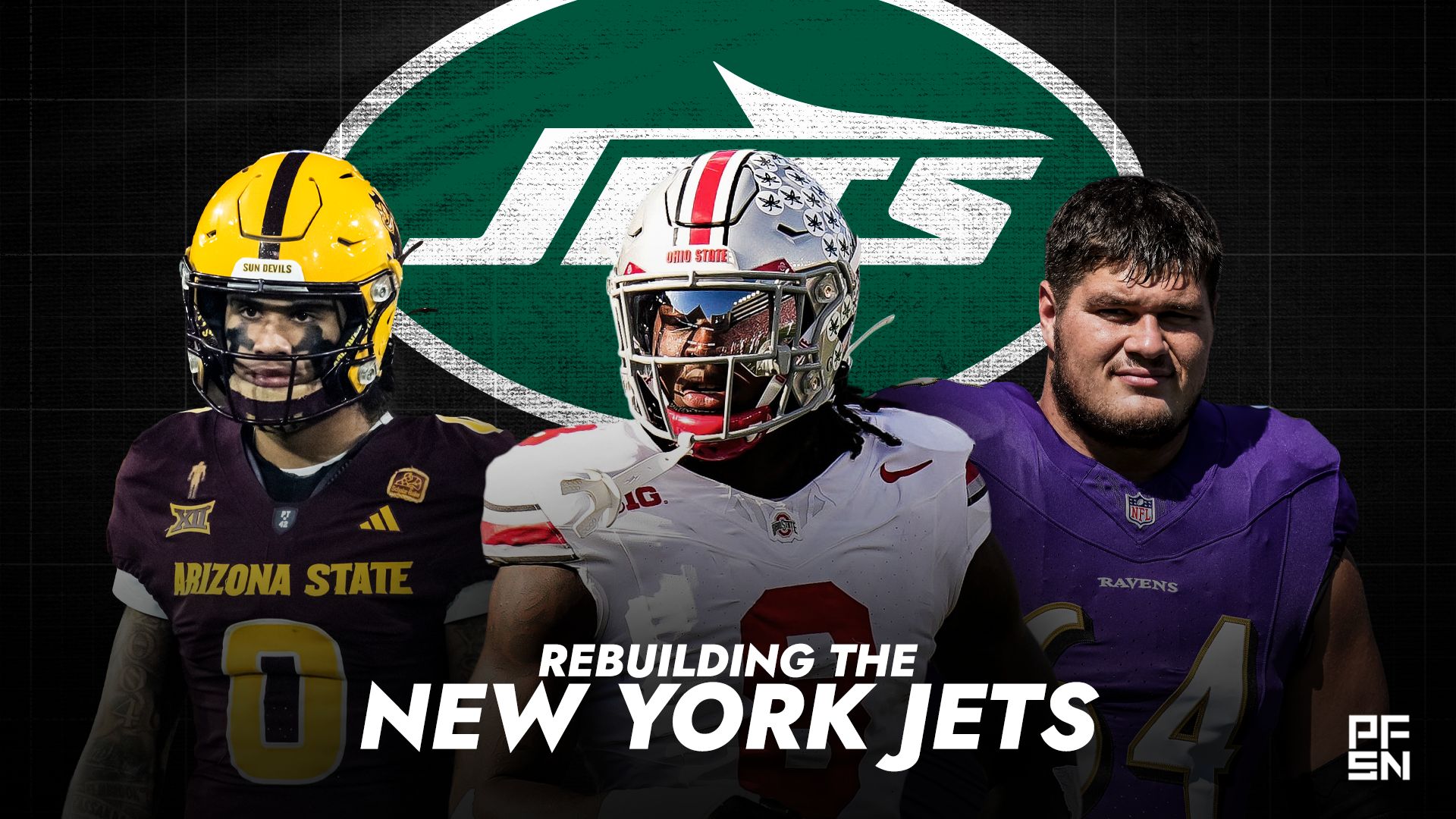
The New York Jets are entering yet another offseason that looks like the start of a full rebuild. At this point, the franchise should be experts at the process. Unfortunately, the reason they’ve had so much practice is the revolving door of general managers and head coaches that has defined the organization for years.
Head coach Aaron Glenn managed to survive a difficult 2025 season in which the Jets finished 3-14 and showed few signs of improvement. Still, for Jets fans searching for a glass-half-full perspective, there are reasons for optimism.
The Jets enter the 2026 offseason with significant salary cap space and a large collection of draft picks. That kind of flexibility can accelerate a rebuild, but only if the front office uses it wisely.
Before free agency begins, the team must address several important in-house decisions.

In-House Moves the Jets Need to Make
Re-Sign Running Back Breece Hall
The Jets had an opportunity to trade star running back Breece Hall at the trade deadline, especially after dealing away defensive cornerstones Quinnen Williams to the Dallas Cowboys and Sauce Gardner to the Indianapolis Colts. At the time, it felt inevitable that Hall might be next.
Instead, he remained with the team through the deadline, signaling the organization may still view him as a foundational piece.
After failing to reach a long-term extension before the offseason, the Jets placed the franchise tag on Hall. While that’s a steep price for a running back at $14.3 million, it should only be a temporary solution. The Jets should work toward a three-year extension worth roughly $28–30 million, giving Hall security while lowering his cap hit and keeping a dynamic offensive weapon in place.
Move On From Quarterback Justin Fields
The experiment with Justin Fields ultimately failed.
Fields signed a two-year, $40 million contract last offseason, but his performance never lived up to expectations. While there were occasional flashes early in the year, the season quickly turned into a series of struggles.
The Jets finished last in the NFL in passing yards per game, averaging just 163.8 yardsarv through the air. Fields also recorded a PFSN NFL Offensive Impact score of 58.7, reflecting inconsistent play and limited offensive production.
He was eventually benched midway through the season in favor of veteran Tyrod Taylor, and at one point, even undrafted rookie Brady Cook saw playing time ahead of him.
At this point, the best move is to rip the band-aid off and release Fields, acknowledging that the signing simply didn’t work.
Key Free Agency Targets for New York
With ample cap space available, the Jets can afford to pursue several impactful additions.
Tyler Linderbaum, IOL, Baltimore Ravens
The Jets’ offensive line isn’t necessarily their most urgent need, but signing Tyler Linderbaum from the Baltimore Ravens would be a statement move.
For Jets fans, it would evoke memories of the late Nick Mangold, the beloved center who anchored the offensive line for over a decade before passing away in October 2025.
This move becomes even more logical if the team decides to move on from the injury-plagued Alijah Vera-Tucker. Linderbaum is young, durable, and one of the best centers in football. Plugging him into the middle of the line could instantly elevate the unit, something Jets fans haven’t seen in years.
Alec Pierce, WR, Indianapolis Colts
The Jets desperately need playmakers.
While quarterback remains the biggest question mark, the team doesn’t need to rush into drafting the wrong franchise passer. Instead, they should build the supporting cast first.
Enter Alec Pierce of the Indianapolis Colts.
Pierce posted a PFSN NFL WR Impact score of 84.6, ranking among the top 10 receivers in the league. He also recorded his first 1,000-yard season on just 47 catches, leading the NFL in yards per reception at 21.3.
Pierce is a vertical threat capable of flipping the field on any play. Pairing him with star receiver Garrett Wilson would give the Jets a legitimate one-two punch on the outside.
Bryan Cook, S, Kansas City Chiefs
The Jets’ defense collapsed in 2025, an especially surprising development for a team coached by defensive-minded Glenn.
The unit finished the year with zero interceptions and allowed nearly 500 points, one of the worst marks in the NFL.
Signing Bryan Cook from the Kansas City Chiefs could help stabilize the secondary. Cookh quietly had a strong season with 85 tackles and six passes defended.
More importantly, he wouldn’t command an enormous contract. That allows the Jets to improve the secondary without sacrificing their ability to spend elsewhere. Ideally, the team will add two safeties, but Cook is a strong place to start.
Three-Round Mock Draft for the Jets
Round 1, Pick 2: Arvell Reese, Ohio State, LB/EDGE
The Jets need a quarterback, but 2027 seems more likely given that they have three first-round picks. With no true franchise passer available at No. 2, New York takes the best player available and builds the foundation first with a versatile Swiss Army knife on the defensive side of the ball. Arvell Reese is a tone-setter. A one-year starter at Ohio State, he exploded onto the scene with 10 tackles for loss, including 6.5 sacks, and consensus All-American honors.
Despite many well-earned glowing reports about his college teammate, Sonny Styles, Reese had just as good an NFL Combine showing. Running a 4.46 40-yard dash at 6-foot-4, 241 pounds will justify that narrative. Reese blends explosive range with punishing power. He can stack-and-shed in the run game, forklift blockers as a blitzer, and convert speed to power off the edge. With free agency looming and the Jets’ defense slipping to a bottom-tier unit last season, Reese becomes an instant centerpiece.
Reese needs refinement in his pass-rush arsenal, but in talks, he reminds people of Micah Parsons. New York can’t pass on that type of potential. He’s scheme-versatile, violent at the point of attack, and exactly the kind of foundational defender this roster needs.
Round 1, Pick 16 (via Colts): Jordyn Tyson, Arizona State, WR
Jordyn Tyson entered the draft cycle as many evaluators’ WR1, and the Jets will gladly scoop him up. At 6-foot-1 and 195 pounds, Tyson blends size and route fluidity with effortless acceleration. He separates with sharp footwork and elastic movement, but he also plays through contact and wins after the catch. He didn’t work out at the combine, but that shouldn’t affect his draft stock all that much, especially considering he’s a true difference-maker when healthy.
With a roster full of needs and a need to pair another weapon with Garrett Wilson, Tyson gives New York another dynamic complement who can operate at all three levels to take pressure off whoever ends up being under center. He’s explosive, refined, and quarterback-friendly, a necessary addition for an offense looking to find consistency.
Round 2, Pick 33: A.J. Haulcy, LSU, S
The New York Jets look to rebuild a struggling secondary by selecting A.J. Haulcy, addressing a defensive backfield that lost star corner Sauce Gardner in a trade and, shockingly, finished the season with zero interceptions as a team. Adding a playmaker with instincts and versatility becomes a clear priority.
Haulcy brings exactly that. At 5-foot-11, 215 pounds, he’s built like a physical box safety but shows impressive fluidity and range in coverage. His ability to quickly diagnose routes and trigger downhill allows him to impact plays both against the pass and the run.
What makes Haulcy particularly appealing is his hybrid versatility. His instant route recognition and aggressive play style make him a defensive chess piece capable of lining up in multiple spots across the secondary.
For the Jets, this pick is about restoring playmaking ability in the defensive backfield. With a unit desperate for turnovers and stability after major changes, Haulcy’s instincts and versatility give New York a defender who can help generate the takeaways the defense lacked a year ago.
Round 2, Pick 44 (via Cowboys): Keith Abney II, Arizona State, CB
Keith Abney II exploded during Arizona State’s playoff run and followed it up with an elite 92.9 PFSN CFB CB Impact score. The Jets won’t reach on needs with so many holes in the roster, but this does match what they need after the Sauce Gardner trade.
At 5-foot-11 and 190 pounds, he wins with energetic footwork and ball skills. New York begins the secondary rebuild and keeps stacking talent with the luxury of the picks at its disposal.
The Quarterback Question (Again)
Every offseason seems to bring the same question for the Jets: Who will be the quarterback?
The unfortunate reality is that the answer likely isn’t currently on the roster.
The 2026 draft class appears to feature just one quarterback widely considered a true franchise prospect: Fernando Mendoza, who is widely projected to go No. 1 overall to the Las Vegas Raiders.
That leaves the Jets in a difficult position, as reaching for a quarterback in the first round may not be the smartest move for the franchise. Instead, the team could explore several alternative paths at the position. One option would be selecting a developmental quarterback in the second round, allowing a prospect to grow without the pressure of starting immediately.
They could also target a late-round project with upside or look to stabilize the position by signing a veteran bridge quarterback. Potential veteran options could include Carson Wentz, Kirk Cousins, a reunion with Geno Smith, or even Kyler Murray if his growing speculation with the Minnesota Vikings doesn’t ultimately work out.
This strategy would buy the Jets time until the 2027 quarterback class, which could be far stronger. That group is expected to include elite prospects such as Arch Manning, Dante Moore, and Julian Sayin.
What the Jets Could Look Like in 2026
If general manager Darren Mougey and Aaron Glenn execute this blueprint, the roster could see a meaningful transformation without sacrificing long-term flexibility.
Offensively, the Jets would feature a strong supporting cast that includes Garrett Wilson, Alec Pierce, and running back Breece Hall, along with a reinforced offensive line anchored by Tyler Linderbaum. That combination would create a far stronger offensive foundation for whichever quarterback eventually emerges as the franchise’s long-term future.
Defensively, the team could focus heavily on youth and competition through the draft, adding pass-rushing help and rebuilding a secondary that struggled badly in 2025.
Adding a veteran presence like Bryan Cook while drafting young defensive backs would allow the Jets to create the kind of competitive depth chart the franchise desperately needs.
If the young players develop and the veteran additions stabilize key positions, the Jets may finally begin building a roster capable of sustained success.
And while the quarterback answer might not arrive in 2026, the foundation could finally be in place for when it does.
