
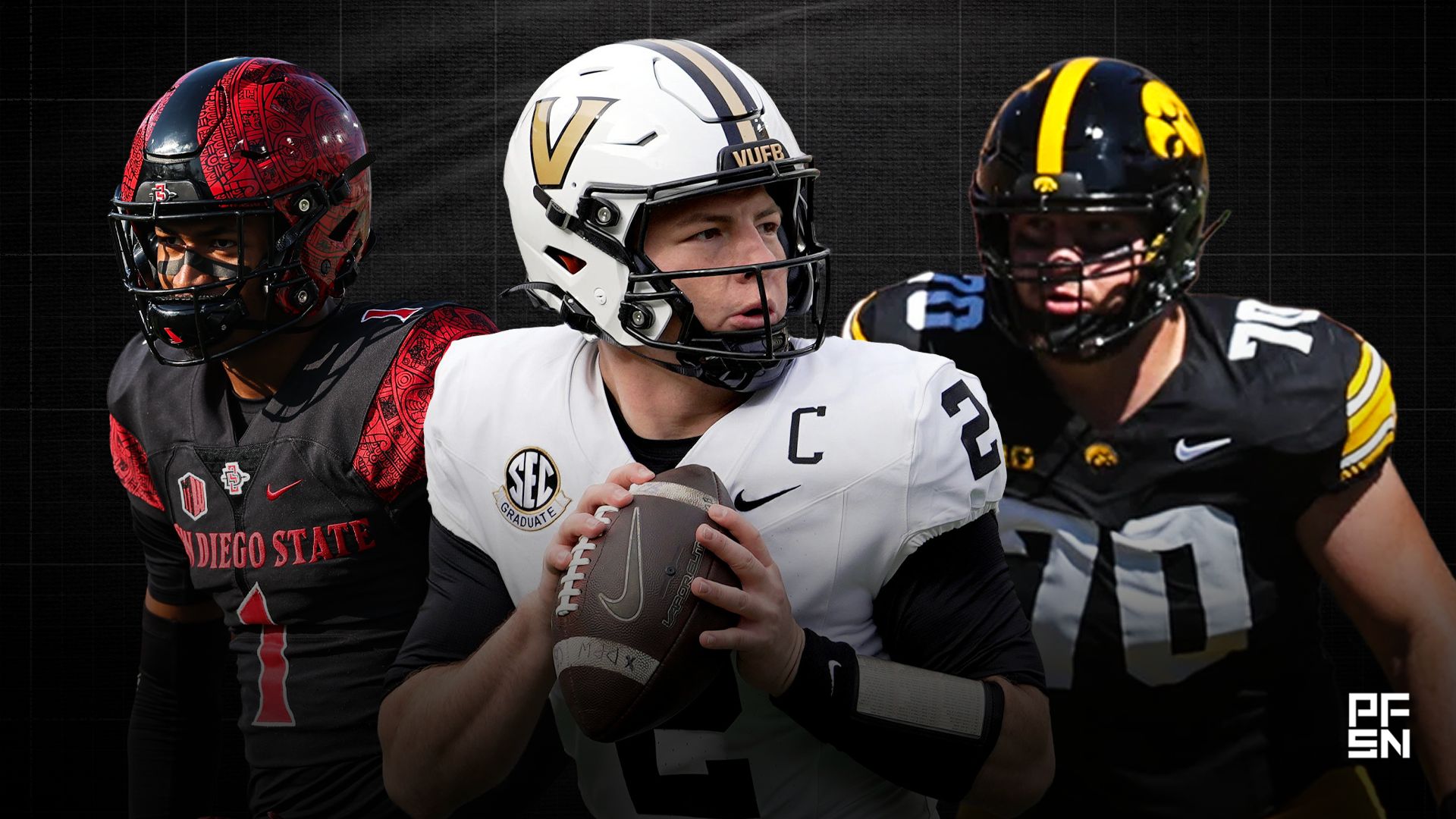
Practices kick off Jan. 27 in Mobile, Alabama, for the 2026 Senior Bowl, and among the 130-plus prospects descending on Hancock Whitney Stadium are some of the most productive players from the 2025 college football season.
Here are the highest-graded players at each position according to PFSN CFB Impact Scores heading into the week, each carrying a story worth telling.
QB: Diego Pavia, Vanderbilt
PFSN CFB QB Impact Score: 94.8
Diego Pavia really is one of the greatest stories in college football. His transition from JUCO player to Auburn slayer with New Mexico State and now to being the face of a resurgent Vanderbilt Commodores football team is the stuff of fairy tales.
Yet his journey isn’t just a fluff piece for halftime programming or a human-interest article. He’s a legitimate college football quarterback, the best in the nation according to PFSN CFB QB Impact Scores.
The Heisman finalist (he finished second to Indiana’s Fernando Mendoza) led the Commodores to the first 10-win season in programme history, throwing for 3,192 yards and 27 touchdowns while adding 826 rushing yards and nine scores on the ground.
He became the first Vanderbilt player ever to be a Heisman finalist or win the Johnny Unitas Golden Arm Award. Perhaps most remarkably, Pavia accounted for 71.4 percent of Vanderbilt’s offensive yards — no other Heisman finalist topped 50 percent.
His poise, his physicality, his absolute refusal to be denied: these are the traits that made him SEC Offensive Player of the Year and will make him a fascinating prospect for NFL scouts to evaluate this week.
RB: Kaytron Allen, Penn State
PFSN CFB RB Impact Score: 89.8
Kaytron Allen leaves Penn State as the programme’s all-time leading rusher, surpassing Evan Royster’s record of 3,932 yards by finishing with 4,180 yards on 769 career carries.
For four years, he shared a backfield with fellow blue-chip recruit Nicholas Singleton, and together they formed one of the most productive rushing duos in college football.
Allen’s senior season was his finest: 1,303 rushing yards and 15 touchdowns — the most in the Big Ten — at a career-best 6.2 yards per carry. The Norfolk, Virginia, native broke Saquon Barkley’s standing on the career rushing list against Nebraska before surpassing Royster in the same game.
Affectionately nicknamed “Fatman,” Allen also added 70 career receptions for 490 yards, proving himself as a complete back. His combination of vision, power, and durability makes him an intriguing prospect for teams seeking a workhorse runner who can contribute immediately on all three downs.
WR: Kevin Coleman Jr., Missouri
PFSN CFB WR Impact Score: 81.6
Kevin Coleman Jr. has played for four programmes in four years: Jackson State, Louisville, Mississippi State, and, finally, Missouri, his home-state school that recruited him persistently since high school.
The well-traveled receiver finally answered Eli Drinkwitz’s fourth recruiting pitch and returned to Columbia for 2025, wearing the same No. 3 jersey that Luther Burden III made famous.
Coleman led the Tigers with 66 receptions for 732 yards while adding a 67-yard punt return touchdown against Arkansas. His college odyssey has included SWAC Freshman of the Year honours at Jackson State (where he outproduced future NFL star Travis Hunter as a freshman) and All-SEC Third Team recognition at Mississippi State.
The St. Louis native carries more than just production; he carries the memory of his younger brother Rashaad, a victim of gun violence, whose picture hangs from his necklace as daily motivation. At 5’11”, Coleman lacks ideal size, but his route-running precision, contested-catch ability, and experience against elite competition make him a legitimate Day 2 prospect.
TE: Justin Joly, NC State
PFSN CFB TE Impact Score: 81.9
Justin Joly spent two seasons at NC State and established himself as one of the best tight ends in programme history.
His seven touchdown receptions in 2025 are the most ever by a Wolfpack tight end in a single season, and his 49 receptions rank fourth all-time at the position despite playing just 21 games in Raleigh.
MORE: $50 Million College Football Coach Lands on Hot Seat After 2025 Season Disappoints
The Brewster, New York, native transferred from UConn after a breakout sophomore season (56 receptions, 578 yards) and immediately became the Wolfpack’s leading receiver under Dave Doeren.
His first-team All-ACC campaign included a signature moment: a 59-yard touchdown catch against Pitt where Joly sustained an injury at the 25-yard line and, through sheer willpower, dragged himself to the end zone. Over four collegiate seasons, Joly accumulated 166 receptions for 1,978 yards and 15 touchdowns.
At 6’3″, 251 pounds, he wins contested catches like a basketball player boxing out for rebounds, a skill set that translates directly to third downs and red-zone situations at the next level.
OL: Beau Stephens, Iowa
PFSN CFB Player OL Impact Score: 94.1
There’s a photograph of Iowa’s offensive line sitting on a bench at Camp Randall Stadium, the scoreboard showing 2:35 remaining in a 37-0 demolition of Wisconsin. Beau Stephens sits in the middle, arms spread around his teammates, wearing a cat-ate-the-canary grin. That image tells you everything about what this group — and this player — accomplished in 2025.
Stephens anchored a unit that won the Joe Moore Award as college football’s most outstanding offensive line, earning first-team All-American recognition from the Associated Press, USA Today, and Pro Football Focus.
He was the highest-graded guard in any power conference, a remarkable achievement for a player who lost his starting job in 2022 and battled through injuries that limited him to just five games in 2023.
The Blue Springs, Missouri, native has been open about his mental health struggles, including ADHD, and how finding the right support system transformed his life and career. He made 34 starts across his Iowa tenure, didn’t allow a sack in either of the past two seasons, and was flagged only six times over four years.
The journey matters, and Stephens’ journey is among the most compelling in this draft class.
EDGE: Nadame Tucker, Western Michigan
PFSN CFB EDGE Impact Score: 86.2
The transformation is staggering. At Houston, Nadame Tucker was a seldom-used defensive end who played just 13 games across three seasons, recording only 10 tackles. At Western Michigan in 2025, he was the MAC’s most dominant player and one of the most productive pass rushers in the entire country.
Tucker finished tied for the FBS lead with 14.5 sacks and led the nation with 21 tackles for loss, earning MAC Defensive Player of the Year and the Vern Smith Leadership Award (essentially the conference MVP) while guiding the Broncos to their first MAC championship since 2016.
A third-team AP All-American, Tucker’s breakout validates the transfer portal as a pathway to opportunity and showcases what can happen when talent meets the right situation. The Teaneck, New Jersey, native didn’t play football until his senior year of high school, and now he’s among the most intriguing edge prospects in this draft class.
DT: Gracen Halton, Oklahoma
PFSN CFB DT Impact Score: 82.9
The Sooners’ defensive resurgence in 2025 was anchored by their interior linemen, and Gracen Halton was at the heart of it. The senior finished with 33 tackles, seven tackles for loss, 3.5 sacks, a forced fumble, and a fumble return for a touchdown, helping Oklahoma allow just 77.3 rushing yards per game, second-best in the nation.
The San Diego native was a consensus four-star recruit who flipped from Oregon to Oklahoma on signing day in 2022, and his development has been steady if not spectacular. He logged 10 tackles as a freshman, 11 as a sophomore, 30 as a junior, and, finally, 33 as a senior.
His compact 6’2″, 285-pound frame generates leverage and quickness that make him dangerous as a pass rusher, even if he lacks ideal length for a traditional NFL tackle. In today’s sub-package-heavy league, that skill set has value.
LB: Jacob Rodriguez, Texas Tech
PFSN CFB LB Impact Score: 90.1
How do you measure reinvention? Jacob Rodriguez arrived at Virginia as a three-star quarterback recruit in 2021, playing various offensive positions as a true freshman.
After transferring to Texas Tech, he switched to linebacker and became one of the best defensive players in college football history at his new position.
MORE: Mark Gronowski’s Year at Iowa Lands Him at the Shrine Bowl
The Butkus Award winner led the Big 12 with 127 tackles in 2024 before following up with 117 tackles, 11 tackles for loss, four interceptions, and a nation-leading seven forced fumbles in 2025. He finished fifth in Heisman Trophy voting.
His background as a quarterback gives him an exceptional understanding of offensive tendencies, and his ball-hawking instincts are remarkable. Six career interceptions and 13 forced fumbles speak to a player who simply finds the football.
Rodriguez’s athleticism won’t blow anyone away at the combine, but his tape reveals something more valuable: a relentless motor, elite instincts, and the kind of football intelligence that translates to Sundays.
CB: Chris Johnson, San Diego State
PFSN CFB CB Impact Score: 96.2
The best-kept secret in college football is secret no longer. Chris Johnson’s senior season with the San Diego State Aztecs was nothing short of historic, and his presence at the Senior Bowl cements what evaluators have been whispering for months: this is a first-round talent who happened to play in the Mountain West.
Johnson’s four interceptions included a 97-yard pick-six against California in a stunning 34-0 upset and a 40-yard house call against Nevada.
Named Mountain West Co-Defensive Player of the Year and a Jim Thorpe Award semifinalist, the 6’0″ corner from Eastvale finished with 49 tackles, nine pass breakups, and two interceptions returned for touchdowns, tied for first nationally.
A three-star recruit who developed steadily through the Aztecs’ programme, Johnson earned first-team All-American honours from Pro Football Focus, Bleacher Report, and Sports Info Solutions. Don’t expect him to remain anonymous much longer.
SAF: Wydett Williams Jr., Ole Miss
PFSN CFB SAF Impact Score: 92.0
Few players at the Senior Bowl have traveled a path quite like Wydett Williams Jr. He started at Division II Delta State, where he spent two seasons developing as a player before earning a Division I opportunity at Louisiana-Monroe.
One dominant season later — 99 tackles, three interceptions, 4.5 tackles for loss — he was heading to Oxford to compete for a national championship.
Williams’ numbers at Ole Miss (60 tackles, three interceptions) reflect a different responsibility within a deeper, more layered defence, but his impact remained unmistakable. The Louisiana native provided a steady presence in a secondary that improved week by week under Pete Golding, including playoff games against the nation’s best offenses.
His arrival in Mobile represents the culmination of a journey from small-school standout to College Football Playoff contributor, the sort of story that reminds you talent can be found anywhere if you’re willing to look.