
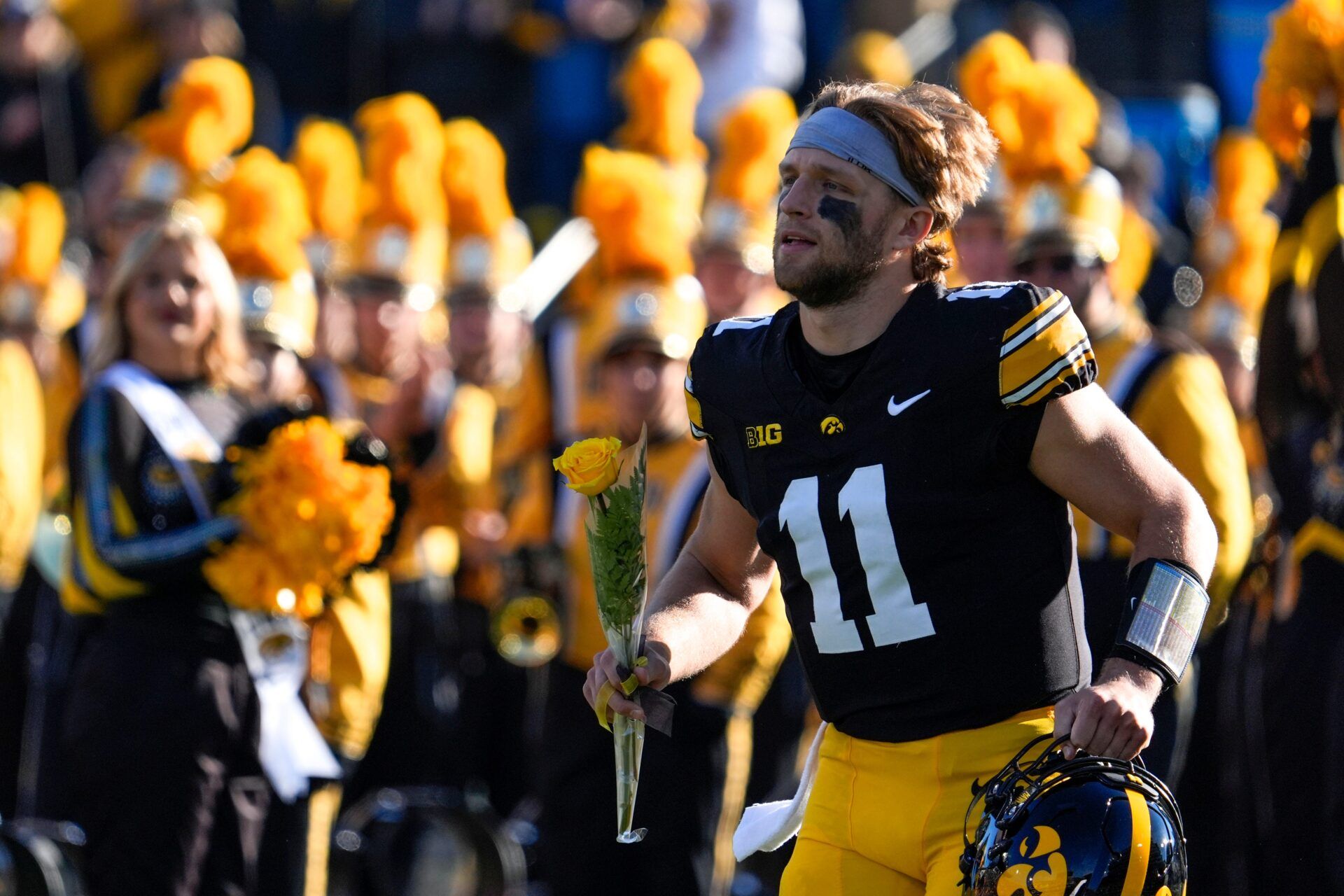
Winning has always followed Mark Gronowski. Few quarterbacks in college football can match his résumé, and even fewer have proven they can carry that winning pedigree across levels of the sport. Now he gets to show that he’s the engine of his winning, not just a product of the system.

Mark Gronowski Brings Proven Winning Leadership to the Shrine Bowl
At South Dakota State, Gronowski was the engine behind an FCS powerhouse, dominating opponents with efficiency, poise, and production. In back-to-back seasons, he threw for 23 and 29 touchdowns, showing command of the passing game while operating one of the most consistent offenses in the country. That success put him on the radar early, with draft buzz already forming before he ever left Brookings.
His move to Iowa, however, presented an entirely different challenge.
The Hawkeyes finished the season 9–4, and despite battling injuries throughout the year, Gronowski still managed to guide the offense effectively. The numbers, though, tell a different story than his FCS days. Instead of airing it out, he threw just 10 touchdown passes against seven interceptions, while doing most of his damage on the ground with 16 rushing scores.
At first glance, it’s a steep statistical drop-off as a passer. But context matters.
Iowa’s offensive identity has long been rooted in a ground-and-pound philosophy, and Gronowski clearly adapted to that approach. With injuries potentially limiting his effectiveness throwing the football, his role shifted toward efficiency, toughness, and situational execution rather than volume and explosiveness. Even with the subdued passing production, he still commanded the offense at a high level, earning a PFSN CFB offensive impact grade of 80.6, good for 33rd nationally.
The supporting cast also played a role. Iowa lacked a true elite, go-to receiver capable of consistently creating separation. According to PFSN CFB WR impact grades, Jacob Gill was the only Hawkeye wideout to grade above a 72. Tight throwing windows and limited perimeter explosiveness made life harder for any quarterback, particularly one adjusting to a new system and battling through injuries. This season was a mental battle he might not have thought was coming, but he made the most of it and has come out a better QB because of it.
Physically, Gronowski checks important boxes. At 6’2”, 235 pounds, he has the ideal size, toughness, and solid arm strength. The lingering question evaluators must answer is whether the dip in passing production was primarily a byproduct of Iowa’s run-heavy scheme and long-standing quarterback development issues, or whether it signals that his earlier efficiency and production don’t fully translate to the FBS level and, eventually, the NFL.
That uncertainty is exactly what makes Gronowski such an intriguing prospect.
He was already viewed as a potential late-round draft pick coming out of South Dakota State, and now he’s added valuable FBS tape against higher-level competition. The Shrine Bowl offers a rare, neutral setting where evaluators can isolate traits like arm talent, processing, accuracy, and command without scheme or supporting-cast limitations. That combination of experience, leadership, and tools makes him an intriguing quarterback prospect.
For Gronowski, it’s an opportunity to remind scouts that winning has never been accidental in his career. Whether he rises above the quarterback pack or blends into it may come down to how he answers those questions when the system is stripped away.
