
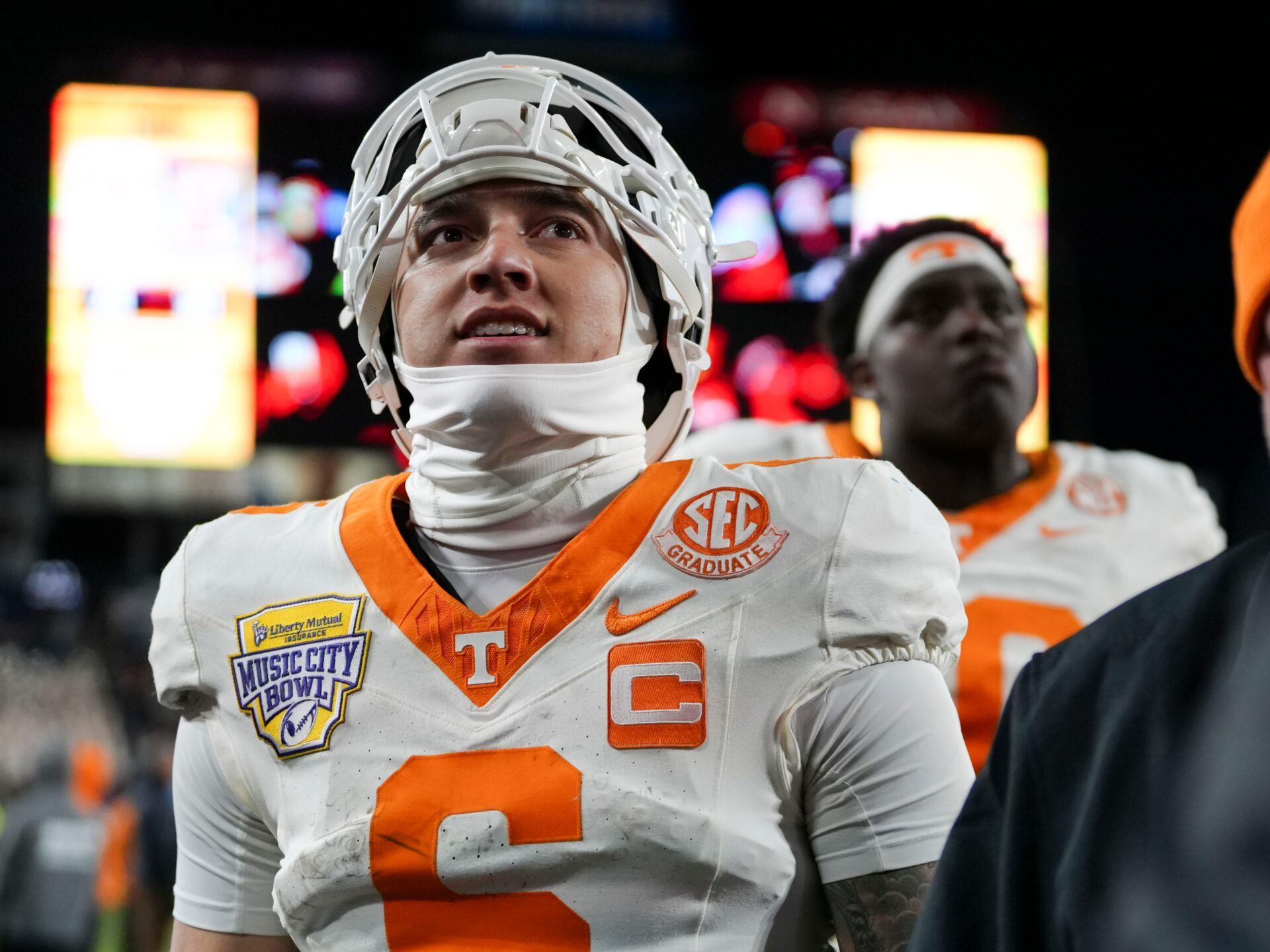
On a recent episode of “Adapt & Respond,” national analyst RJ Young lit up the college football world with a pointed question: Why would Tennessee Volunteers leadership hesitate to support an extra year of eligibility for quarterback Joey Aguilar after the season he just delivered?
At first glance, it doesn’t make much sense.

Joey Aguilar Shone in a Breakout 2025 Campaign at Tennessee
Aguilar’s 2025 campaign in Knoxville was more than solid; it was elite by several measures. He finished top 10 nationally in passing yards with 3,565 and top 20 in passing touchdowns with 24. According to PFSN’s CFB QB Impact Metrics, Aguilar posted an 86 grade, ranking No. 26 in the country. Even more telling, he helped power Tennessee to an 87.1 Offense Impact Score, a top-10 mark nationally.
Those aren’t numbers programs casually walk away from.
So why would the university chancellor appear reluctant to back Aguilar’s bid for another year?
Despite the outside noise, this isn’t about Tennessee “turning on” Aguilar. It’s about the increasingly complicated and fragile landscape of NCAA eligibility rules.
NCAA Eligibility Rules Are What They Are
As Young explained, the chancellor’s decision to side with the NCAA will likely “serve him well in the long term, but not in the short term.” The core issue in Aguilar’s case centers on the long-standing “five years to play four” framework. That guideline appears to be the foundation of the Volunteers’ chancellor’s reasoning for not fully backing Aguilar’s push for an additional season of eligibility.
RELATED: Josh Heupel’s Tennessee Makes Major Coaching Move Amid Joey Aguilar’s Eligibility Case
Rather than a personal stance against the quarterback, the decision reflects a broader institutional position on maintaining structure within an already evolving eligibility system.
The NCAA has faced mounting legal challenges in recent years over eligibility restrictions. Two of the most talked-about cases involve quarterbacks Diego Pavia and Trinidad Chambliss, both of whom pursued legal avenues in attempts to secure additional eligibility.
Each lawsuit puts pressure on the system. And from an administrative standpoint, backing one case too aggressively risks opening the floodgates. If every productive upperclassman begins suing for an extra season, the structure of roster management, already chaotic in the transfer portal era, becomes even more unstable.
University leadership, especially at a program like Tennessee, must weigh more than on-field production. They must consider precedent, compliance, and the program’s long-term health within NCAA governance.
There’s another layer to this discussion, one that rarely makes headlines.
College football is, at its core, developmental. If sixth- and even seventh-year players become common, opportunities shrink for younger quarterbacks waiting their turn. Highly recruited freshmen and sophomores may opt to transfer rather than sit behind veterans, stacking extra seasons through legal maneuvering.
MORE: How NIL Is Elevating NFL Quarterback Play by Keeping Future Stars in College Longer
In the NIL and transfer portal era, retention matters. Roster balance matters. Development pipelines matter.
While Aguilar’s return would likely raise Tennessee’s immediate ceiling in 2026, it could also complicate long-term quarterback succession planning.
The bottom line? This isn’t about Tennessee not valuing Aguilar.
It’s about staying within established rules and avoiding unnecessary legal entanglements. With the NCAA already under scrutiny, universities are walking a tightrope. Supporting every eligibility challenge might win short-term goodwill, but could create systemic chaos.
Joey Aguilar proved he can lead a top-10 caliber offense. That much is clear. But whether he gets another season in Knoxville may depend less on stats and more on the evolving legal landscape of college football.
And in today’s game, sometimes the hardest decisions happen far from the field.
