
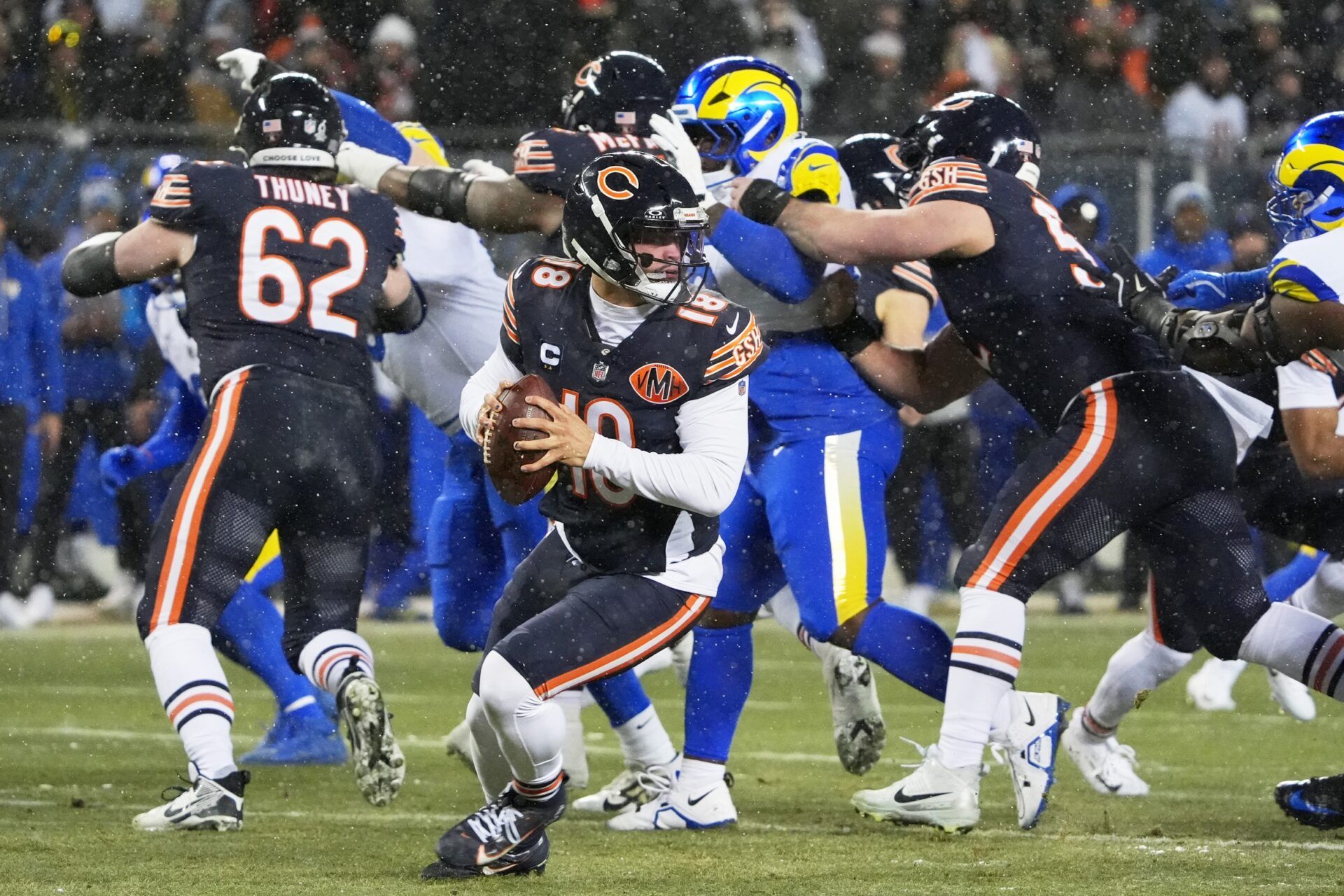
Caleb Williams and the Chicago Bears ran out of comebacks Sunday night at Soldier Field. The Los Angeles Rams escaped with a 20-17 overtime victory, ending Chicago’s season on a frozen field where magic finally met its limit.
It wasn’t supposed to end this way. Williams authored one more impossible moment in the fourth quarter, a fourth-and-4 heave to Cole Kmet with 18 seconds left that forced overtime and briefly made believers of everyone watching. But in overtime, with a chance to win, Williams threw his third interception of the night. Kamren Curl dove to snag the pass intended for DJ Moore, and Harrison Mevis’ 42-yard field goal moments later sent the Rams to the NFC Championship.
The interception total matched the most Williams had thrown in any game this season. It was a brutal way to end what had been a magical ride.
What Ben Johnson Built in Chicago Survives This Loss
Twelve months ago, the Bears fired Matt Eberflus mid-season after a Thanksgiving loss to Detroit defined by clock mismanagement. The locker room had slipped away. Williams, the No. 1 overall pick, looked lost behind a porous offensive line that allowed a league-high 68 sacks. Chicago finished 5-12.
Johnson inherited that mess and turned it into an 11-6 regular season, a division title, and the franchise’s first playoff win since 2010. The Bears’ 31-27 Wild Card comeback against Green Bay, erasing an 18-point deficit, wasn’t a fluke. It was the seventh fourth-quarter comeback of Williams’ season, the most by any quarterback under 25 in NFL history.
Sunday’s loss doesn’t erase that progress. Johnson didn’t build a juggernaut. He built a team that could compete despite significant defensive limitations. The Bears ranked 22nd in PFSN’s Defense Impact metric and allowed 6.0 yards per play during the regular season. They weren’t supposed to be here.
Holy pic.twitter.com/IBPnuGlYFu
— StaceyDales (@StaceyDales) January 19, 2026
The offensive infrastructure that Johnson installed will outlast this defeat. Chicago’s offensive line, reinforced by Joe Thuney, Jonah Jackson, and Drew Dalman, cut Williams’ sack rate from 10.8% to 4.05%. His time to throw actually increased from 3.03 seconds to 3.20. They had the league’s second-best offensive line, according to PFSN’s OL Impact metric. The protection held throughout the season, even if Sunday’s frigid conditions created problems.
The running game transformed, too. After the Week 5 bye, the Bears ranked third in the league in rushing yards and yards per carry. D’Andre Swift rebounded from a career-worst 2024 as one of the league’s most-improved RBs. Rookie Kyle Monangai added 783 yards. That foundation doesn’t disappear because January ended a round too soon.
Why This Isn’t Another False Start
The temptation is to compare this to 2018, when Matt Nagy’s first season ended with a double-doink loss to the Philadelphia Eagles in the Wild Card round. That team also went worst-to-first behind a second-year quarterback and a first-year coach. Nagy won Coach of the Year… and then it all collapsed.
Johnson’s situation differs in one critical way: Williams showed genuine development, not scheme-dependent production. He set a Bears’ single-season record with 3,942 yards. His seven regular-season interceptions represented real decision-making progress. The playoff turnovers are concerning, five across two games, but they came against quality defenses in high-leverage moments. The sample is small. The arrow still points up.
“He’s a completely different quarterback than when we first took this job,” Johnson said before the Wild Card win. That assessment still holds. Williams’ 58.1% completion rate needs work. His tendency to play hero ball creates turnovers when the prayer goes unanswered, as it did against Curl in overtime. But the talent is obvious, and Johnson has shown he can develop it.
The relationship between coach and quarterback proved rocky early. Williams described their initial dynamic as “pretty fragile” and wondered if Johnson even liked him during training camp. That tension dissolved as wins accumulated. By December, Williams was calling Johnson “the best coach in the world.”
“When you have that trust, and you got somebody that has your back, has your six, you can strive for anything,” Williams said.
The trust remains. The foundation remains. The season is over, but the trajectory isn’t. Despite the loss, Williams still finished the game against the Rams with a 78.1 (B+ grade), according to PFSN’s Quarterback Impact metric.
Johnson will spend the offseason addressing the defensive deficiencies that ultimately caught up with Chicago. The secondary needs reinforcement. The pass rush beyond Montez Sweat lacks consistency. Cobie Durant picked off Williams twice before Curl’s dagger, exposing coverage issues that plagued the Bears all year.
But the hardest part is done. Johnson changed the culture. Williams embraced structure without losing his improvisational edge. The Bears won their first playoff game in 15 years and pushed a Rams team that averaged 30.5 points per game to overtime in the divisional round. One loss doesn’t undo that. Chicago’s rebuild isn’t starting over; it’s entering Year Two.