
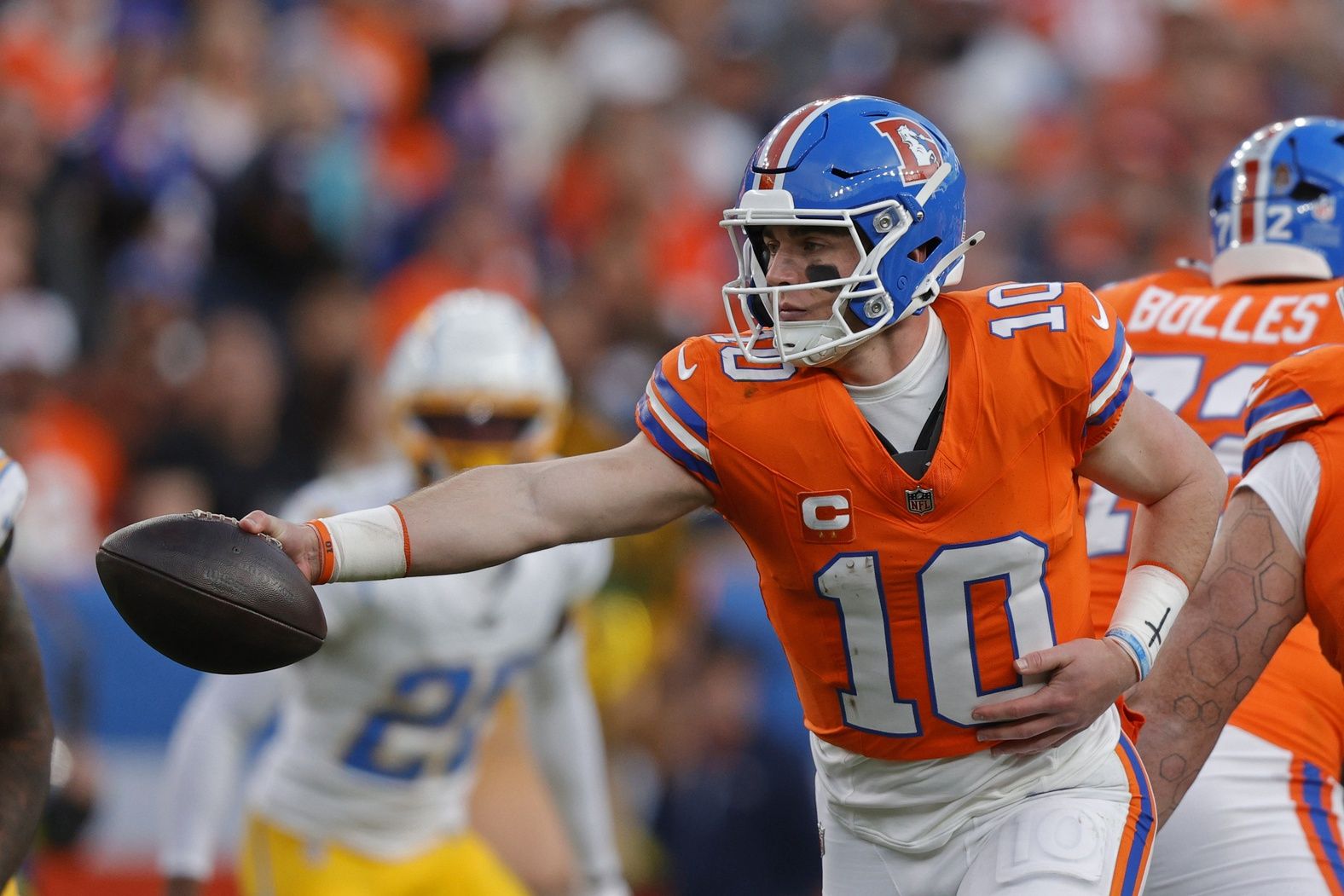
The Bills and Broncos present the divisional round’s starkest philosophical clash: Buffalo’s third-ranked offense against Denver’s top-graded defense, a collision that could determine whether Josh Allen finally reaches the Super Bowl or whether Sean Payton’s rebuilt Broncos prove they belong among the AFC elite.
Buffalo’s Elite Offense Meets Denver’s Suffocating Defense
- Kickoff: Saturday, Jan. 17, 4:30 p.m. ET
- Location: Empower Field at Mile High, Denver
- TV: CBS
Per PFSN’s proprietary metrics, this matchup pits strength against strength in the truest sense. Buffalo’s offense grades at 86.5 (third in the league according to PFSN’s Offense Impact metric), powered by Allen’s 90.0 quarterback grade—an A- that ranks third among all signal-callers. Denver’s defense sits at 90.1, the league’s best, built on a pass rush that registered 68 sacks this season, tied for fifth-most since 1963.
The numbers suggest a genuine toss-up. PFSN’s Playoff Predictor gives Denver a 54.4% edge over Buffalo’s 45.6%, with the Broncos’ overall power ranking (79.2, third) barely edging the Bills (77.8, fifth). For a No. 1 seed hosting at altitude with a bye week of rest, that margin is razor-thin.
What separates this from a standard “good offense vs. good defense” narrative is the quarterback disparity underneath. Allen grades 11.4 points higher than Bo Nix (78.6, C+), a gap that represents the difference between an MVP-caliber performer and a second-year quarterback still developing. Denver’s defensive dominance has masked offensive limitations all season. Buffalo’s offensive firepower has papered over a defense that grades just 78.0 (13th). Something has to give.
Payton understands the challenge Allen presents. He told reporters this week that Allen creates what he calls “second act explosives”—plays that break down and still produce chunk gains.
“It’s been a while since I saw someone gain seven yards on a sneak,” Payton said. “He’s one of the stars of our league.”
Focused. Not even a thumbs up.
*Playoff* Josh Allen arriving at Mile High Stadium.#BillsMafia @BuffaloPlus pic.twitter.com/kSVw7OCNOT
— Dan Fetes (@danfetes) January 17, 2026
The Broncos played man coverage on a league-high 60.8% of opponent dropbacks this season, per ESPN. That approach demands winning individual battles, and Allen has made a career of punishing aggressive coverage when his first read isn’t there. He holds the postseason record for total yards per game (310.6) among quarterbacks with 10-plus playoff starts.
Buffalo enters without safety Jordan Poyer (hamstring) and cornerback Maxwell Hairston (ankle), while wide receivers Gabe Davis and Tyrell Shavers are out for the season. That depleted receiving corps puts even more pressure on Allen to manufacture production with his legs and James Cook’s league-leading 1,621 rushing yards.
Why This Game Will Be Decided in the Trenches
Both offensive lines grade within a point of each other—Buffalo fourth (81.3), Denver fifth (80.9)—which shifts the outcome to the skill positions and coaching. And that’s where the matchup gets interesting.
Denver’s pass rush features four players with seven-plus sacks: Nik Bonitto (14), Jonathan Cooper (8), John Franklin-Myers (7.5), and Zach Allen (7). They’ll face a Bills offensive line that allowed Allen to take 40 sacks during the regular season, 26 more than he absorbed in 2024. Payton has asked Broncos fans to maximize noise when Buffalo enters the huddle, calling sustained crowd pressure across 65 snaps “a huge advantage.”
The Broncos also rank second in rush defense, allowing 91.1 yards per game. Cook and the Bills’ ground attack, ranked first in the league, represent a true force-on-force collision. Last year’s Wild Card meeting saw Cook run for 120 yards and a touchdown in Buffalo’s 31-7 demolition. Denver’s defensive coordinator Vance Joseph hasn’t forgotten.
“Obviously, his legs are special,” Joseph said of Allen. “At his size, he can make every single throw.”
Neither team brings reliable special teams into this matchup—Buffalo ranks 27th (70.0), Denver 22nd (70.9)—which removes the possibility of a hidden edge and guarantees this game will be won between the tackles.
Payton’s film study this week revealed a pattern: Buffalo lost the turnover battle in all but one of its five regular-season defeats. The Broncos, who set an NFL record with 12 comeback wins and feature Nix’s league-leading seven game-winning drives, are built to capitalize on mistakes. If Allen turns it over in Denver’s thin air, the Broncos have the clutch DNA to close it out.
But if Allen plays clean and Buffalo’s offensive line holds up long enough for the ground game to churn, the Bills’ offensive ceiling is simply higher than what Denver’s limited offense can match. The gap between a 90.0 quarterback and a 78.6 quarterback matters most when the margin for error disappears.
This is Denver’s first home playoff game in a decade. It’s also Buffalo’s clearest path to a Super Bowl in the Allen era, with Patrick Mahomes and Lamar Jackson already eliminated. One of these teams will have its season defined by Saturday. Given the razor-thin projections, neither should feel confident—and neither should feel afraid.