
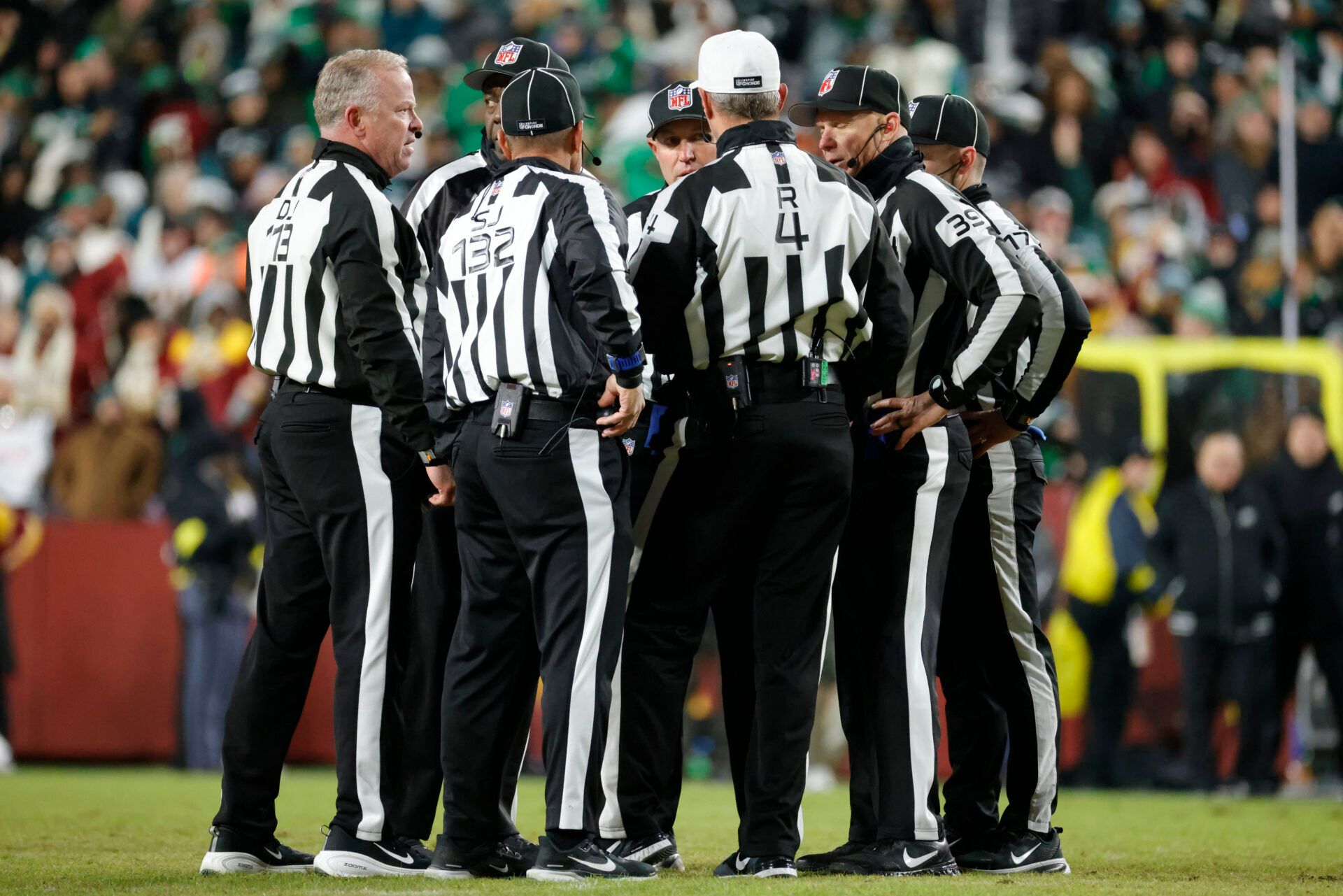
The play clock hits zero, but the flag stays in the official’s pocket. If you’ve watched enough NFL football, you’ve seen it happen. The delay-of-game penalty seems straightforward until you understand how officials actually call it.
By the NFL rulebook definition, it’s a delay of game if the ball is not put in play by a snap within 40 seconds after the start of the play clock. The penalty costs five yards from the previous spot, and the down is replayed.
How the Play Clock Works
The 40-second interval starts when a play ends, unless certain administrative stoppages occur. After timeouts, the two-minute warning, penalty enforcement, or the end of a quarter, teams get 25 seconds, beginning with the referee’s whistle, to put the ball in play.
The back judge monitors the play clock. But here’s where theory meets practice: once the back judge sees the play clock expire, he then looks immediately to the ball. If it is being snapped, there is no foul for delay of game. That sequence creates a brief window, roughly a second, between the moment zero appears on the clock and the flag comes out. Smart quarterbacks know exactly how much rope they have.
This mechanic explains why fans at home see zero on the broadcast clock while the snap goes off cleanly. The official can’t watch the clock and the ball at the same time.
READ MORE: Super Bowl 60 Predictions: Predicting the Winner, Final Score, MVP, and More
Delay of game can also be called on the defense. The penalty applies if officials believe the defense is taking an inordinate amount of time to get set for the next play, particularly against hurry-up offenses that try to quick-snap. Defenders who fail to quickly yield the ball to officials, prevent offensive players from getting up, or kick the ball away can draw a flag.
When Coaches Take the Penalty on Purpose
The five-yard penalty is occasionally worth accepting. Sometimes the penalty is committed intentionally on fourth down in order to give the punter a more advantageous punting distance to decrease the odds of a touchback.
Picture 4th-and-6 from the opponent’s 40-yard line. A punt from there risks a touchback, giving the opposing offense the ball at their own 20. A delay-of-game penalty moves the line of scrimmage back to the 45, providing more room for the punter to place the ball inside the 10.
Coaches might also deliberately attempt to draw the defense offside in fourth-and-short situations using a hard count. If the defense doesn’t jump, the team simply lets the play clock expire, takes the five yards, and punts farther. The gambit costs nothing if it fails.
In a Week 17 Broncos-Chiefs matchup on Christmas Day 2025, Denver coach Sean Payton employed exactly this strategy. Facing 4th-and-2 from the Chiefs’ 9-yard line with under two minutes remaining in a 13-13 game, Payton sent his offense onto the field with no intention of snapping the ball.
MORE: Conservatives Call for Boycott of Super Bowl 60 Over Bad Bunny’s Halftime Show: ‘ENOUGH IS ENOUGH’
The plan was to try to draw the defense offside with a hard count; if that failed, Denver would accept the delay-of-game penalty and kick a field goal. Chiefs defensive tackle Chris Jones bit on the hard count and jumped into the neutral zone, giving the Broncos a fresh set of downs. Denver capitalized, scoring a touchdown to win 20-13.
One quirk worth noting: because delay of game is a dead-ball foul that prevents the snap from occurring, the defense rarely has reason to decline it; there’s no play result to keep in its place. When a team intentionally backs up five yards before punting, the opponent is essentially forced to accept the enforcement.
League averages show delay of game remains relatively uncommon. In the 2024 season, there were an average of 5.38 delay-of-game penalties per team league-wide, according to nflpenalties.com. NFL quarterbacks are professionals, and most know how to manage the play clock. When delays happen, they’re often strategic rather than accidental.