
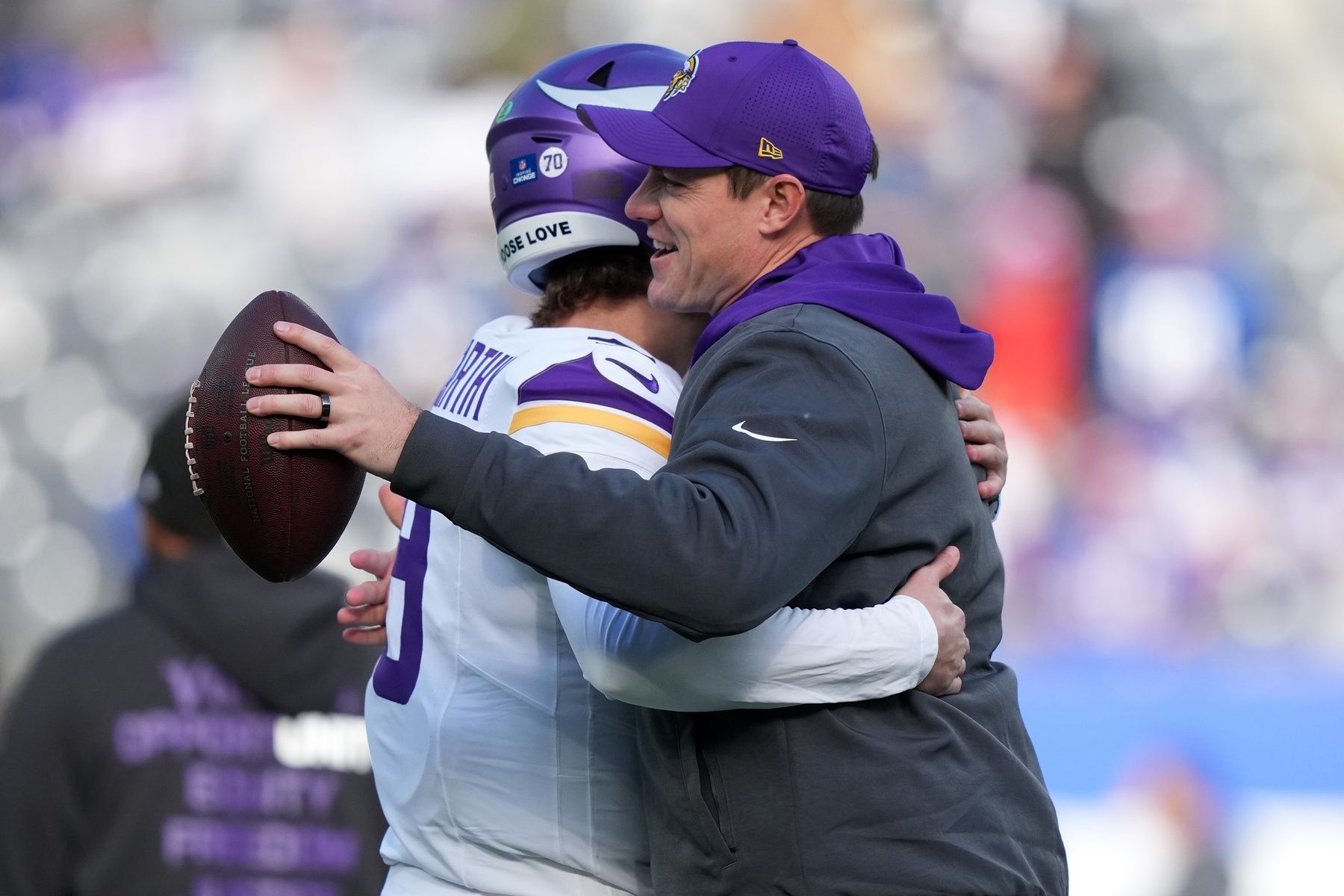
Kevin O’Connell’s quarterback plan keeps springing leaks, and J.J. McCarthy sits right at the center of it. Report that Minnesota plans to explore veteran options, despite McCarthy returning next season, quietly confirms what the league already suspects: the Vikings aren’t fully convinced. That uncertainty has only grown louder after a turbulent first year with McCarthy as the starter.
Kevin O’Connell Can’t Catch a Break With J.J. McCarthy
Dianna Russini reported: “J.J. McCarthy will return to the Vikings next season, but that doesn’t guarantee that he’ll be the starter. Sources say Minnesota plans to explore established options via trade or free agency to strengthen its quarterback room.”
Trey Wingo didn’t mince words reacting to the report. Pulling the plug after McCarthy’s uneven debut season, he argued, would signal a complete organizational failure with a first-round pick.
“If they didn’t bring him back after his first season as a starter…uneven as it was…it would be an admission of total organizational failure with a 1st round pick.”
It’s a fair point, but it also ignores the bind O’Connell and the front office now face; balancing patience with a young QB against a roster built to compete sooner rather than later.
If they didn’t bring him back after his first season as a starter…uneven as it was…it would be an admission of total organizational failure with a 1st round pick https://t.co/ypmmT3g5gH
— trey wingo (@wingoz) January 3, 2026
The original plan unraveled quickly. McCarthy missed significant time due to multiple injuries, and when he did play, the results swung wildly. His show of promise came late in the season and mostly against struggling defenses, while his overall efficiency numbers landed near the bottom of the league.
McCarthy finished the season with a QBR of 33.5, ranking 46th out of 58 quarterbacks who made at least one start. He surpassed 200 passing yards only twice and ranked near the bottom of the league in completion percentage above expected. Minnesota also finished tied for 30th in the NFL in that metric, a reflection of both inconsistent accuracy and disrupted timing within the offense.
PFN’s QB impact metric ranked McCarthy at 40th with an impact score of 61.9. Alas, injuries and pressure amplified those struggles.
McCarthy absorbed an average of 10 hits per game, among the highest rates for starting quarterbacks, and led the league in passes batted at the line of scrimmage. During his first six starts, his turnover rate was among the worst in the NFL, and his off-target throw percentage hovered above 20% before improving late in the year. But that late uptick was not enough.
Behind the scenes, Minnesota also misplayed its safety nets. The Vikings believed they had a reliable veteran path lined up, only to watch those options disappear one by one. By the time the dust settled, McCarthy was being forced to learn on the fly, whether ready or not.
That put O’Connell in a tough spot schematically. His pass-heavy system drew criticism as McCarthy’s mechanics and accuracy wavered, prompting the staff to scale things back midseason. The Vikings’ offense was one of the league’s worst. Ranked at 28th on the PFSN’s NFL offense impact metric, the result was a quarterback still learning fundamentals while being judged against veterans thriving elsewhere.
Still, it wasn’t all bleak. Down the stretch, McCarthy showed tangible improvement: better decision-making, fewer turnovers, and renewed confidence from teammates. In his last three games that he played, McCarthy threw for 5 TDs to just two picks. Those signs are why Minnesota hasn’t closed the door on him, even as it scans the market.
That’s the dilemma for O’Connell. Stick with McCarthy and risk another developmental season, or bring in a proven veteran and complicate the future.
