
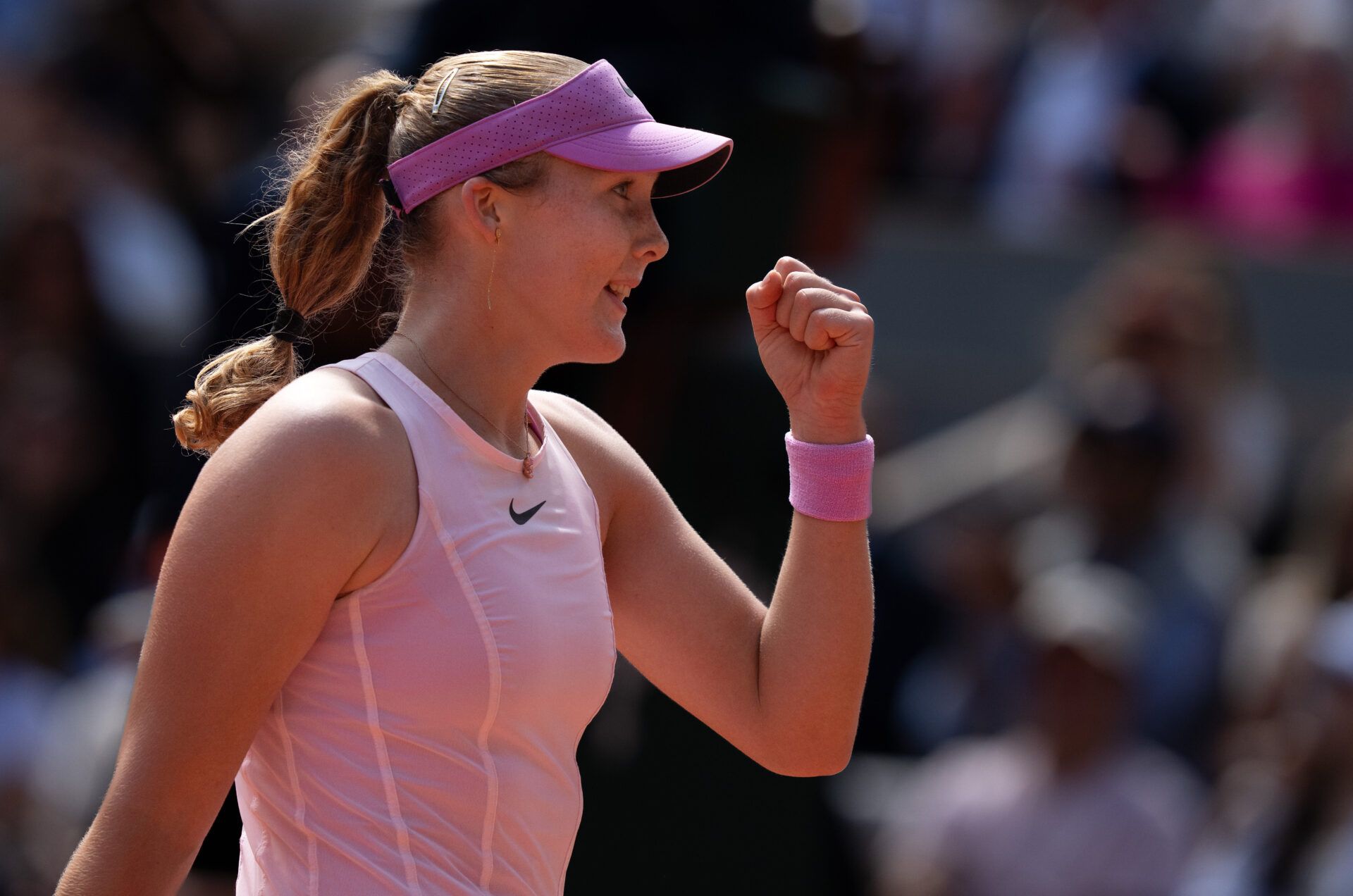
At just 19 years old, Mirra Andreeva has conquered Roland Garros. On Saturday, the Russian sensation defeated Polish qualifier Maja Chwalinska 6-3, 6-2 to secure the 2026 French Open title. In doing so, she etched her name in the history books, becoming the youngest champion in Paris since Monica Seles in 1992 and the first Russian woman to lift the Coupe Suzanne Lenglen since Maria Sharapova in 2014. But behind this success lay a major shift in mindset. And that was all credit to Roger Federer.
French Open Champion Mirra Andreeva Reveals How Roger Federer Inspired Her Victory
Just a month ago, at the Madrid Open, Andreeva was going through a difficult emotional stretch before losing in the final to Marta Kostyuk. During the Round of 16 match, she was seen shouting at her box, “I’m not a champion. I will lose.” Even before that, there had been incidents in which she had meltdowns, smashed rackets, hit herself, and had outbursts against fans who booed.
Fans and analysts had wondered if that would linger in Paris, especially for a teenager carrying such a weight of expectations. But at this French Open, Andreeva was remarkably composed and focused. In the post-match presser, when asked if there was a major mental reset, she revealed:
“I wouldn’t say there was a big reset or something that I just decided to switch completely or to change the approach for matches.
“Like my psychologist says, you can always choose how you’re gonna be on court and who you’re going to be as a person as well, so I just decided to choose to be a fighter.”
That sports psychologist, Alexis Castorri, who previously worked with Andy Murray, was key in her French Open run. Andreeva credited Castorri, revealing that she consulted her before the semifinal for advice on techniques and mindset.
But that wasn’t all. Andreeva spent time analyzing Roger Federer’s matches to study how he acts on court.
“I watched a lot of Roger’s matches here,” Andreeva said. “I’m not gonna have obviously the same aura. Like ever, no one is gonna have the same aura. But I really wanna try to impersonate the way he behaves a little on the court. Because I love watching him on the court when he used to play.”
Federer is famous for his calm behavior on and off the court, but as a teenager, he also had the same case as Andreeva and many others. With a sports psychologist, he worked hard to control his emotions, using his “fire and ice” mindset (ice for calm demeanor and fire for the yearning to win) to win for decades.
“Maybe that (watching Federer) helped me a bit. I really wanted to look good on the court. Not be frustrated or be not happy with how I play,” Andreeva noted. “Also, for the people, it’s nice to watch how players try their best and fight and compete. So I just felt like that’s what I wanted to do. That’s what I was focusing on.”
Andreeva has a lot ahead of her. After her maiden Grand Slam title, she will now move on to the upcoming grass-court season.
