
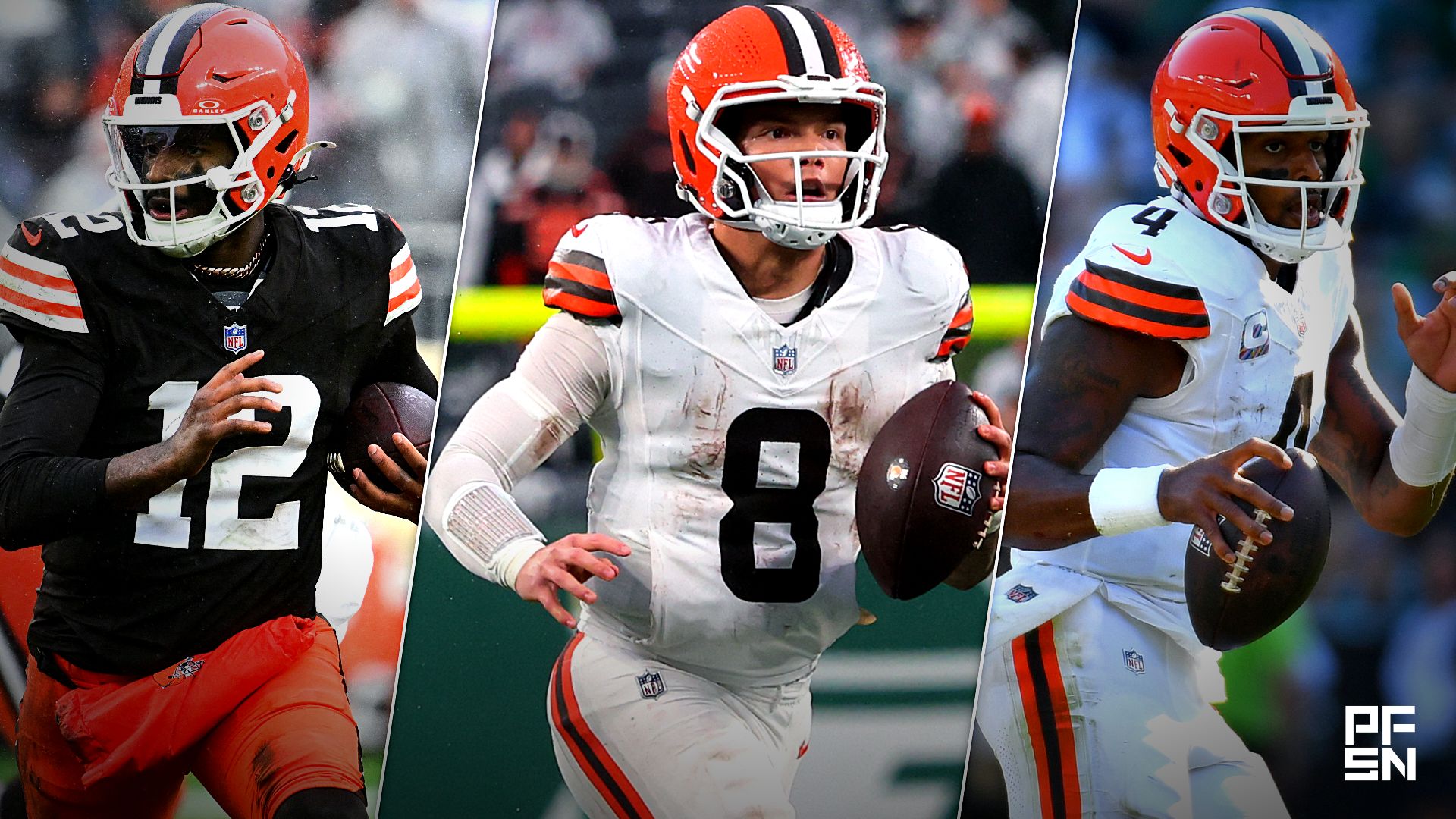
The Cleveland Browns are once again stuck in quarterback limbo. Between a crowded depth chart, uneven production, and constant speculation about trades, there is no clear direction under center.
That uncertainty has become a talking point across the league, with analysts and former players weighing in on whether the Browns are helping or hurting themselves by keeping so many options alive. It is not just about talent anymore. It is about clarity, development, and whether this approach gives anyone in that room a real chance to succeed.
Browns Struggle for Clarity With Shedeur Sanders, Deshaun Watson in Crowded QB Room
The conversation picked up steam following comments from Matt Simms on the April 27 episode of SiriusXM NFL Radio’s “Airing It Out,” where he explained the core issue facing Cleveland.
“It’s a crowded room. I don’t really know what the thoughts are, but, of course, early indications suggest there is no intention of trading a Dillon Gabriel [for example]. He seems to always be the one who is up for consideration for that.”
That observation hits at the heart of Cleveland’s problem. The Browns are trying to evaluate multiple quarterbacks at once, but doing so may be slowing everyone’s progress. Development at the NFL level is built on reps, rhythm, and trust within the offense. When those reps are split too many ways, it becomes harder for any one player to establish control.
The names involved only add to the complexity. Deshaun Watson has not taken a snap since 2024, leaving a major question mark around his future. Shedeur Sanders, despite the hype entering the league, has struggled to produce. Sanders finished the 2025 season at No. 46 overall with a 56.9 score (F grade) in PFSN’s NFL QB Impact Metrics, indicating a significant gap between potential and performance.
Then there is Dillon Gabriel, who stepped in after Joe Flacco was traded to the Cincinnati Bengals and started six games while appearing in 10. His own QBi grade landed at an F, and his momentum stalled once Sanders was given the opportunity. That constant shifting has made it difficult for Cleveland to build continuity — a consistent trend with the franchise for decades.
Simms’ comments suggest the Browns are caught between evaluation and commitment. They want to keep options open, but that approach can create uncertainty in the locker room and on the field. For receivers, linemen, and coaches, it becomes harder to buy into a system when the leader of that system keeps changing.
Taylen Green Adds Intrigue to an Already Unclear Plan
Just when it seemed like the quarterback room could not get any more crowded, Cleveland added another name in the 2026 NFL Draft with Taylen Green in Round 6. The move brought excitement, but it also raised more questions about the team’s long-term vision.
Simms sees the upside right away.
“I like him a whole lot. I really do,” Simms said. “Taylen Green absolutely has superstar-like qualities to his football game. And, yes, is there room for development? There is no doubt about it, but I mean, this guy really does have the potential to do some impressive things at the NFL level with his size, with his ability to run and scramble. He can cover ground extremely quickly with his long stride. He has probably one of the strongest arms in this draft class.”
That evaluation paints Green as the kind of player teams love to stash and develop. His physical traits stand out immediately, especially his arm strength and mobility. In a vacuum, this is the type of pick that makes sense for a team searching for long-term answers.
But Cleveland is not operating in a vacuum. The Browns already have multiple quarterbacks fighting for reps, and adding another developmental player only tightens the squeeze. Simms acknowledged the raw areas in Green’s game as well, pointing to rhythm and touch passing as areas that need refinement.
“It’s the underdeveloped rhythm passing or touch passing that you didn’t see a ton of at the college level, but he’s got a rocket for an arm; there’s no throw that he can’t make,” Simms continued. “I think Taylen Green is absolutely a steal for the Cleveland Browns here late, and really can be a viable football player for them in the future.”
That future-focused outlook is encouraging, but it also highlights the disconnect in Cleveland’s current plan. The Browns are trying to win now while also developing multiple quarterbacks at once. That balancing act rarely works cleanly in the NFL.
The ripple effects extend beyond the quarterbacks themselves. Offensive cohesion depends on timing, chemistry, and consistency. When the starter is unclear, those elements are harder to establish. It can stall the growth of young receivers and limit what the coaching staff can realistically install week to week.
The trade speculation only adds another layer. Although ESPN’s Adam Schefter recently reported that the Browns have no intention of trading Gabriel, the idea of moving one of the quarterbacks has been floated, whether it is Watson, Sanders, or Gabriel. Yet the lack of action suggests indecision. Holding onto all of them keeps options alive, but it also delays answers.
BE AN NFL GM: PFSN’s Ultimate GM Simulator
At some point, the Browns will have to choose a direction. Until then, they remain stuck in a cycle of evaluation without resolution.
One thing is for certain: Cleveland keeps throwing darts, hoping one eventually hits the bullseye. Unfortunately, there have been a lot of misses, and there’s no telling what could come from this current group.
