
The 2026 Senior Bowl running back class isn’t overflowing with surefire stars, but it is packed with intriguing skill sets, physical runners, and projection-based upside. While the group lacks elite, consensus RB1 certainty, it offers NFL teams a wide range of archetypes, from bruising early-down backs to versatile space players, all trying to seize a rare opportunity in a down positional year.
At the forefront of this class are Kaytron Allen and Le’Veon Moss, two very different backs who embody both the promise and the questions that define this Senior Bowl crop.

Senior Bowl Running Backs: Kaytron Allen and Le’Veon Moss Headline a Group Filled With Potential and Questions
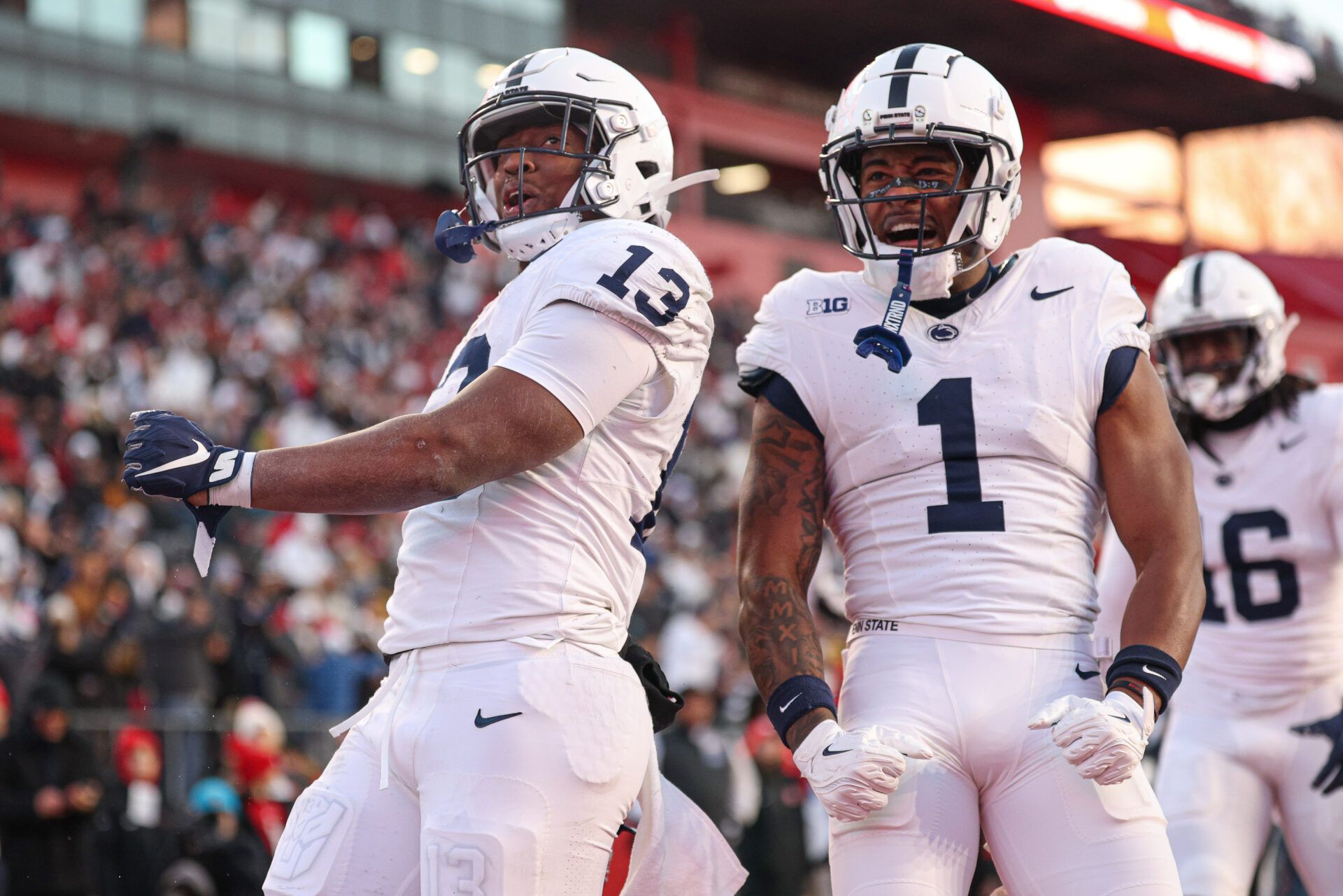
Kaytron Allen, Penn State
One of the top backs at the Senior Bowl, Kaytron Allen, surprised many by returning to Penn State for the 2025 season after three productive years. In an era where running backs are encouraged to strike while the iron is hot, Allen chose unfinished business, aiming for a Big Ten title and national championship.
Neither ultimately materialized, but Allen’s approach never wavered. He played the entire season without complaint, a trait that will resonate strongly with NFL evaluators.
Listed at around 5’11”, 220 pounds, Allen is a classic downhill bruiser. He thrives between the tackles, consistently generating four to five yards per carry with a north-south running style that translates cleanly to the NFL. He’s not flashy or overly creative, but his efficiency, toughness, and reliability are exactly what teams covet on early downs.
Allen enters the process as RB6 on the PFSN Consensus Big Board with an 81.05 draft grade, firmly in the mix as a Day 2 value option.
Jonah Coleman, Washington
Jonah Coleman represents a fascinating contrast in this class. Standing just 5’9” and nearly 230 pounds, Coleman is compact, hyper-dense, and incredibly difficult to bring down. Arm tackles rarely work; it often takes multiple defenders to stop him.
Coleman is currently RB2 on PFSN’s Draft Big Board and the 61st overall prospect, a ranking that both reflects his talent and underscores the positional weakness of the 2026 RB class.
While he lacks true breakaway speed and isn’t overly explosive in space, Coleman compensates with exceptional foot speed, leverage, vision, and spatial IQ. He’s a disciplined setup runner with strong engagement balance who consistently works through contact. His game isn’t flashy, but it’s efficient, physical, and sustainable.
Rahsul Faison, South Carolina
Rahsul Faison entered South Carolina with hopes of becoming a bell-cow back after transferring from Utah State, where he rushed for over 1,000 yards and eight touchdowns. That role never fully materialized.
Despite playing in all 12 games, Faison finished with just 470 rushing yards and three scores, a sharp drop-off from the previous season. At 6’0”, 218 pounds, he has the frame to grind between the tackles, but he hasn’t shown much as a receiver or a true home-run threat.
Once graded at 81.3 in 2024, Faison fell to a 73.4 PFSN RB Impact Grade in 2025. With limited national exposure, he enters the Senior Bowl as one of the bigger wild cards.
Seth McGowan, Kentucky
Seth McGowan fits the recurring theme of this class: physical, downhill runners who thrive on contact. Quietly, McGowan was one of the more productive backs in college football last season.
He earned an 81.3 PFSN CFB RB Impact Grade (32nd nationally), scored 12 rushing touchdowns (20th in FBS), and carried the load for a subpar Kentucky offense that ranked just 49th in offensive impact grade according to PFSN. Defenses keyed on him every week, and he still delivered.
McGowan has shown he can handle volume well, and looks like a back with plenty of tread left. He may lack explosiveness, but his overall durability and nose for the end zone stand out.
Jamarion Miller, Alabama
Jamarion Miller entered 2025 with a clear opportunity to emerge as Alabama’s lead back, and failed to seize it definitively. In fact, it was his least efficient season as a runner, with his lowest yards-per-carry total, raising concerns about his long-term NFL ceiling.
That said, Miller still offers real value. At 220 pounds, he’s an uber-explosive athlete with slashing lateral burst and impressive one-cut ability. He’s also a near-elite pass protector, bringing unmatched competitive energy and versatility.
Effort and flexibility define Miller’s game, but his inconsistent vision continues to limit his production. As a utility and role-based NFL back, however, he remains intriguing.
Le’Veon Moss, Texas A&M
Le’Veon Moss might be the most polarizing back in the entire group.
On one hand, he’s a legitimate big-play threat who can take any touch to the house. On the other hand, his availability and consistency remain major concerns. Moss played just six games in 2025, contributing to a drop in his PFSN CFB RB Impact Grade from 77.5 to 73.8.
Injuries, declining production, and the fact that he’ll be 23 years old as a rookie complicate his evaluation. Availability is often the most important trait for a running back, and Moss hasn’t consistently shown it. The upside is real, but so is the risk.
Adam Randall, Clemson
Adam Randall is one of the most intriguing projection players in the class.
A former four-star wide receiver recruit, Randall transitioned to running back in 2025, and the move changed his career. He rushed for 814 yards and 10 touchdowns, added 36 receptions, eclipsed 1,000 yards from scrimmage, and earned an 83.1 PFSN CFB RB Impact Grade.
At 6’2”, 230 pounds, Randall combines size, athleticism, and receiving ability in a rare package. His vision and instincts are understandably raw after just one year at the position, but his skill set draws comparisons to Antonio Gibson, only bigger.
Currently, RB12 on PFSN’s big board (200th overall), Randall has legitimate steal potential if he continues to develop.
Nicholas Singleton, Penn State
Nick Singleton has been on NFL radars for years.
The 6’0”, 226-pound back totaled nearly 4,500 scrimmage yards and 54 touchdowns, reportedly runs a 4.35-second 40, and has been clocked at 23.6 MPH. His straight-line explosion and seam-stretching speed are elite.
Singleton excels on wide-zone concepts and designed touches in space, but his vision, creativity, and hip flexibility remain inconsistent. Despite being the “lightning” to Kaytron Allen’s “thunder,” Allen overtook him as Penn State’s RB1, an eyebrow-raising development.
Ranked RB7 on PFSN’s Consensus Big Board, Singleton remains an explosive, scheme-dependent weapon rather than a complete back.
J’Mari Taylor, Virginia
J’Mari Taylor emerged seemingly out of nowhere in 2025, rushing for 1,062 yards and 14 touchdowns, while adding 43 receptions for Virginia.
The 5’9”, 204-pound transfer from North Carolina Central showcased the versatility he’ll need to survive at the next level. He played a key role in Virginia posting a 78.7 PFSN Offensive Grade, reaching the ACC Championship Game, and winning 10 games.
Taylor lacks ideal size, but his dual-threat ability gives him a clear developmental pathway.
Mike Washington Jr., Arkansas
Mike Washington Jr. brings prototype size at 6’2”, 228 pounds, and thrives as a downhill enforcer. He absorbs contact, handles heavy workloads, and punishes defenders in tight quarters while showing just enough quickness to surprise.
Ball security remains his biggest red flag, with 10 career fumbles, and his receiving résumé is limited. Still, he helped power an Arkansas offense that ranked in the top five nationally with a 90.5 PFSN RB Impact Grade.
Washington profiles as an early-down hammer with clear strengths and clear areas to clean up
