
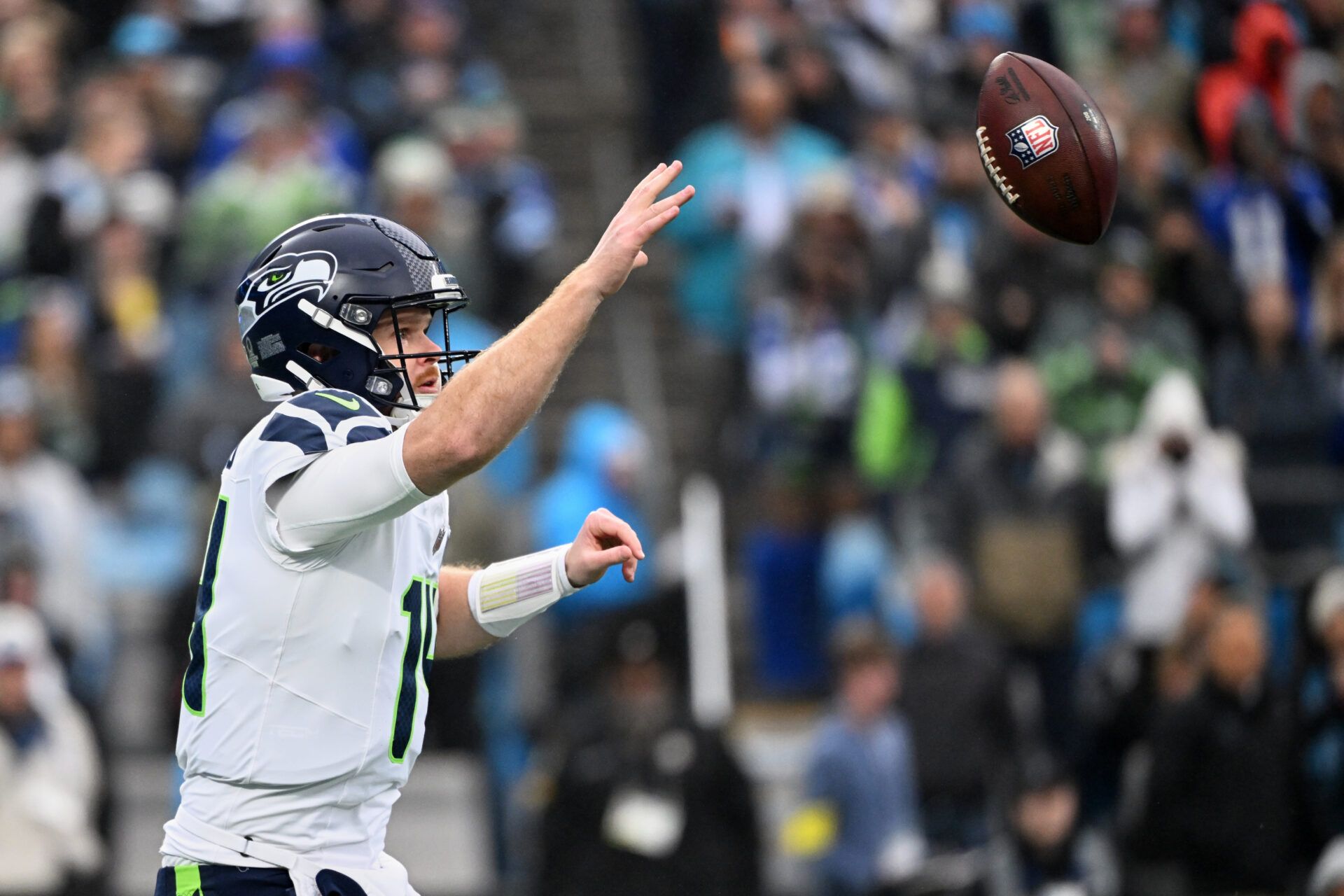
Intentional grounding exists for one reason: to make sure pass rushers get rewarded for beating their blocks.
Without it, every quarterback facing pressure could simply throw the ball into the dirt and walk away with nothing worse than an incomplete pass. The rule forces quarterbacks to make real decisions under duress, and it appears to have been evolving since 1914.
The NFL rulebook defines intentional grounding as a foul when “a passer, facing an imminent loss of yardage because of pressure from the defense, throws a forward pass without a realistic chance of completion.”
Three conditions must all be present: the quarterback is inside the pocket, he’s under defensive pressure, and there’s no eligible receiver in the area where the ball lands.

How Intentional Grounding Gets Called (and Avoided)
The penalty carries real teeth. Inside the field of play, it costs the offense 10 yards from the previous spot and a loss of down. If the quarterback releases the ball from his own end zone, it’s an automatic safety. That end zone wrinkle is why you’ll see quarterbacks take sacks near the goal line rather than throw the ball away.
Escaping the call requires getting outside the pocket. Once a quarterback moves beyond the original position of either offensive tackle, he only needs to throw the ball past the line of scrimmage to avoid the penalty.
The receiver proximity requirement disappears. That’s why you see quarterbacks sprint toward the sideline and fire the ball into the third row of seats. Perfectly legal, as long as the pass crosses the line of scrimmage.
The NFL quietly made this easier in 2024. The league redefined what it means to be “out of the pocket” in two separate sections of the rulebook. A quarterback is now considered outside the pocket “if any part of his body or the ball is outside the pocket area.”
That’s a meaningful expansion. A quarterback no longer needs to fully escape the tackle box. Getting a shoulder or even the ball itself past the edge is enough to trigger the more lenient rules.
READ MORE: Super Bowl 60 Predictions: Predicting the Winner, Final Score, MVP, and More
Spiking the ball to stop the clock isn’t grounding, but there’s a catch most fans don’t know: the clock has to be running. In 2018, Patrick Mahomes spiked the ball against Cleveland when the clock was already stopped.
The officials flagged him for intentional grounding because the rulebook only permits spikes “to stop a running game clock.” If the clock isn’t moving, the spike serves no legal purpose, and the quarterback is just throwing the ball into the ground with no receiver nearby.
Why the Rule Keeps Changing
The NFL had 60 intentional grounding calls in 2023, according to nflpenalties.com, and the league noticed.
The Competition Committee considered a proposal ahead of the 2024 season that would have eliminated the distinction between quarterbacks inside and outside the pocket entirely. Under that version, any quarterback would only need to get the ball past the line of scrimmage to avoid the penalty, regardless of position.
That proposal didn’t pass in its original form, but the subtle pocket redefinition achieved a similar goal through the back door. The results were immediate: grounding calls dropped to 34 in 2024, a 43% decrease. But the 2025 season has seen a sharp reversal.
Through the conference championships, officials have flagged 59 intentional grounding penalties, nearly matching the 2023 total that sparked the rule change discussion.
The league wants to protect quarterbacks while maintaining some balance. Eliminating grounding entirely would devalue pass rushing, but the current rule’s complexity creates inconsistent officiating.
MORE: Conservatives Call for Boycott of Super Bowl 60 Over Bad Bunny’s Halftime Show: ‘ENOUGH IS ENOUGH’
Super Bowl 58 illustrated the problem. With just over nine minutes left in the fourth quarter, Mahomes dropped a low snap, recovered, and threw the ball toward midfield with no receivers anywhere near it. The 49ers’ pass rush had him trapped, and the throw looked like textbook grounding. The officials didn’t call it. The Chiefs tied the game on that drive and went on to win in overtime.
The controversial no-call reignited debate about officiating consistency, and weeks later at the league meetings, the NFL expanded replay assist for the 2024 season to include intentional grounding, allowing replay officials in New York to review whether a quarterback was in the pocket and under duress.
The rule appears to date back to 1914, just two years after an incomplete pass stopped resulting in a turnover. Once quarterbacks realized they could throw the ball away to escape pressure without consequences, the league stepped in. The fundamental tension hasn’t changed in 110 years. The NFL wants quarterbacks to take calculated risks, not escape routes.