
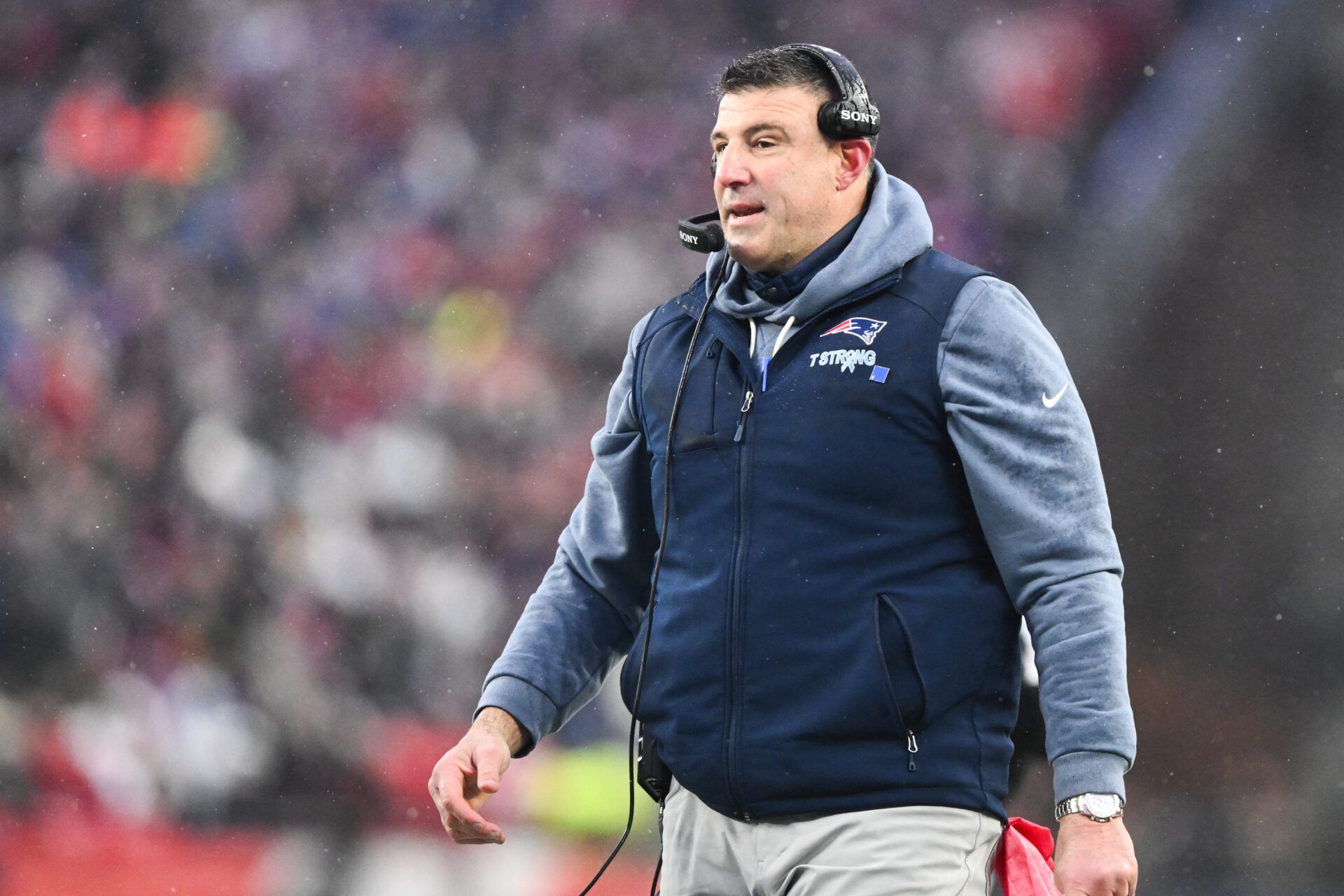
Khyiris Tonga has spent four seasons bouncing around the NFL, from Chicago to Atlanta to Minnesota to Arizona, trying to prove that a seventh-round pick from BYU belongs on a roster. Now the 29-year-old defensive tackle sits in Santa Clara preparing for the first Super Bowl appearance of his career, and when asked what makes Mike Vrabel different from every other coach he’s played for, Tonga doesn’t talk about scheme or strategy.
Mike Vrabel Bridges the Gap Between Player and Coach
“He literally sounds like one of us,” Tonga said during Super Bowl 60 media availability. “He’s really locked in and in tune with the players.”
That observation cuts to the core of New England’s improbable turnaround. Plenty of former players become head coaches. Few of them retain the vocabulary, the cadence, the locker-room shorthand that makes players feel like they’re being led by one of their own rather than managed by an authority figure.
The NFL is littered with former players who became coaches and failed. Playing at the highest level doesn’t automatically translate to connecting with the next generation. What separates Vrabel is that he hasn’t sanitized his communication for the coaching profession.
Tedy Bruschi, Vrabel’s former Patriots teammate, noted before the season that Vrabel’s approach reminded him more of Bill Parcells than of Bill Belichick because of how he interacts with players, both professionally and personally. Vrabel addressed that comparison directly in September.
“You gotta meet them where they’re at and bring them along to where they need to get to,” Vrabel told Bruschi on ESPN’s “Sunday NFL Countdown.” “It’s OK for us to have different personalities. We have to have one singular mentality about how we operate on the football field.”
That singular mentality has produced one of the most efficient defenses in playoff history. New England’s unit leads all qualifiers in average points allowed at 8.7 per game, total yards allowed at 209.7, and rushing yards allowed at 71.3. The Patriots have recorded 12 sacks across three postseason games.
The defensive turnaround shows up in PFSN’s Defense Impact Metric. In 2024, New England ranked No. 30 with a DEFi of 66.1. Under Vrabel and defensive coordinator Terrell Williams, the Patriots jumped to 12th at 78.2. That 12-point swing represents more than schematic changes. It represents players believing in who’s leading them.
But the numbers stem from something harder to quantify: players who believe their coach speaks their language.
“I play hard for that man,” defensive tackle Christian Barmore said after the AFC Championship Game. “The things that man taught me, how he coaches me, I really respect the man with my life.”
For Tonga, reaching the Super Bowl validates a journey that took him through four franchises in as many years. When the Bears drafted him No. 250 overall in 2021, he was a day-three afterthought with concerns about his arm length and hand size. BYU coach Kalani Sitake had developed Tonga into a productive college player, but NFL evaluators weren’t convinced.
From Seventh-Rounder to Super Bowl Starter
Tonga’s path crossed with Vrabel’s when New England signed him to a one-year, $2.7 million deal last March. He arrived as a low-profile depth signing behind Milton Williams and Christian Barmore. Instead, he became a key rotation piece, playing 14 games with 8 starts, and evolved into an unexpected offensive weapon.
The 335-pound nose tackle has taken 18 snaps on offense this season, four of them as a lead blocker in the team’s last two playoff games. When asked whether there’s a play call in which he gets the ball near the goal line, Tonga smiled.
“That’s always the big man’s daydream,” he said. “So far, just keep it vanilla. Be where I’ve got to be and do what’s best for the team.”
Vrabel knows that daydream intimately. As a Patriots linebacker from 2001-08, he caught two touchdown passes from Tom Brady in Super Bowls, becoming the first defensive player to score an offensive Super Bowl touchdown since William Perry in 1986. Every reception in his 14-year career went for a touchdown.
“It’s super fun to see it from the offensive standpoint and seeing what they got to do,” Tonga added. “I’ve got a lot of respect for them on that side of the ball.”
That cross-positional appreciation reflects Vrabel’s coaching influence. He spent his 2024 season as a consultant with the Cleveland Browns, absorbing defensive coordinator Jim Schwartz’s principles about generating pressure through rotation and fundamentals. Now he applies those concepts with a defensive line that plays like a hockey unit, fresh bodies constantly cycling onto the field.
Tonga’s former coach at BYU understands the significance of this moment. Sitake, who stayed with the Cougars after a flirtation with Penn State, has guided BYU to back-to-back 10-plus-win seasons. Tonga committed to BYU after Sitake was named head coach during his mission, a decision that would shape the rest of his football career.
“Kalani is everything, man,” Tonga said of his college coach. “Everything that BYU is looking to represent, I think Kalani is the perfect image.”
The through-line connects Sitake to Vrabel: coaches who develop overlooked players into contributors by treating them as partners rather than subordinates. Tonga needed four teams to find the right situation. He found it with a coach who still remembers what it felt like to suit up every Sunday.