
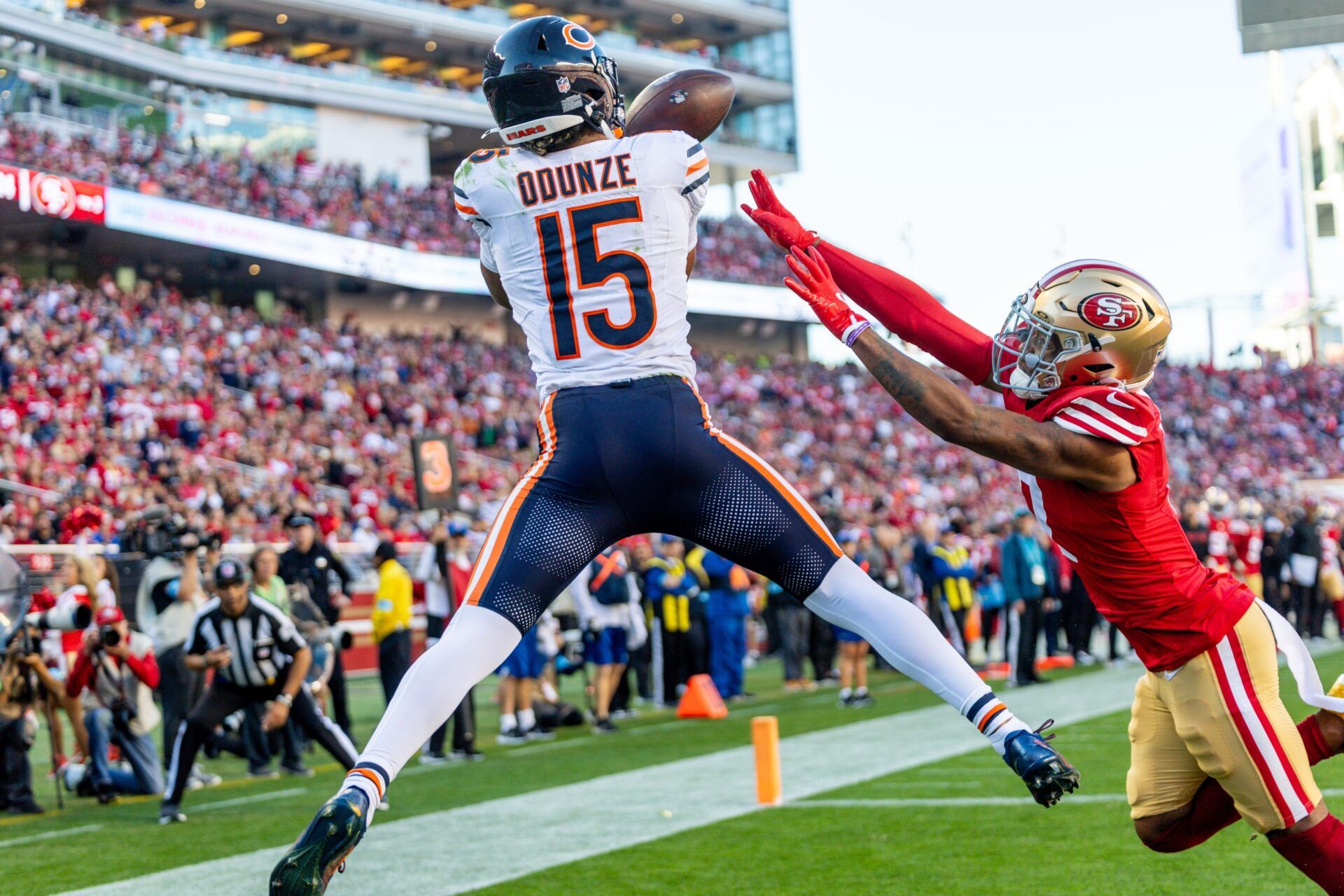
The fantasy football community’s love for Rome Odunze is starting to cool, and the numbers back that up. The Chicago Bears’ wideout did pass the all-important 525-yard rookie mark, a good sign for future success, but his path to a big second year has more bumps than many managers first thought.
The Market Momentum Shifts
The dramatic swing in Odunze’s trade activity tells a revealing story about changing perceptions. After being acquired in over 64% of PFSN user trades during both May and June, the tide has turned decisively. Through early July, 300 of the 348 trades involving Odunze have seen fantasy managers moving on from the second-year receiver. This represents one of the most dramatic sentiment shifts we’ve seen for a player with his perceived upside.
The selling pressure isn’t happening in a vacuum. Fantasy managers recognize that Odunze’s rookie campaign, while meeting basic thresholds for future success, revealed efficiency issues that could limit his ceiling. His 734 receiving yards put him in a group with mixed results in Year 2.
Rome Odunze is going to have a monster sophomore year. pic.twitter.com/example
— Caleb Williams Fan Club (@CalebFC18) May 29, 2025
The 525-Yard Threshold Provides Hope, But Context Matters
Odunze’s 734 receiving yards as a rookie cleared the critical 525-yard benchmark that separates potential fantasy assets from likely busts. Historical data shows that wide receivers who fail to reach 525 yards as rookies have a 94.1% bust rate, making Odunze’s achievement significant for his long-term prospects. However, simply clearing this threshold doesn’t guarantee success.
Players who finish between 525-699 yards as rookies have only a 30.6% success rate of becoming valuable fantasy assets. Odunze’s 734 yards places him in the next tier, 700-899, where the success rate improves to approximately 64.2%. While these odds are encouraging, they’re far from the near-certainty that many fantasy managers assumed when projecting his sophomore breakout.
His efficiency was rough. He averaged just 1.33 yards per route run, ranking 75th in the league. That puts him in a tier with guys who didn’t make the most of their chances. While players have overcome poor rookie efficiency numbers to break out in Year 2, it represents a significant hurdle rather than a minor concern.
The Short-Area Dependency Problem
One of the biggest red flags in Odunze’s rookie year was how much he relied on short targets. A staggering 72.2% of his fantasy points per game came on balls thrown less than 15 yards downfield. This dependency on underneath work limits his ceiling potential and makes him vulnerable to target competition from players who excel in similar areas.
The Bears’ selection of Luther Burden III with the 39th overall pick compounds this concern. Burden saw over 75% of his college targets on passes under 10 air yards. That’s a lot of overlap with Odunze’s best routes. While some fantasy managers view this as complementary skill sets, the reality is that both players could occupy similar roles in Ben Johnson’s offense.
MORE: Chicago Bears Predicted To Cut Ties With $50,000,000 Star Playmaker Ahead of 2025 NFL Season
Johnson’s offensive philosophy emphasizes getting playmakers the ball in space through short, high-percentage throws. This approach should theoretically benefit both receivers but also create competition for the same target types that mainly comprised Odunze’s rookie production. The addition of Burden represents a potential ceiling cap rather than a rising tide that lifts all boats.
The Late-Season Regression Reveals Deeper Issues
The most concerning trend in Odunze’s rookie campaign was his dramatic decline as the season progressed. Through the first nine weeks, he delivered 91.3% of expected production given his target diet, suggesting he was effectively maximizing his opportunities. However, his efficiency cratered over the final nine weeks, dropping to 74.8% of expected production.
This late-season fade coincided with increased defensive attention and more sophisticated game-planning from opponents. As teams accumulated film on Odunze and the Bears’ offensive tendencies, his production suffered significantly.
The regression also occurred when Caleb Williams was theoretically becoming more comfortable in the offense. If Odunze’s production declined while his quarterback was improving, it raises questions about his ability to capitalize on better circumstances. This pattern is particularly troubling for fantasy managers banking on natural progression in Year 2.
The Coaching Upgrade Provides Optimism
The most significant factor working in Odunze’s favor is Johnson’s arrival as head coach. Johnson’s track record of maximizing receiver production during his tenure as Detroit’s offensive coordinator provides legitimate reason for optimism. His ability to scheme players open and create favorable matchups could address some of Odunze’s efficiency concerns.
Johnson’s offense historically features multiple receivers contributing at high levels, suggesting there’s room for both Odunze and Burden to succeed. His creative use of formations and motion could help Odunze find easier targets and reduce his reliance on winning contested situations. The coaching upgrade represents the strongest argument for Odunze’s potential breakout.
However, even Johnson’s proven system doesn’t guarantee individual success. His Detroit offense featured established veterans like Amon-Ra St. Brown and emerging talents who showed better rookie efficiency than Odunze.
He will very likely prefer DJ Moore’s established skills as his new version of St. Brown. The coaching upgrade provides an opportunity, but Odunze must still demonstrate the ability to capitalize on improved circumstances.
The Dynasty Perspective Requires Patience
For dynasty fantasy managers, Odunze represents a challenging evaluation. His rookie production cleared critical thresholds while revealing concerning efficiency issues. Adding Burden, Colston Loveland, and the coaching change creates opportunity and competition. Fantasy managers considering moves involving Odunze should utilize the PFSN Trade Analyzer to evaluate fair compensation given his mixed outlook.
The current selling wave reflects growing recognition that Odunze’s sophomore breakout isn’t the foregone conclusion many assumed. His 734 receiving yards place him in a category where success is possible but far from guaranteed. The efficiency concerns, late-season regression, and increased target competition create legitimate reasons for skepticism.
MORE: Top 10 Chicago Bears Offenses of the 21st Century: Where Does Josh McCown’s 2013 Campaign Rank?
Smart dynasty managers should view Odunze as a hold rather than a buy, with his value likely dependent on early-season performance. His long-term outlook brightens considerably if he shows improved efficiency and maintains production despite increased competition. However, if the efficiency issues persist or worsen, his window for becoming a consistent fantasy asset may close quickly.
The fantasy community’s shifting sentiment toward Odunze reflects a more realistic assessment of his ceiling and floor. While the potential for a breakout exists, the path requires overcoming obstacles that weren’t initially apparent. Fantasy managers should adjust their expectations accordingly and avoid overinvesting in what remains a speculative asset despite his draft pedigree.
