
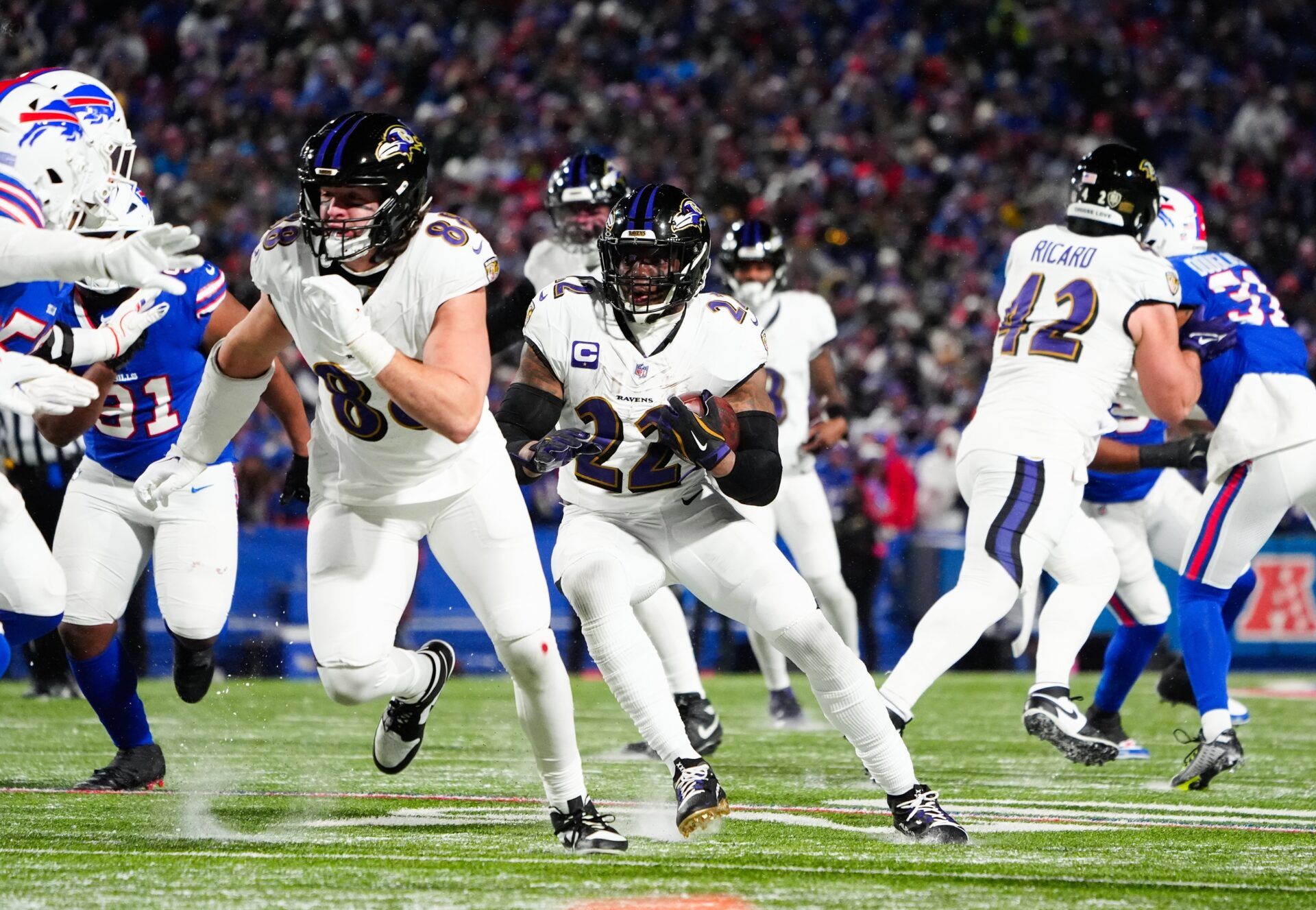
Derrick Henry met and exceeded expectations in his first season with the Baltimore Ravens, and thus, fantasy football managers. He rushed for 1,921 yards and 16 touchdowns while averaging 5.9 yards per carry, which worked out to 19.2 fantasy points per game, ranking him as RB3 on the season.
Contrary to what conventional wisdom suggests about veteran running backs, as Henry enters his age-31 season, it’s unlikely that we’ll see a significant decline due to his team’s context. It’s the same scheme with Todd Monken still calling plays, plus Lamar Jackson’s threat on the ground opens up running lanes for Henry.
With that said, Henry is the seventh-most oft-traded player among PFSN Trade Analyzer users, ranking third at the RB position in that regard. The question is, why are fantasy players trying to get rid of Henry? Is it time to cut bait on one of the best running backs of this generation?
Should Fantasy Managers Trade Derrick Henry Before Age Catches Up?
The answer to why dynasty league owners are trading Henry is quite simple; because in dynasty leagues, you want to secure value on an asset before it starts to depreciate. And when it comes to a running back on the wrong side of 30, that clock is certainly ticking.
Derrick Henry over the past six seasons:
9,130 YDS
102.6 YPG
84 TDThere’s no RB with better numbers in that span. pic.twitter.com/XScDcb8kSc
— StatMuse Football (@statmusefb) June 18, 2025
The former Tennessee Titans RB was terrific last season, showing that he still has juice left in the tank. But that doesn’t change the fact that Father Time catches up with every NFL player, especially running backs, at some point.
While he likely has another year of elite production left in him, it’s better to trade Henry before signs of decline appear because you can get a larger return. What you should ask for depends on whether your team is good enough to contend or if it’s time to rebuild.
Trading Derrick Henry While Contending: Target Youth Plus Assets
If you’re a contender, I would recommend trying to flip Henry for a younger back plus an additional asset. Perhaps you can swing a deal for James Cook and a 2026 second-round pick. The idea here is to secure a marginal downgrade at running back, allowing you to contend still, while setting up your team with a future asset.
Cook should still produce like a top-15 RB in an elite running game with Josh Allen and the Buffalo Bills. However, your league mate will be more open to trading Cook because of a contract dispute that could mean it’s his last year in Buffalo. Cook is seeking a $15 million per-season extension and has been absent from voluntary team activities while negotiations remain stalled.
Rebuilding Teams Should Target Premium Draft Capital
If you’re set to rebuild, the first move would be to try to get a 2026 first-round pick for Henry. If that proves too challenging a task, consider acquiring a young player, with one potential target being Ray Davis, along with a 2026 second-round pick.
There’s a good chance that Cook is going to leave in free agency following the 2025 NFL season, putting Davis in a position to lead the Bills’ backfield. We saw Davis put up 442 yards and three touchdowns in his rookie season. If he becomes Buffalo’s lead back, there’s top-15 upside.
Redraft Strategy: Target Henry’s Final Elite Season
If you’re in a redraft league, the move is to target Henry in the second round and ride what could be his last elite season in the NFL.
It’s hard to see Henry disappointing at that ADP with how dominant the Ravens offense should be. Remember, we’re talking about the fourth-highest scoring Flex that you can get in the second round. The discount due to injury risk as a 30-plus-year-old player is already priced in.
