
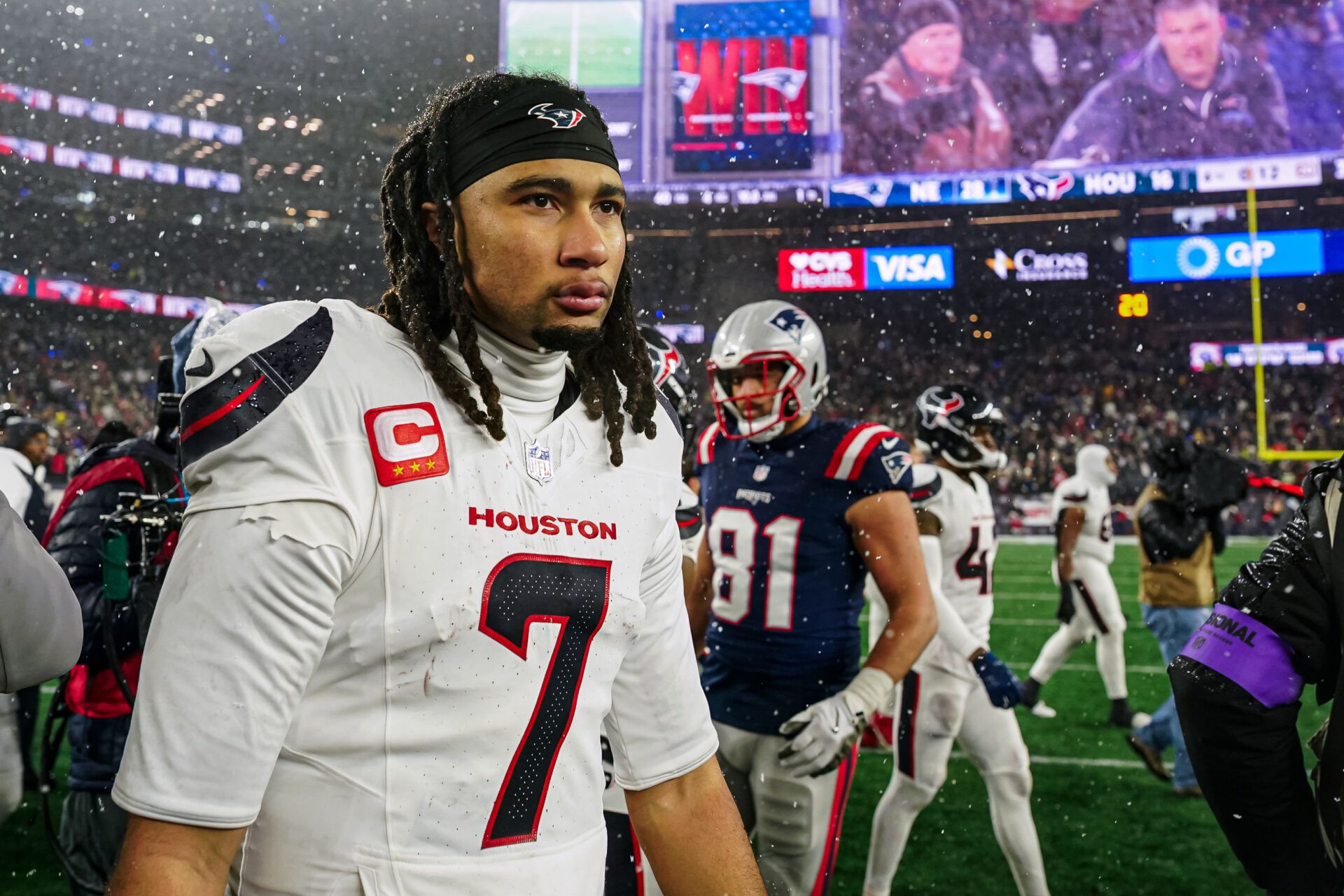
C.J. Stroud entered the postseason with Houston positioned as a legitimate AFC threat, backed by a dominant defense and expectations that the third-year quarterback could take the next step. Two games later, the Texans are heading into another offseason of uncertainty, and the spotlight has shifted sharply onto Stroud’s performance when the margin for error was smallest.

Is It Fair To Question C.J. Stroud’s Contract Outlook After Turnover-Plagued Playoff Losses?
Speaking on the “Dan Patrick Show,” NFL analyst Dan Patrick delivered a stark evaluation of Stroud’s recent play and what it could mean financially for the Texans. “C.J. Stroud… I think he cost himself millions and millions of dollars these last two games. There is no way I’m going to extend him,” Patrick said.
The comment followed Houston’s 28-16 divisional-round loss to the New England Patriots, a game that mirrored many of the same issues Stroud showed a week earlier in the wild-card round. Against New England, Stroud completed 20 of 47 passes for 212 yards, threw 4 interceptions, including a pick-six, and posted a passer rating of 28.0. The Texans managed only two field-goal drives in the second half as the offense failed to capitalize on repeated stops by an elite defense.
“C.J. Stroud…I think he cost himself millions and millions of dollars these last two games. There is no way I’m going to extend him.”
– DP on C.J. Stroud and the #Texans. pic.twitter.com/wAkwmIv5RU
— Dan Patrick Show (@dpshow) January 19, 2026
Those struggles came directly after a sloppy Wild Card win over Pittsburgh, in which Stroud threw multiple turnovers but was bailed out by a defense that overwhelmed the Steelers. In total, Stroud committed 7 turnovers across the two playoff games, a jarring departure from the regular season, when he threw 8 interceptions and did not lose a single fumble over 14 games.
From an analytical standpoint, the postseason collapse stood in contrast to Stroud’s broader body of work. He finished the season ranked 19th in PFSN’s QB Impact Rankings, placing him squarely in the middle tier of starting quarterbacks. That ranking aligned with a year that was productive but inconsistent, particularly in high-leverage situations.
Texans’ Elite Defense Amplifies Scrutiny on Stroud’s Postseason Regression
Houston’s defensive dominance only intensified the criticism surrounding Stroud’s performance. The Texans entered the postseason with the league’s second-ranked unit in PFSN’s Defense Impact Rankings, a group that consistently gave the offense favorable field position and margin for error. Against New England, that defense forced multiple turnovers, held the Patriots to seven third-down conversions, and kept the game within reach well into the second half.
Stroud’s inability to capitalize on that support raised familiar questions about his ceiling. Houston did not need explosive heroics. Ball security and efficient game management would have put the Texans in a position to advance. Instead, poor decisions under pressure, errant throws, and a breakdown in timing with his offensive line defined the loss.
The postseason downturn arrives at a critical point in Stroud’s career arc. This offseason represents the earliest window for the Texans to negotiate a franchise-altering extension that could exceed $250 million. Patrick’s comments reflect a growing league-wide debate about whether Houston should move forward with that commitment now or wait and exercise the fifth-year option on Stroud’s rookie contract.
