
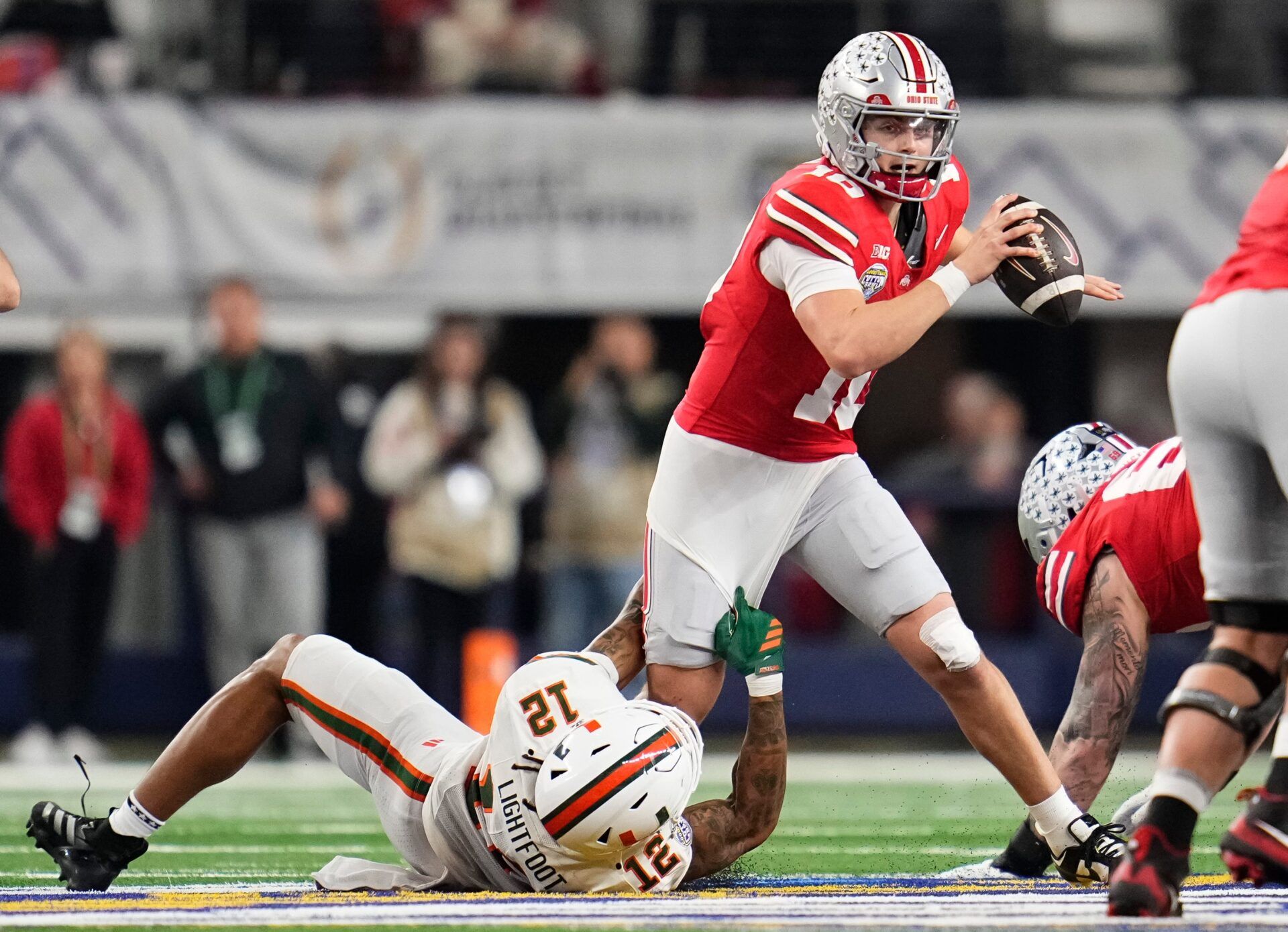
Ohio State’s shocking CFP quarterfinal loss to Miami wasn’t a reason to smash the panic button, but it was a wake-up call.
The Buckeyes didn’t just lose a game; they exposed more roster holes than many expected heading into the postseason.
All May Not Be as Bleak as Might Appear
The good news?
- They’re Ohio State, still one of the most attractive destinations in college football. The transfer portal opens at the perfect time, giving the Buckeyes a chance to address their needs aggressively.
- This isn’t about tearing the roster down. It’s about reloading smartly. Let’s take a look at the most urgent areas Ohio State should target and how the portal can help fix them quickly.
Defensive Line: Reloading Elite Talent
Ohio State’s defensive line is set to lose some serious firepower. Replacing Caden Curry and likely Kayden McDonald will be a priority, and there’s also a strong chance Arvell Reese enters the NFL Draft after being utilized as an edge rusher.
The production leaving Columbus is elite-level:
- Curry recorded an 83.6 in terms of PFSN’s Edge Impact Score, ranking 11th nationally.
- Reese is projected as a top-5 pick in the 2026 NFL Draft and a top-five overall prospect on PFSN’s Draft Consensus board.
That’s not production you simply replace with development alone.
Enter Chaz Coleman, one of the top edge rushers to hit the portal from Penn State. Coleman is extremely young, having just entered his sophomore season, and is loaded with upside. He’s also from the region and is looking for stability after a turbulent freshman year amid the James Franklin situation.
This is where Ohio State needs to flex its muscle. Coleman fits the profile perfectly: elite traits, local ties, and long-term upside. Landing him would immediately stabilize the edge rotation and keep the defensive line at a championship level.
Offensive Line: Identity Crisis in the Trenches
Statistically, Ohio State’s offensive line wasn’t bad. Their 83.4 PFSN College Offensive Line Impact Grade ranked them No. 21 nationally, which is respectable. But anyone watching the games knows the numbers don’t tell the full story.
Quarterback Julian Sayin spent far too much time running for his life, first against Indiana in the Big Ten Championship Game, then again versus Miami, where the Buckeyes surrendered five sacks and lost control of the line of scrimmage.
Ohio State football is at its best when it dominates up front, with depth and future NFL draft picks across the line. That identity faded in 2025. The run game was inconsistent and often nonexistent, forcing Sayin into hero-ball situations far too often.
One portal solution stands out: Carius Curne, the former LSU offensive lineman. Listed primarily as a guard, Curne has the versatility to slide across the line if needed, including potential snaps at tackle. He brings physicality, experience, and the kind of edge Ohio State has been missing.
If the Buckeyes want to reclaim their identity, they need maulers. It starts up front.
Running Back: Production Is There But Touchdowns Aren’t
Bo Jackson had a solid season, earning an 84.5 PFSN College Running Back Impact Score, ranking 18th nationally among running backs. He rushed for 1,035 yards and added 200 receiving yards, showing versatility and reliability.
But one stat stands out, and not in a good way: Jackson had five rushing touchdowns, and the team has 24 (45th in college football).
That lack of finishing stalled drives and forced Ohio State into more field goals than they would’ve liked. If the Buckeyes want to maximize their offense, they need more punch in the red zone.
Two portal options make sense depending on how aggressive Ohio State wants to be:
- Caleb Hawkins (North Texas): Led the nation with 23 rushing touchdowns. If Ohio State wants to overhaul the run game and add a true finisher, Hawkins is the home-run swing.
- Evan Dickens (Liberty): A strong complementary option who rushed for 1,339 yards (No. 5 nationally) and earned an 80.4 grade. He’d provide depth, competition, and reliability alongside Jackson.
Either way, competition in the backfield would raise the ceiling of the offense.
Bonus Need: Offensive Coordinator
This might be the most important move of all.
With Brian Hartline departing for the head coaching job at USF (well-deserved), Ohio State is suddenly without an offensive coordinator. Ryan Day calling plays against Miami highlighted a growing issue. At this stage of his career, Day should be overseeing the entire operation, not micromanaging the offense.
One intriguing name to watch: Garrett Riley, recently let go by Clemson. Riley is still highly respected as a play-caller and could benefit from a revival at a marquee program like Ohio State.
Chip Kelly was briefly mentioned as a possibility, but he’s now headed to Northwestern. That makes this hire even more critical.
The good news? This is one of the most attractive OC jobs in the country. Whoever steps in will inherit:
- Julian Sayin at quarterback.
- Jeremiah Smith as a centerpiece weapon.
- An offense that had a PFSN College Offense Impact Score of 91.7 in 2025, the third-highest mark nationally.
There will be no shortage of interest. Ohio State just has to make the right decision.
