
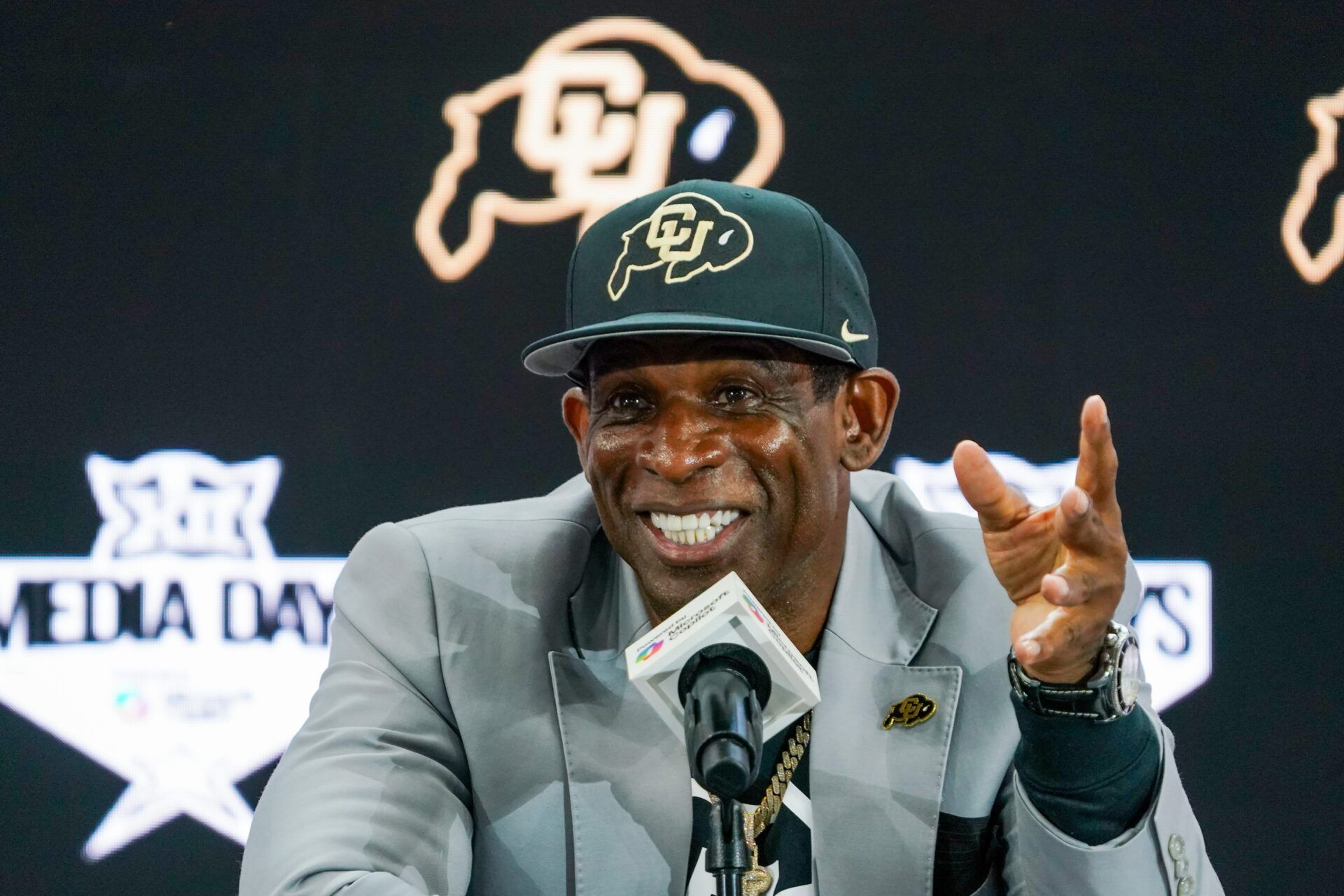
Deion Sanders stood at the podium during Big 12 Media Days with a message that addressed college football’s biggest problem.
The Colorado head coach wasn’t mincing words about NIL deals and the chaos they’ve created. His solution? Stop pretending the current system works and start copying what does.

Why Does Colorado HC Deion Sanders Think NIL Creates an Unfair Playing Field?
The college football landscape has shifted rapidly, largely due to the rise of NIL deals. While these opportunities benefit student-athletes, they have also deepened the divide between powerhouse programs and those with limited funding.
Wealthier schools now leverage major donor support and lucrative endorsements to secure elite talent, leaving smaller programs struggling to compete. As these major developments continue to unfold, Sanders has closely monitored them, expressing concern about the NCAA’s uncertain role in this evolving system.
Colorado head coach Deion Sanders has reemerged on the college football stage, and with him comes a renewed critique of the current state of NIL deals. Speaking at Big 12 Media Days, Sanders didn’t hold back while addressing the competitive disparity NIL has introduced into the sport.
He pointed directly at the imbalance in spending among programs and its visible impact on postseason appearances. “All you gotta do is look at the [CFP] and see what those teams spent, and you’ll understand darn well why they’re in the playoffs,” Sanders said.
His frustration was rooted not in the principle of player compensation, which he supports, but in the lack of structure guiding it. Sanders voiced concern over how programs now land recruits based primarily on NIL money rather than coaching or development.
“All you gotta do is look at the [CFP] and see what those teams spent, and you’ll understand darn well why they’re in the playoffs.”
Deion Sanders on NIL and the current state of college football. pic.twitter.com/y6A5C3dWUP
— ESPN (@espn) July 9, 2025
“You got a guy that’s not that darn good, but he could go to another school and they give him a half a million dollars and you can’t compete with that,” he said. “We’re not complaining because all these coaches up here could coach their butts off… but what’s going on right now don’t make sense.”
Sanders noted that schools with the largest donor bases are stockpiling talent, while others simply can’t keep pace financially.
“And you’re talking about equality, not equality, like equal, I guess, equality. And all you have to do is look at the playoffs and see what those teams spent, and you understand darn they’re wider in the playoffs.”
What Solution Does Sanders Propose for College Football’s NIL Problem?
Sanders has long advocated for NIL regulations and, earlier in April, proposed a clear solution: a salary cap mirroring the NFL’s structure.
“There should be some kind of cap,” he said in an interview with USA Today‘s Jarrett Bell. “Our game should emulate the NFL game in every aspect. Rules. Regulations. Whatever the NFL rules, the college rules should be the same.”
Sanders believes a structured cap would allow fairness to prevail across programs of varying size and resources. This approach would level the playing field by preventing the wealthiest programs from simply outspending their competition for top talent.
However, the current trajectory suggests his concerns are only growing. As part of a recently approved antitrust settlement in the House v. NCAA case, schools will soon be permitted to share up to $20.5 million annually with athletes. However, for Sanders, that measure falls short of addressing the core issue.
“It’s kind of hard to compete with somebody who’s given $25, $30 million to a darn freshman class,” he said, pointing out the growing gap between schools flush with cash and those without such advantages.
Sanders’ message was direct and uncompromising. Without firm guidelines, the sport risks becoming a predictable cycle dominated by the wealthiest programs. His NFL-style salary cap proposal represents a fundamental shift toward structured competition rather than the current free-for-all approach that has transformed college recruiting into a bidding war.
