
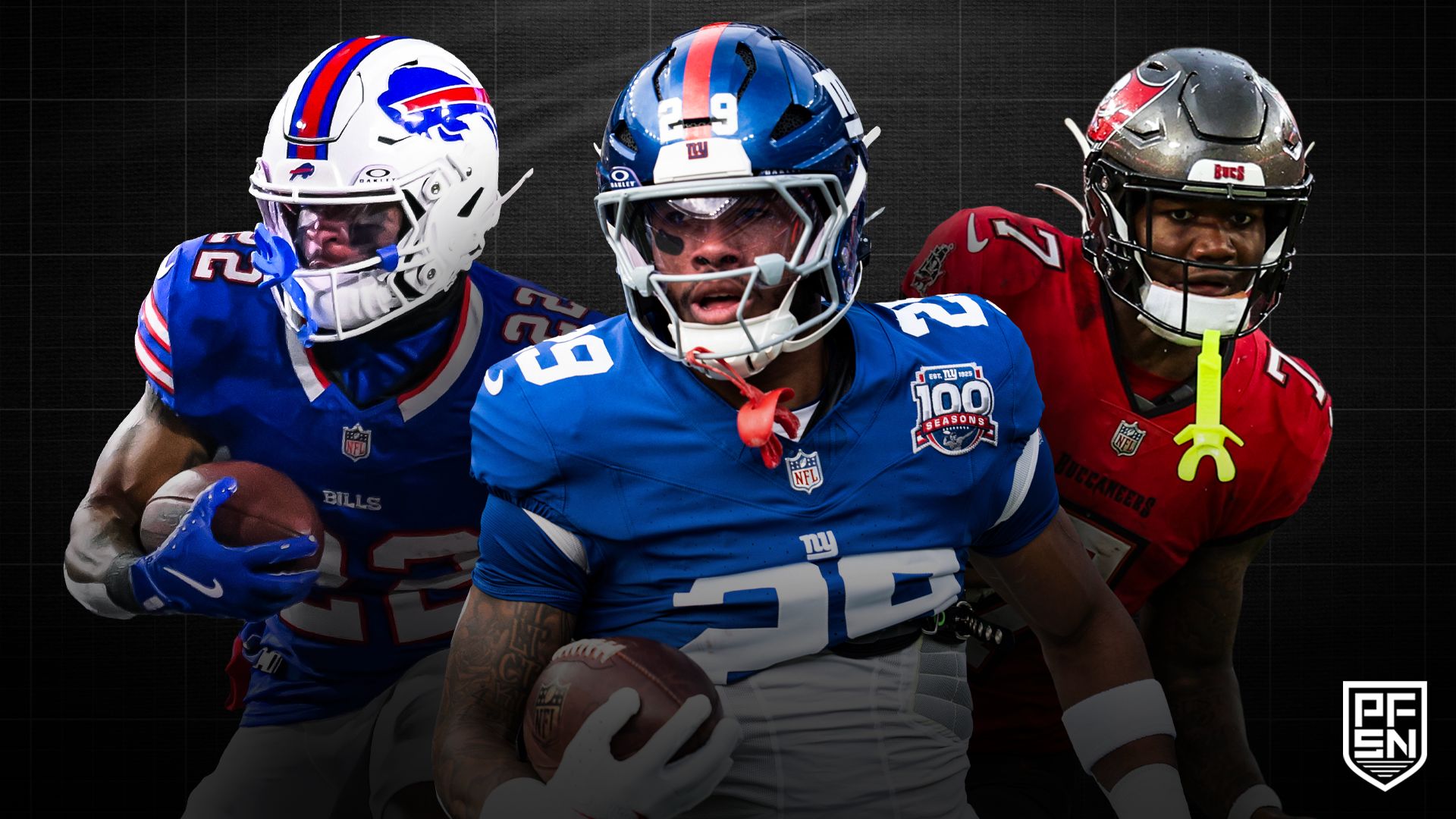
The 2025 running back class is considered a candidate to rival the famed 2017 class that is the greatest of all time. The 2024 running back class, though…not so much.
Despite the lackluster efforts of just about everyone not named Bucky Irving, there are still 10 running backs who entered the NFL last year that will be selected in most fantasy football leagues. So, let’s rank them!
2025 Sophomore Running Back Rankings
1) Bucky Irving, Tampa Bay Buccaneers
Bucky Irving exceeded all expectations as a third-round rookie last season. He averaged 14.4 PPR fantasy points per game, finishing as the overall RB19. That was an incredible return on investment for what was essentially a handcuff pick in fantasy drafts.
However, Irving wasn’t really the RB19. He was unstartable for the first five weeks of the season, playing well behind Rachaad White. Eventually, though, head coach Todd Bowles figured out that White is one of the worst pure runners in the NFL. That, combined with White’s untimely fumbles and Irving’s improved play, led to the rookie eventually taking over.
Bucky Irving 10+ yard runs
Arguably the shiftiest back in the league as a rookie 🦆 pic.twitter.com/GfAeL6Q1c5
— NFL Draft Files (@NFL_DF) May 14, 2025
From Weeks 6–18, Irving averaged 16.9 ppg, and if we isolate his stats after the Tampa Bay Buccaneers’ Week 11 bye, that jumps to 18.3. Furthermore, if we remove his 2.8 points in Week 14 when he exited early due to injury, we get 20.9.
The Bucs have one of the best run-blocking offensive lines, and Irving is now the clear starter. Tampa Bay also has a subpar defense in a division that should offer plenty of shootouts.
2) Tyrone Tracy Jr., New York Giants
Tyrone Tracy Jr. did well for a fifth-round rookie. He averaged 10.7 ppg, finishing as the overall RB26 in total points. That’s nothing special on its own, but Tracy started the year as a seldom-used backup to Devin Singletary.
From Weeks 1–4, Tracy didn’t play more than 31% of the snaps in any game. He had just 18 total opportunities in those four contests.
But in Week 5, the Tracy takeover began. From that point forward, he averaged 13.2 ppg — solid RB2 numbers. Not bad for a late-round dart throw.
Tracy proved he can handle volume, rushing 16+ times in seven games. He also showed some burst, recording a 15+ yard run on 5.2% of his carries.
Tracy enters 2025 in the best spot of any back besides Irving. Although the New York Giants drafted Cam Skattebo in the fourth round, Tracy’s role should be, at worst, a satellite back plus.
He may not make a huge leap, but it would be a surprise if Tracy offered no fantasy value, which is more than can be said for most names on this list.
3) Ray Davis, Buffalo Bills
We’re only at No. 3 and already into true handcuffs. That’s the best-case scenario for everyone left.
Ray Davis is clearly the back to roster behind James Cook. We’ve already seen it. Last season, Cook missed one game, and while Ty Johnson started on paper against the New York Jets, Davis was the featured back. He played 62% of the snaps, had 23 opportunities, and posted 152 scoreless yards, good for 18.2 fantasy points without a touchdown.
The Buffalo Bills return the same three backs atop their depth chart. If Cook misses time, Davis is the primary beneficiary and has already proven he can produce at a high level. With an RB45 ADP, he doesn’t cost much. Just know he’ll sit on your bench until something happens to Cook.
4) Trey Benson, Arizona Cardinals
You could rank these guys in any order — it’s all preference. However, Trey Benson gets the nod here for a couple of reasons.
The Arizona Cardinals re-signed James Conner through 2026 in November, but they also made clear Benson is their RB2.
Arizona didn’t add to its backfield this offseason. Behind Conner are Emari Demercado, Michael Carter, and DeeJay Dallas. If Conner (now 30 and often banged up) goes down, Benson likely becomes the RB1.
We don’t know what he’d do with the job, but the opportunity alone puts Benson in this spot. His RB44 ADP places him between Davis and the next guy. Like all the rest, his value hinges entirely on the starter missing time.
5) Isaac Guerendo, San Francisco 49ers
One of the least likely rookies to get playing time last year, Isaac Guerendo rose from fourth on the depth chart to RB1 due to injuries. Christian McCaffrey, Elijah Mitchell, and Jordan Mason all got hurt. Guerendo started four games and scored 19.2, 26.8, 11.5, and 13.9 fantasy points, respectively, in each of them — an average of 17.85 ppg, or RB1-level production.
In the 5 games Isaac Guerendo saw 10+ touches, he averaged 16.3 fantasy points.
IG has already showcased the perfect balance of speed, physicality and elusiveness! Going in the 14th round Guerendo is an absolute steal! Here are some of his top plays from 2024👇🏽@isaacGuerendo pic.twitter.com/G0wY8dDFt9
— Tim (@FireUpFantasyTG) June 3, 2025
That performance made the San Francisco 49ers comfortable with him as McCaffrey’s backup, as they moved on from both Mitchell and Mason, leaving Guerendo unchallenged. San Francisco did draft Jordan James in the sixth round, but he shouldn’t threaten Guerendo’s RB2 role. The latter’s RB43 ADP puts him in the same injury-dependent handcuff cluster.
6) Braelon Allen, New York Jets
Braelon Allen started out as a low-usage backup but quickly carved out a real role (11 and 14 opportunities in Weeks 2 and 3, respectively). Allen started one game in Week 14 with Breece Hall out, but he wasn’t quite a workhorse (16 opportunities for 81 yards and 12.1 fantasy points). That’s solid but underwhelming given the hype.
One big issue, though, was that Allen wasn’t the clear No. 2. He split work with rookie Isaiah Davis, and all three backs got touches in multiple games.
Allen enters 2025 in the same spot. Hall is the RB1, and Allen is the RB2, but it would still be a timeshare if the former were to miss time. That explains Allen’s drop to RB54 in ADP — well below the more defined handcuffs above.
7) Blake Corum, Los Angeles Rams
Despite a great 2023 season, fantasy managers were skeptical about Kyren Williams, which is common with late-round breakout running backs. And the Los Angeles Rams drafting Blake Corum in the third round only added to the noise.
Some thought Corum would push for Williams’ job or at least create a timeshare. But that’s not Sean McVay’s style — he prefers a true RB1.
Williams stayed healthy, and Corum was just a backup. He didn’t even open the year as the RB2, Ronnie Rivers did. Corum didn’t earn that job until later.
On limited work, Corum wasn’t impressive. He averaged 3.6 yards per carry, and only four of his 58 runs went for 10+ yards.
Corum enters Year 2 as the presumed RB2, but the Rams drafted Jarquez Hunter in the fourth round, muddying things again. That’s why Corum’s ADP dropped to RB60 — just three spots ahead of Hunter.
8) Jaylen Wright, Miami Dolphins
The Miami Dolphins drafting Jaylen Wright in 2024 was curious. They already had De’Von Achane and kept Raheem Mostert and Jeff Wilson Jr. Wright was viewed as Achane insurance and a possible challenger for RB2. But he wasn’t explosive, averaging just 3.7 yards per carry and catching three passes all year.
This year, though, Wright is in a good spot if Achane gets hurt. Mostert is gone, but the Dolphins did sign Alexander Mattison and drafted Ollie Gordon II.
Wright is still a Day 3 back who didn’t show much. With an RB57 ADP, there’s no confidence he’s the next man up or can produce like Achane.
9) MarShawn Lloyd, Green Bay Packers
MarShawn Lloyd entered the NFL with high expectations. The Green Bay Packers didn’t know what they’d get from Josh Jacobs, and Aaron Jones was gone. However, Lloyd couldn’t stay healthy and never got going.
Lloyd played in one game, getting seven touches for 18 yards. Meanwhile, Emanuel Wilson and Chris Brooks served as Jacobs’ backups.
Lloyd has a shot to win the RB2 job in Year 2, and the Packers run enough that 6–8 touches a game could offer value. But after a lost rookie year, he’s a shaky handcuff — his RB61 ADP says as much.
10) Audric Estimé, Denver Broncos
Sean Payton had some praise for Audric Estimé during OTAs.
#Broncos HC Sean Payton on what he wants to see from Audric Estime:
“Just running style, his physicality — the things that got him drafted, the things that we saw. A little bit harder for him last year. For a handful of these guys. I don’t want to say the grade was incomplete,… pic.twitter.com/9TzJGbBsso
— The Coachspeak Index (@CoachspeakIndex) May 29, 2025
But actions speak louder. If Payton was confident, Denver wouldn’t have spent a second-round pick on R.J. Harvey.
Estimé had 76 carries as a rookie, averaging 4.1 ypc. His best chance at value is as a goal-line back. At 221 pounds, he fits that mold better than the 205-pound Harvey.
Still, Estimé couldn’t get much going last year in a wide-open backfield, and his RB75 ADP is a reflection of it. Most leagues won’t draft him, and that’s probably how it should be.

I give you full permission to use my Guerendo tweet!
– Tim (FireUpFantasyTG)