
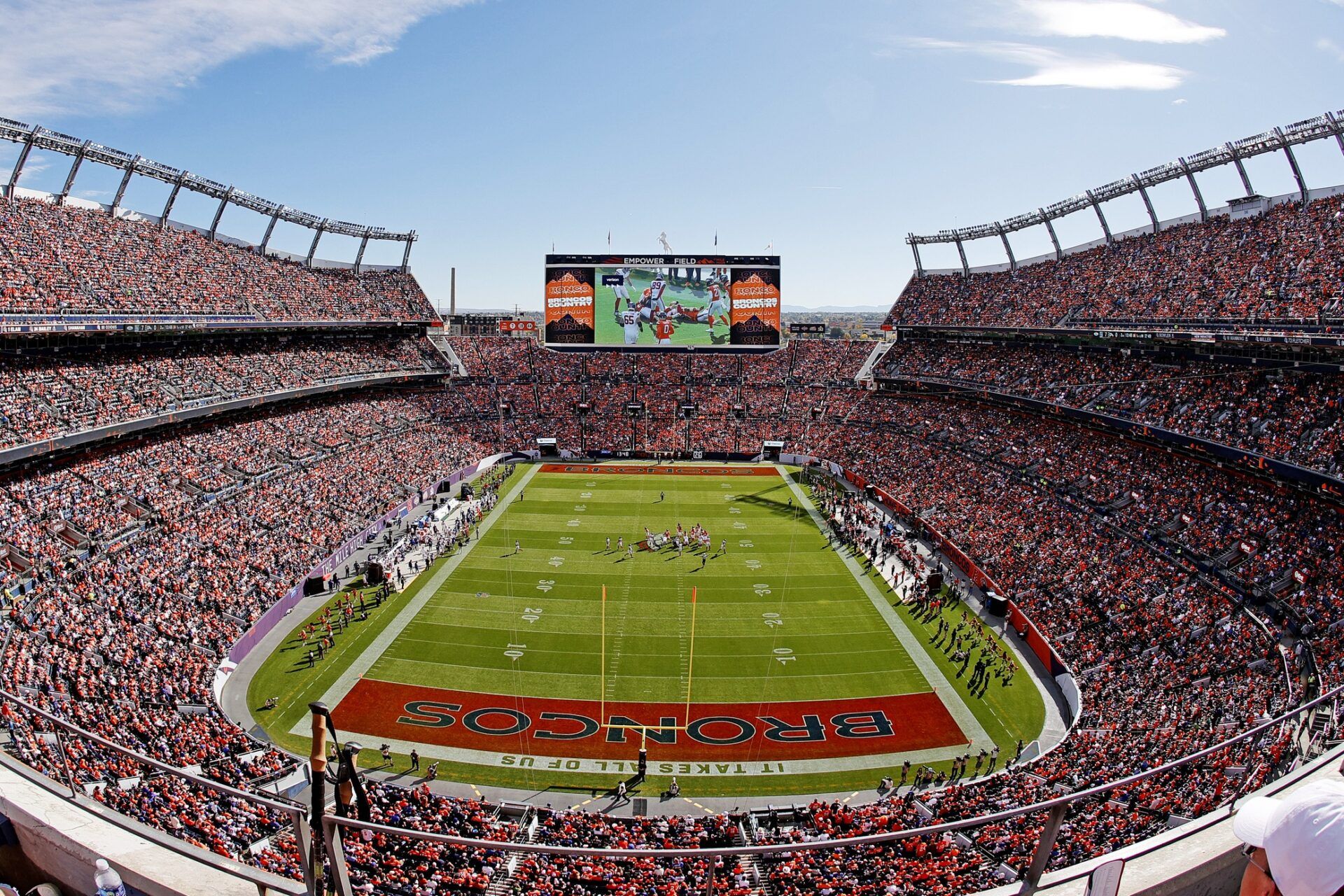
If you’ve ever watched a Denver Broncos home game, chances are you’ve heard the phrase “Mile High” more times than you can count. The roar of the “Mile High crowd” and the famous “Mile High Salute” have become part of the NFL’s lore over the years.
But why is the Broncos’ stadium called Mile High, and what’s the story behind that name? Here’s everything you need to know about how geography and local pride came together to create one of the most iconic names in NFL history.

What Does ‘Mile High’ Actually Mean For the Denver Broncos?
The city of Denver is famously known as the “Mile High City” because it sits one mile or 5,280 feet above sea level, making it one of the highest-elevation cities in the United States. That same elevation applies to the Broncos’ home stadium, Empower Field at Mile High.
Denver’s original football field, Bears Stadium, opened in 1948, named after the city’s minor league baseball team, the Denver Bears. It became the Broncos’ home when they joined the American Football League (AFL) in 1960.
MORE: 2026 7-Round NFL Mock Draft
In 1968, the city officially renamed the venue Mile High Stadium to reflect Denver’s elevation of 5,280 feet, or exactly one mile above sea level. Since then, the name has become a powerful symbol of the football team over the decades, and by the 1970s and ’80s, Mile High Stadium had become one of the most intimidating environments in the NFL.
What Advantage Does the Broncos’ Home At Mile High Have?
Apart from the loud, loyal, and passionate fan base in Denver, the city’s altitude also gives the Broncos a literal psychological edge and a one-of-a-kind home-field advantage over visiting teams.
The thinner air in Denver means less air resistance, allowing the football to travel farther on passes and kicks. For the players, the thin air at high elevation means there’s less oxygen available, leading to quicker fatigue.
This effect is especially noticeable in the fourth quarter, when players are already exhausted. Visiting teams often struggle to adjust while the Broncos players are conditioned for it.
That gives the Broncos one of the strongest and most unique home-field advantages in the NFL. To counter this, some opposing teams arrive early to acclimate to the altitude.
The Broncos even use this as an intimidation tactic against opponents, playing “altitude sickness” warning videos before games to remind them that it will literally be an uphill climb in Denver.
Although it’s not unique to the NFL, the city’s NBA team, the Denver Nuggets, also uses these before home games.
Kickers benefit from the altitude, too, as the field-goal range in Denver is roughly five yards longer than at sea level stadiums on average. However, factors such as wind and cold can make it difficult to kick the ball accurately.
What Does the “5280” on the Broncos Helmet And Uniform Mean?
Before the 2024 season, Denver unveiled new uniforms for the first time since 1997 as part of the “Mile High Collection.” Each helmet and the inside collar of the jersey feature the number “5280,” in honor of the city’s elevation, which stands at 5,280 feet, or one mile, above sea level.
Why Was the Original Mile High Stadium Demolished?
The original Mile High Stadium was demolished in 2001 to make way for a modern venue nearby. It was originally named Invesco Field at Mile High, later renamed Sports Authority Field, and is now known as Empower Field at Mile High, following a sponsorship deal in 2019.
Will the Broncos Continue To Play At Empower Field At Mile High?
According to USA Today’s Broncos Wire, the Denver Broncos are exploring plans to build a new stadium at Burnham Yard. However, that project remains years away, and the Broncos are expected to continue playing at Empower Field at Mile High at least through the 2030 season, when their current lease expires.
However, the name “Mile High” is likely to remain, as fans have been adamant that the phrase continue regardless of the sponsor. For locals, “Mile High” is part of a legacy and heritage that a sponsorship deal can’t rebrand, and so, no matter who sponsors the venue, Denver will always be Mile High.
Preview for Broncos vs. Patriots AFC Championship Game
PFSN Analytics: Patriots: 67.9% win rate, Broncos: 32.1% win rate
Power Ranking
- NE: 7th (77.3)
- DEN: 3rd (79.2)
Offense
NE: 2nd (86.6; B) in PFSN’s Offense Impact (OFFi)
- Drake Maye: 2nd (91.1; A-) in PFSN’s Quarterback Impact (QBi)
- Offensive Line: 12th (74.5; C) in PFSN’s Offensive Line Impact (OLi)
DEN: 15th (75.9; C) in PFSN’s Defense Impact (DEFi)
- Stidham: Four qualified QBi games in his career. Best score: 81.4 (B-) with the Raiders vs the 49ers in 2022. His lowest score was a 72.7 (C-) in 2022.
- Offensive Line: 5th (80.9 B-)
Defense
- NE: 12th (78.2 C+)
- DEN: 1st (90.1 A-)
Special Teams
- NE: 20th (73.9 C)
- DEN: 22nd (70.9 C-)
Preview Notes
- Drake Maye has six fumbles, including three lost, in two postseason games after having eight with three lost in 17 regular-season games.
- The Broncos and Patriots have met in the postseason five times, with the home team winning each time. This will be the fifth time they play in Denver.
- Denver’s defense allowed an NFL-best 2.1 yards per play in the red zone. In contrast, New England’s red zone offense averaged 2.9 yards per play, ranking last in the league.
- On offense, the Broncos averaged 3.4 yards per red-zone play, ranking third in the NFL. Defensively, the Patriots allowed an average of 3.8 yards per red-zone play, ranking last.
- Denver’s fourth-quarter point differential was +64, second-best in the NFL for the regular season. The Patriots’ fourth-quarter point differential was -12, putting them at 19th overall.
- New England would be the ninth team to make a Super Bowl the year after losing at least ten games.
- New England is 9-4 in AFC Championship Games since the 2001 season.
A win gives the Patriots their 40th all-time postseason win, breaking a tie with the San Francisco 49ers. - Denver is 8-2 all-time in AFC Championship games, including 6-1 at home.
- A win would clinch Denver’s ninth Super Bowl appearance, breaking a tie with the Dallas Cowboys, Pittsburgh Steelers, and San Francisco 49ers for the second most. New England’s 11 is the most in NFL history.
