
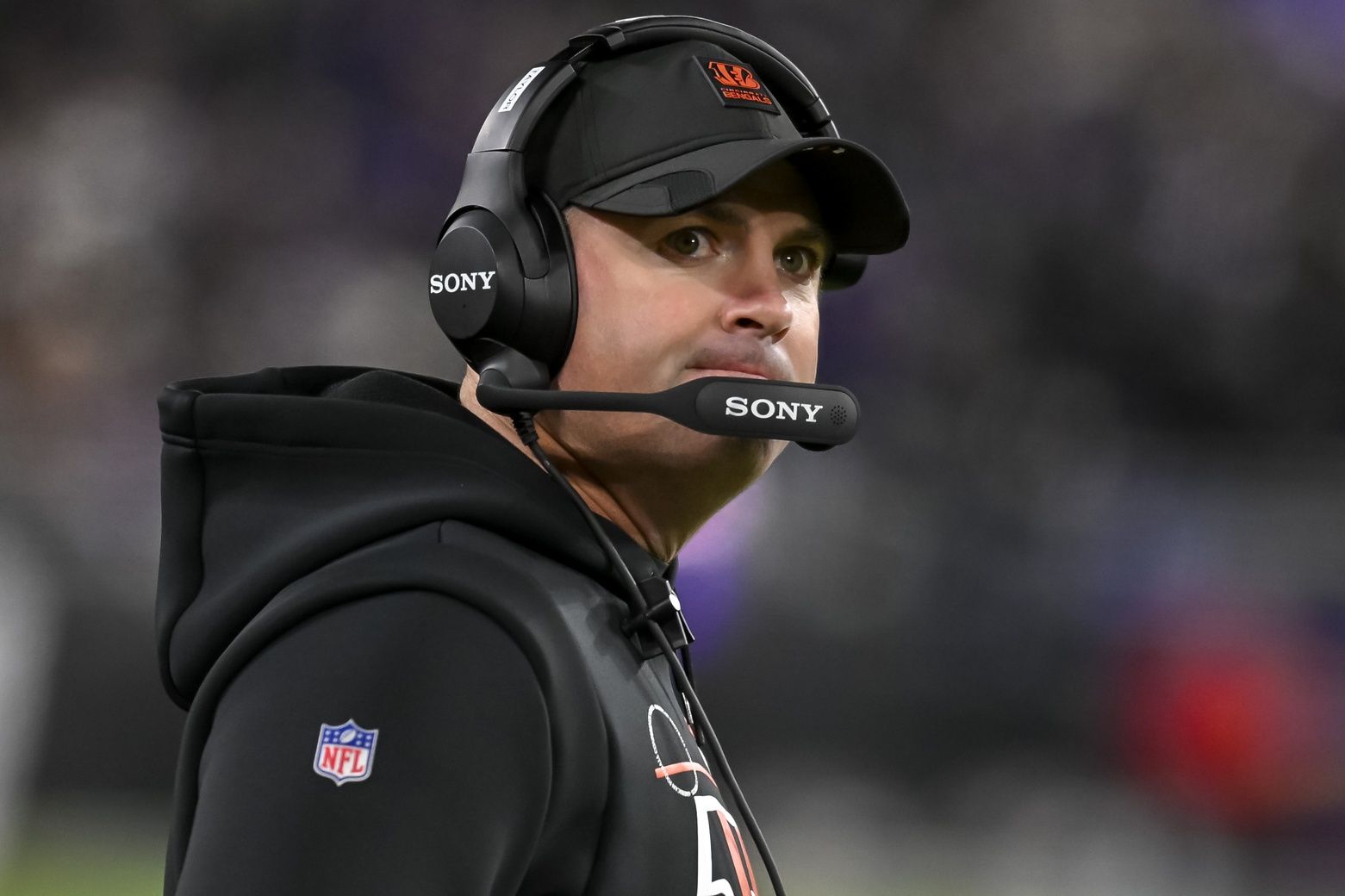
The landscape of NFL coaching security often shifts late in the season, and this week’s conversations across the league suggest the Cincinnati Bengals no longer sit outside those discussions. What once seemed like a settled situation for Zac Taylor now carries a degree of uncertainty that has drawn attention from decision makers and peers alike.

Growing League-Wide Concerns About Multiple Coaching Futures, Including Cincinnati
According to Dianna Russini of The Athletic, the NFL has typically seen at least five head coaching vacancies emerge each year for more than a decade. Currently, only the New York Giants and the Tennessee Titans have openings, but executives around the league widely expect that number to increase.
Although nothing is guaranteed, teams being discussed as potential additions to the cycle reportedly include the Atlanta Falcons, Cleveland Browns, Arizona Cardinals, and the Bengals, as well as the Raiders. This grouping places Taylor directly within a cluster of coaches whose job security is being privately debated despite no official moves.
To better understand why Taylor is now part of these conversations, PFSN’s Offense Impact metric offers additional context. The Bengals hold a 71.4 Offensive Impact Score, ranking 22nd in the league, and earned a C-minus offensive grade during the 2025 season, which saw them finish with a 4–8 record.
Their overall rank of 553 places them well below league average, reinforcing why evaluators see the Bengals as a team whose performance no longer guarantees coaching stability.
That context matters because ownership expectations have shifted. Last offseason, top candidates like Mike Vrabel and Ben Johnson were pursued aggressively, and both are now winning at the highest level with their new teams.
Their success reinforces a league-wide belief that fast turnarounds are possible, increasing scrutiny on coaches whose teams have experienced inconsistency. Taylor’s presence in this conversation suggests the Bengals could be evaluated under that same accelerated standard.
The Raiders example, as illustrated by Russini, illustrates how internal uncertainty can quickly reshape the perception of a coaching staff.
The organization’s struggles under the influence of Tom Brady’s minority ownership role led to comments from Antonio Pierce such as, “They might need decades to fix this bad boy,” punctuated by a staffer saying, “It’s hard to argue with him.”
While the Bengals’ situation is not described as chaotic, their inclusion among teams under league-wide watch reflects how delicate coaching stability can become when performance and direction invite questions.
The coaches have roughly a month to reinforce their standing before postseason and offseason evaluations begin. For Taylor, this timing increases the stakes.
The Bengals being mentioned alongside four other franchises signals that the league sees them as a team in potential transition rather than one operating with complete confidence in its long-term plan.
Taken together, Taylor’s status is no longer viewed as untouchable. As the season closes, the Bengals’ performance and organizational alignment will determine whether he remains the franchise’s guiding voice or enters a coaching cycle that appears poised to expand.
