
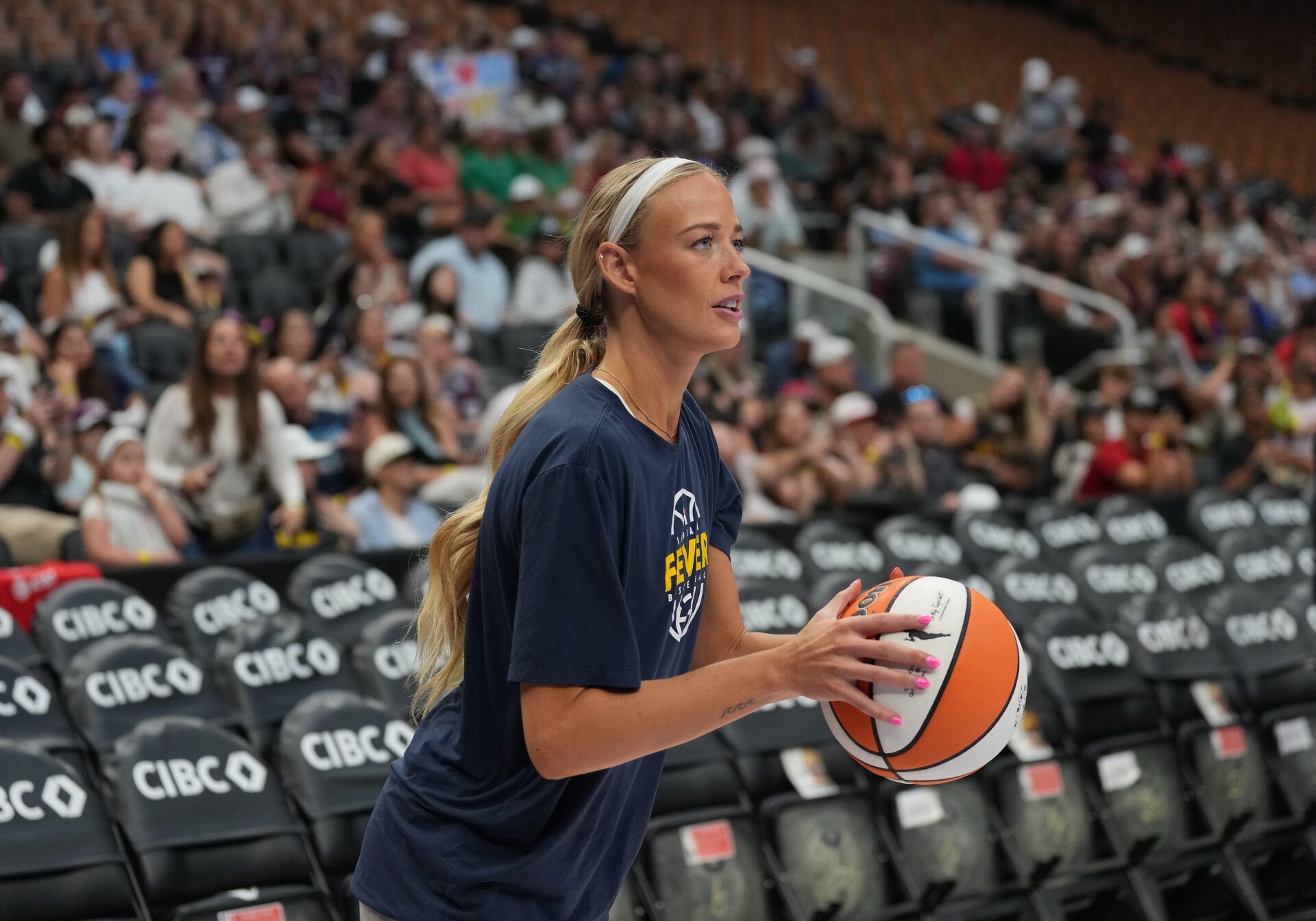
Sophie Cunningham turned a routine interview into a culture war. The Indiana Fever guard’s outspoken defense of female-only locker rooms and her call for restrictions on trans athletes in women’s sports sent shockwaves through the league, igniting a fierce debate about inclusion and fairness.
While the WNBA’s CBA clearly states that “only players who are women are eligible to play in the WNBA,” it offers no clear definitions regarding gender identity or anti-transgender policies. This ambiguity prompted activists to demand answers. But as the debate rages on, corporate giant Nike now finds itself caught squarely in the crossfire.
XX-XY Athletics Puts Nike’s Neutrality to the Test Over Sophie Cunningham’s Trans-Athlete Controversy
Since ESPN published Sophie Cunningham’s interview, fans have rallied outside WNBA arenas holding “Thank You, Sophie” signs and gold balloons shaped like her No. 8 jersey, showing unwavering support for the veteran star.
In a marketing campaign to promote fair competition and equal opportunities for young girls and women, XX-XY Athletics, founded by former gymnast Jennifer Sey, released a video calling out Nike’s silence and challenging them to take a stand.
“Dear Nike, why won’t you stand up for me? Why won’t you? Why do you claim to support women and girls? Yet when we need you most, you remain silent. Today, males are claiming our identity. Our sports. Our spaces. Men and boys are stealing opportunities, medals, trophies, and our future. It is not fair. Or just. In fact, it is often dangerous. Yet you refuse to use your platform to stand up.”
“You say you’re for social justice and progress. So, why do you allow men’s rights to come before ours? See, with a big platform comes an even bigger responsibility. You have a chance to do the right thing. Not just do the easy thing. So we are asking you, Nike, as the biggest voice in all of sports, ‘Will you stand up for me? Will you? Will you just do it?’ #saveWomensSports.”
Oh dear, Nike. https://t.co/nRrTurF2z3 pic.twitter.com/5Ltp4KjERK
— XX-XY Athletics (@xx_xyathletics) August 20, 2026
The criticism arrives at a turbulent time for Nike. The sports titan’s stock has plunged nearly 78% from its 2021 peak, recently hitting a 12-year low below $40 per share and wiping out more than $200 billion in market value.
While slumping sales and fierce competition pose ongoing challenges, Nike’s brand reputation has weathered critical blows, most notably in 2019, when the Air Max 1 Quick Strike Fourth of July sneaker, featuring the Betsy Ross flag, was pulled due to concerns about racial insensitivity. This move was intended to avoid controversy, but it was labeled as anti-patriotic for rejecting U.S. history.
The brand’s struggle also extends into the endorsement arena. While Nike has managed to retain top WNBA stars like Caitlin Clark, Sabrina Ionescu, and A’ja Wilson, major NBA icons have begun charting their own paths.
Stephen Curry, for example, left Under Armour to sign a landmark 10-year, $400 million deal with Li-Ning for wider exposure and a breakthrough in the Asian market.
NBA legend Shaquille O’Neal famously chose Reebok over Nike, saying he refused to be “just another guy on the shelf.”
With rising consumer expectations and more choices than ever, the sneaker industry finds itself in a tight competitive squeeze. Brands must navigate this shifting landscape, recognizing that corporate silence on socially sensitive matters is often frowned upon by the public. Will Nike continue to swear by neutrality, or will it choose to take a public stand that could potentially reshape women’s sports for years to come?
