
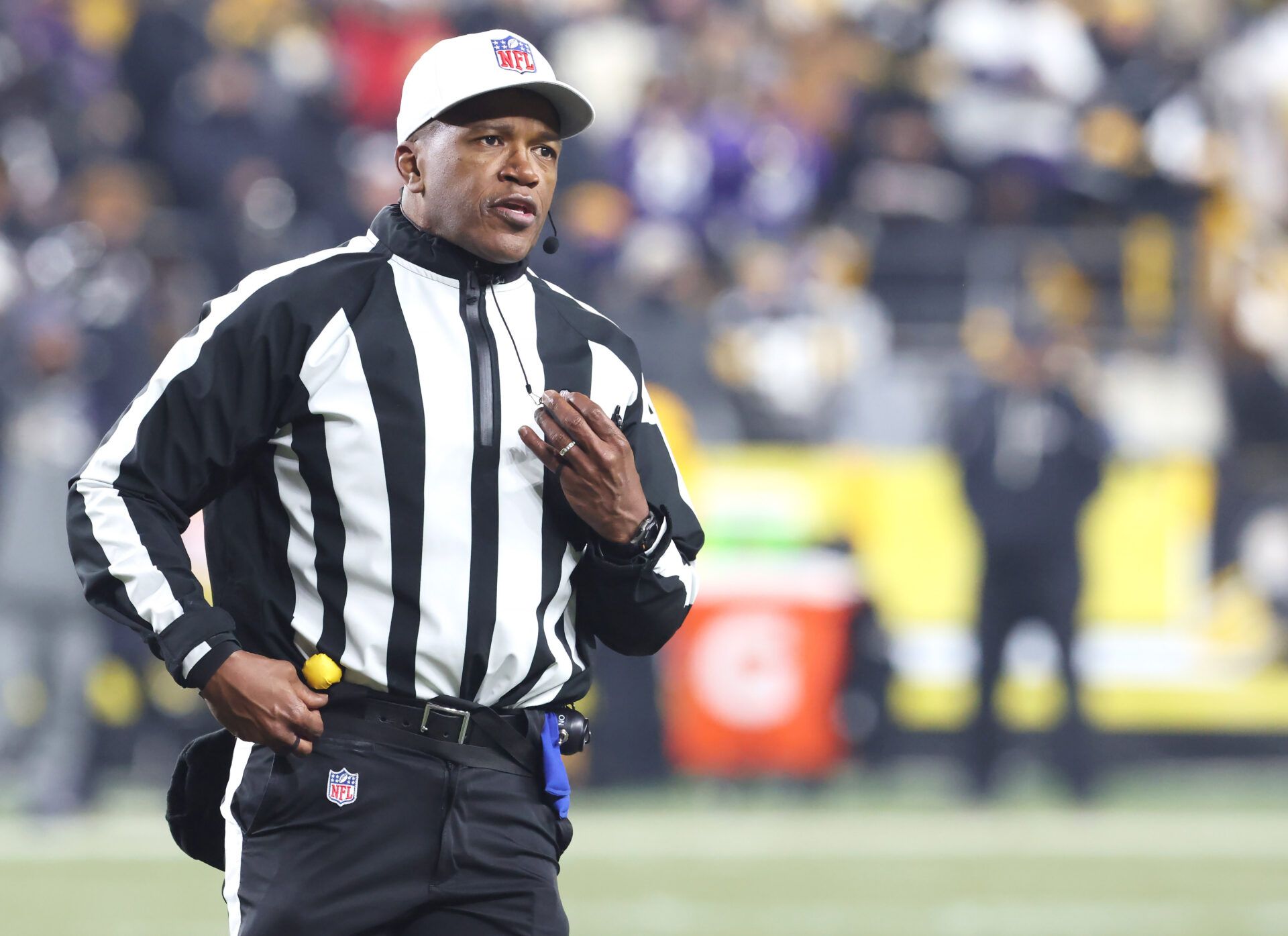
The NFL first implemented roughing the passer in 1940, as the league was adjusting the game to make it more passer-friendly. Eight decades later, no 15-yard penalty generates more postgame controversy or social media outrage.
Roughing the passer remains the most controversial call in the NFL, frustrating defenders who feel they’re being punished for playing football.
How Roughing the Passer Works (And Why It’s So Subjective)
In the 2025 regular season, officials called roughing the passer 94 times league-wide, averaging 2.94 penalties per team, per NFLPenalties.com. The Chicago Bears were flagged most often with nine such penalties. Understanding why the call remains so divisive requires looking beyond the rulebook language to how the rule is actually enforced.
In football, roughing the passer is a foul in which a defensive player makes illegal contact with the quarterback after the latter has thrown a forward pass. On a roughing the passer penalty, the defense will lose 15 yards of field position, along with giving the offense an automatic first down. Flagrant violations can result in ejection.
The rulebook spells out several specific infractions. Roughing will be called if, in the Referee’s judgment, a pass rusher clearly should have known that the ball had already left the passer’s hand before contact was made.
Defenders may only get up through the rusher’s first step after such a release (prior to the second step hitting the ground) to make contact. After that, they must attempt to avoid driving through the quarterback.
Other prohibited acts include forcible contact to the head or neck, hits at or below the knee when the quarterback has both feet on the ground, and landing on the passer with full body weight. That last provision is where things get complicated.
Prior to the 2018 NFL season, the NFL indicated that it would begin to increase enforcement of the roughing the passer penalty against defenders who make certain types of unnecessary, forcible contact with the quarterback.
The league added specific language about body weight and driving quarterbacks into the ground. Most notably, Clay Matthews III, then-linebacker for the Green Bay Packers, was flagged for roughing the passer three times in the Packers’ first three games of the season.
Matthews became the symbol of defender frustration. In the aftermath of said infractions, some argued that penalizing acts such as driving quarterbacks into the ground and landing on them with full body weight has made it exceptionally difficult for defenders to perform their jobs.
Critics pointed out that physics dictates where a 260-pound pass rusher lands after committing to a sack. Others commented that Matthews got penalized for an inability to defy physics.
The 2022 season brought another wave of controversy. Atlanta Falcons defensive lineman Grady Jarrett was penalized 15 yards for “unnecessarily” throwing Tampa Bay Buccaneers quarterback Tom Brady to the ground.
The following night, Kansas City Chiefs defensive lineman Chris Jones was flagged for landing on Las Vegas Raiders quarterback Derek Carr with his full body weight. Carr himself admitted that he thought that Jones made a good play and that his tackle was not egregious.
Those back-to-back controversies prompted ESPN’s Troy Aikman to suggest on air that the NFL should “take the dresses off” and let defenders do their jobs. The league’s competition committee met with owners to discuss the penalty, but little changed.
Why Replay Review Won’t Fix the Problem
NFL Competition Committee Chairman Rich McKay told Tom Pelissero of NFL Network that the replay assistant will now be permitted to correct certain types of incorrect calls for roughing the passer.
Starting with the 2024 season, they can decide if there is “clear and obvious” evidence that a defender did not make contact with the head or neck area of a quarterback on a roughing the passer call.
Notice the limitation. The replay assistant can review objective questions: Did the defender hit the helmet? Was it actually forcible contact to the head? McKay claims the league can use replay assistants for purely objective questions, such as whether or not a defender made contact with a quarterback’s helmet.
But the calls that generate the most outrage involve judgment, not objective facts. Did the defender “unnecessarily” drive the quarterback to the ground? Did he land with his “full body weight” when he could have avoided it? Was the contact excessive, given the circumstances? Replay can’t adjudicate those questions.
There’s another structural problem. The rulebook instructs officials to throw flags when in doubt about quarterback safety. And given that the rule expressly requires a flag to be thrown “when in doubt,” when would it ever be “clear and obvious” that there was no doubt about whether roughing happened? The standard for calling the penalty and the standard for overturning it work in opposite directions.
The league would rather deal with periodic criticism arising from phantom roughing calls than risk not having starting quarterbacks available to play in high-profile games. That’s the trade-off the NFL has accepted. Controversial flags are a feature, not a bug.
As for the common perception that star quarterbacks benefit disproportionately from roughing calls? The data doesn’t support it. Of QBs who have at least 1,250 dropbacks since 2015, Brady actually has the fourth-lowest Roughing the Passer calls per QB hit in the NFL at 3.94%. The “you can’t touch Brady” narrative was always more tribal grievance than statistical reality.
The NFL isn’t confused about what it’s doing. Quarterbacks are the product. They drive ratings, sell jerseys, and define franchises. Defenders can adjust their technique, find work elsewhere, or accept the occasional phantom flag as the cost of doing business in a passing league.
That calculation might frustrate purists who remember when football was played between the whistles. But the NFL has made its choice, and replay review was never designed to change it.