
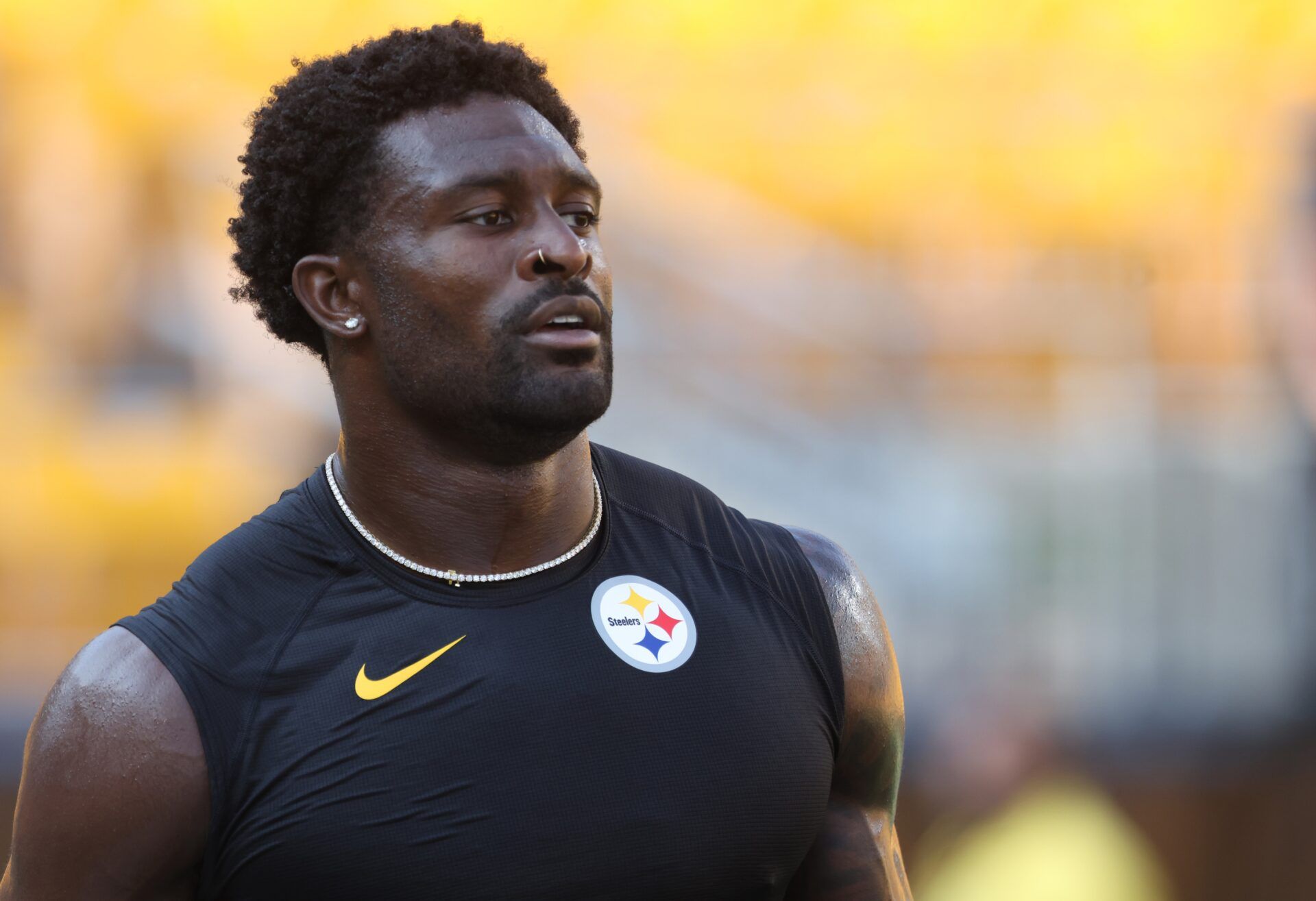
The Seattle Seahawks’ spring overhaul hit a dramatic turning point when the franchise parted ways with one of its most iconic offensive stars. In March 2025, the Seahawks traded DK Metcalf to the Pittsburgh Steelers, turning an NFC West headliner into the focal point of a revamped Steelers offense in dire need of a true game-changing receiver.
Why Did the Seahawks Trade DK Metcalf?
Metcalf was traded from the Seattle Seahawks to the Pittsburgh Steelers in March 2025, marking the end of a six-year tenure that featured three 1,000-yard seasons and two Pro Bowl nods. The blockbuster move was driven primarily by contract negotiations and diverging organizational priorities.
With Metcalf’s contract set to expire after the 2025 season, Seattle balked at matching the top-tier extension figures the star receiver demanded. At the same time, Metcalf was eager to join a contender built for an immediate playoff push. Pittsburgh, seeking a true WR1 to elevate its offense, acted quickly and aggressively to secure the deal, signaling its win-now intent while Seattle shifted focus toward a long-term roster reset.
Trade reports confirmed that Pittsburgh landed DK Metcalf, while Seattle received a 2025 second-round pick (No. 52), a sixth-rounder, and a seventh-rounder (No. 223) in return.
Soon after finalizing the trade, the Steelers signed Metcalf to a four-year, $132 million extension that included an $18 million raise on his 2025 salary and $60 million guaranteed in the first two seasons, cementing him among the NFL’s highest-paid receivers.
The deal sent shockwaves through both organizations. Seattle retooled its receiving corps around Jaxon Smith-Njigba and later signed Cooper Kupp to a three-year, $45 million contract following his release from the Rams. Pittsburgh, on the other hand, secured its long-term WR1 as part of an aggressive, win-now roster build.
In a follow-up move, Seattle packaged the No. 52 pick from Pittsburgh with its own No. 82 pick to trade up to No. 35, where it selected South Carolina safety Nick Emmanwori, further underscoring the team’s renewed defensive focus. The blockbuster trade ultimately illustrated two contrasting approaches: Seattle’s cap-conscious roster recalibration versus Pittsburgh’s determination to acquire elite playmakers at any cost.
Steelers’ Offense Changed After Metcalf’s Arrival
Metcalf’s arrival completely reshaped Pittsburgh’s passing-game dynamics. He immediately took over as the WR1, giving the Steelers a dominant physical presence who thrives in contested catches and creates separation off the line. His skill set fits seamlessly into Pittsburgh’s plan to revamp its offensive weapons and anchor the receiving corps around a true No. 1 target.
Reports at the time highlighted the Steelers’ willingness to overhaul their entire WR room, including trading George Pickens to the Cowboys, to commit both financially and structurally to Metcalf as their focal point.
From a tactical perspective, Metcalf’s presence forces defenses to adjust their coverage schemes. His vertical speed and ability to stretch the field dictate safety depth and open up diverse route opportunities for complementary receivers and tight ends. His contract structure underscores Pittsburgh’s commitment to keeping him at the core of their offense as they chase sustained postseason contention.
For Seattle, trading Metcalf reflected a broader philosophical shift. The franchise pivoted toward a more balanced offensive identity, bringing in Cooper Kupp while reshaping the quarterback and receiver hierarchy. The second-round pick acquired in the deal was strategically used to reinforce the defensive side of the roster.
The trade has settled into two distinct narratives that reflect different organizational priorities. Pittsburgh bet big on an elite boundary weapon, making him both the financial and schematic priority at receiver. At the same time, Seattle avoided a significant WR cap outlay, redistributed assets via the draft, and reshaped its offense with a combination of veteran leadership and young talent.
The final verdict will ultimately hinge on postseason performance, but the motivations and immediate impacts have become clear through the early portion of the 2024-25 season.
Seahawks Players’ Fantasy Outlooks for Week 9
Here’s what PFSN’s Kyle Soppe wrote on the Seahawks’ notable players’ fantasy outlooks for the Week 9 matchup against the Washington Commanders:
Sam Darnold
The volume isn’t quite the same, but you could have made a lot of money forecasting Sam Darnold to average more fantasy points per pass this season than last.
Fantasy Points Per Pass Attempt
- 2024 with Vikings: 0.53
- 2025 with Seahawks: 0.57
After a strong start to the season, Washington has struggled to create pressure without the courtesy of the blitz, and that means one of two things is likely to happen on Sunday night: (1) Darnold is comfortable in a clean pocket or (2) the Commanders are left vulnerable on the back-end as a result of needing to crowd the line of scrimmage.
Realistically, I’m OK with either result, but which adventure you believe is most likely for them to choose impacts where Darnold ranks among the pocket-locked QBs this week.
Sam Darnold Splits
- 2024, when blitzed: 66.4% complete and 133.6 rating
- 2025, when blitzed: 59.3% complete and 92.9 rating
- 2024, when not pressured: 73.7% complete, 8.2 yards per attempt
- 2025, when not pressured: 78.7% complete, 10.3 yards per attempt
With Seattle coming off the bye, I’m more bullish on Darnold in this spot than the industry norm and see him as a threat to the top 12 at the position, even without an expectation of any points on the ground.
Jaxon Smith-Njigba
We spent time this summer worrying about what a move out of the slot would mean for Jaxon Smith-Njigba, with Seattle moving on from the receivers they had banked on for years, thus elevating JSN into a truly featured role.
We nailed the “out of the slot” portion of that. The “worrying” part? That was silly.
Smith-Njigba’s slot usage has fallen from 77.4% of routes to 19.4%. The loss of those “easier” targets hasn’t mattered in the least.
His average depth of target is up 41.3% from a season ago, and it hasn’t stopped him from earning 10 looks per game. He had a 40-yard catch in each of his first six games this season and has scored in three straight, following his TD in Week 7 against the Texans with an easy dunk on the uprights all in one motion from his route, an impressive athletic feat for a six-footer wearing pads.
I think a 38.3% target share and a 46.3% receiving-yardage share (he has 819 receiving yards and is the only Seahawk at even 300) are probably high-water marks. I have a hard time not penciling in some regression, but even a bit of backtracking keeps him EASILY inside the top 10 the rest of the way.
He’s a matchup-proof alpha. The numbers are expected to continue piling up this week and moving forward, giving you great value based on his preseason ADP.
Whispers … He faces the Panthers in Week 17, giving him every chance to not only be the reason your team makes the playoffs, but the reason you win the whole thing.
Kenneth Walker III
This is an old man yelling at clouds situation, and guess what? The clouds? They never listen. Kenneth Walker has his weekly moments, but NFL coaches love consistency, and if anything, Walker has been a consistent detriment.
He’s pacing to finish as a 20th percentile running back in terms of rush gain rate, something he’s done every season of his career up to this point. There’s a reason that the Barry Sanderses of the world are considered special: that home run-seeking style is hard to pull off.
Walker has been held under four yards per carry in three straight, held out of the end zone in four straight, and has just five catches in six games since catching three balls in Week 1.
We can beg for more work, but he hasn’t really earned it. Giving him more work would encourage a style that has been a net negative for going on five seasons. There is raw talent here, no doubt, and maybe we get a taste of that this weekend. Or maybe we don’t.
The fact that we can’t count on him carries over to the coaching staff, and that’s why I have a hard time penciling him in for over 15 touches in any single game. The touch count is close enough to that of Zach Charbonnet, so I’ll continue to rank him a touch higher because I have to account for the potential of a splash play, but I don’t feel great about playing him as an RB2 this week. Or, to be honest, any week.
