
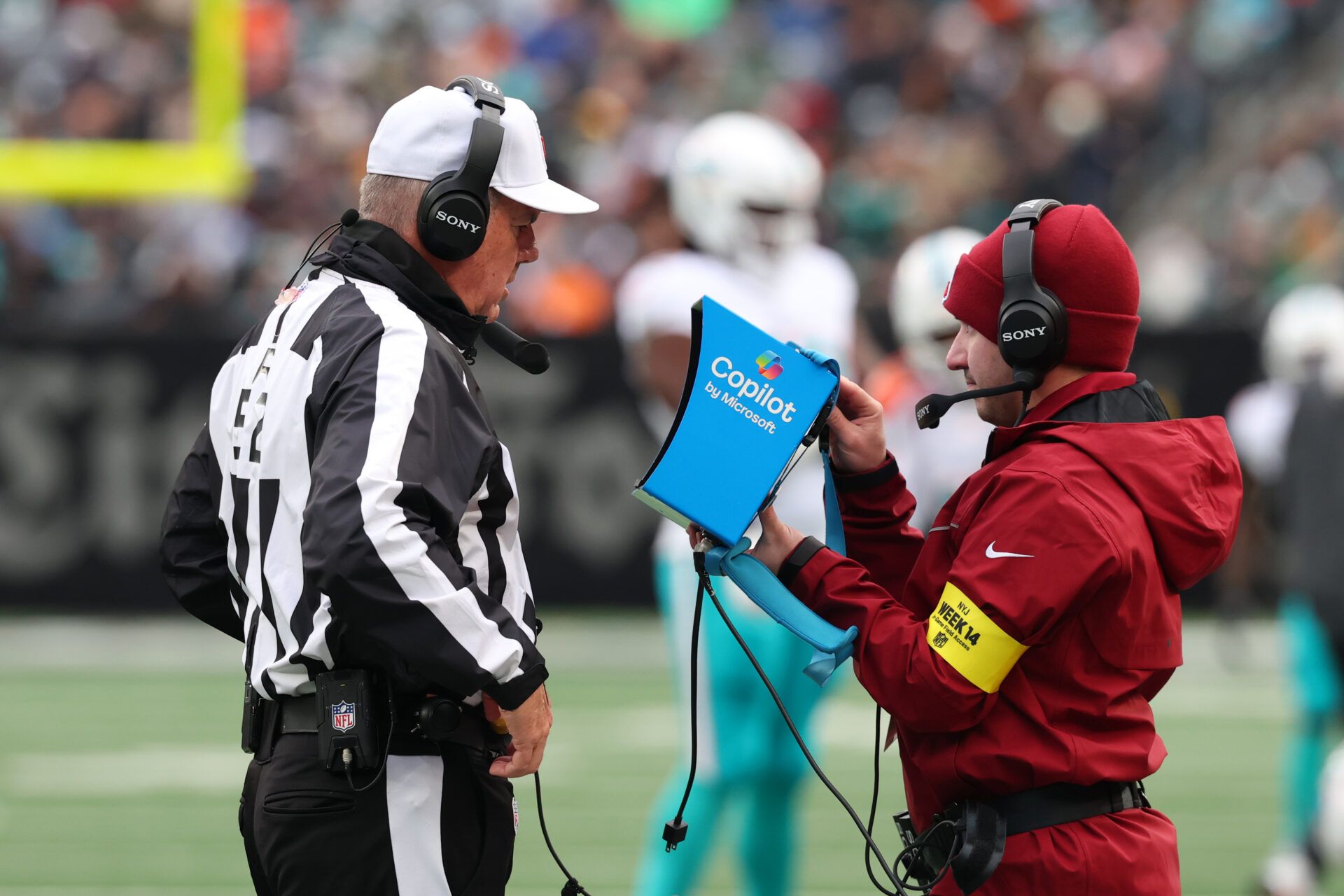
The NFL’s replay system operates on a principle that explains nearly every decision about what can and cannot be challenged: objectivity. Lines on a field don’t lie. A foot either touched the sideline or it didn’t. A knee either hit the turf before the fumble or it didn’t. The league trusts cameras to settle binary questions, but it still doesn’t trust them to second-guess judgment calls like holding or pass interference.
That line between objective and subjective has governed replay for more than two decades. And in 2025, the NFL is quietly starting to blur it.
How the Challenge System Works
Each team gets two challenges per game. Win at least one of those, and you earn a third. Before 2024, coaches needed both challenges to go their way to get that third opportunity, but the league loosened the requirement after the Detroit Lions proposed it.
Challenges require a timeout in reserve. Lose the challenge, lose the timeout. Win it, and you keep your timeout for later. Coaches must throw the red flag before the next snap, and they can’t challenge anything inside the final two minutes of either half. During that window, the replay booth in the stadium and the Art McNally GameDay Central command center in New York take over all reviews.
The stakes are real. Mike Tomlin learned that the hard way during a 2024 Monday Night Football matchup against the New York Giants. Tomlin challenged a George Pickens incompletion, believing it was a touchdown, even though the NFL’s replay assist system had already confirmed the call. Since scoring plays are automatically reviewed, coaches can’t challenge them. Tomlin’s flag cost Pittsburgh a timeout.
The reviewable list covers plays governed by lines: the sideline, goal line, line of scrimmage, and line to gain. Possession questions qualify too, including whether a pass was complete or incomplete, whether a fumble occurred, and who recovered a loose ball. Scoring plays and turnovers are automatically reviewed regardless of when they occur.
What cannot be challenged? Nearly all penalties. Holding, offsides, unnecessary roughness, false starts, illegal formations. These are judgment calls that officials make in real time, and the league has historically declined to give replay the authority to overrule them.
The one exception: illegal participation, meaning too many players on the field. That’s an objective, countable violation.
How 2025 Is Changing the Objective-Subjective Line
The 2025 season brought the most significant expansion of replay authority over penalties in years. For the first time, replay officials can now pick up flags for facemask, horse collar, tripping, hits on a defenseless player, and running into or roughing the kicker. They can review roughing-the-passer calls when the flag involves contact to the head or neck. The booth has also recently been given authority to review plays for unnecessary roughness near the sideline.
None of these can be challenged by coaches. The replay booth initiates all reviews, and only when clear and obvious video evidence exists. The league isn’t opening the door for coaches to challenge every borderline call. Instead, it’s giving New York officials the power to correct egregious mistakes before they decide games.
This expansion builds on changes from 2024, when the league added two new reviewable situations: whether a passer was down or out of bounds before throwing a pass, and whether the game clock expired before the snap. Both are objective questions that the previous system couldn’t address.
The NFL tried a broader approach once. In 2019, pass interference became reviewable after a blatant no-call in the NFC Championship Game helped the Los Angeles Rams beat the New Orleans Saints. The experiment lasted one season. Officials almost never overturned pass interference calls, and the inconsistency frustrated everyone. The rule wasn’t renewed for 2020.
The lesson the league took from that failure shapes its current approach: expand replay only where video can provide definitive answers, not where it invites more subjective interpretation.
Coaches still control challenges for possession, boundary lines, and first-down spots. But the booth’s growing authority means fewer game-altering mistakes will slip through. Whether a defender actually grabbed the facemask or a horse-collar tackle actually occurred are questions video can answer cleanly. The 2025 rules reflect the NFL’s bet that expanding replay in those areas won’t create the chaos the pass interference experiment did.
The system remains imperfect. A receiver can get mugged on a route with no flag, and no challenge will fix it. But the gap between what cameras can see and what officials can correct is narrowing, one objective call at a time.