
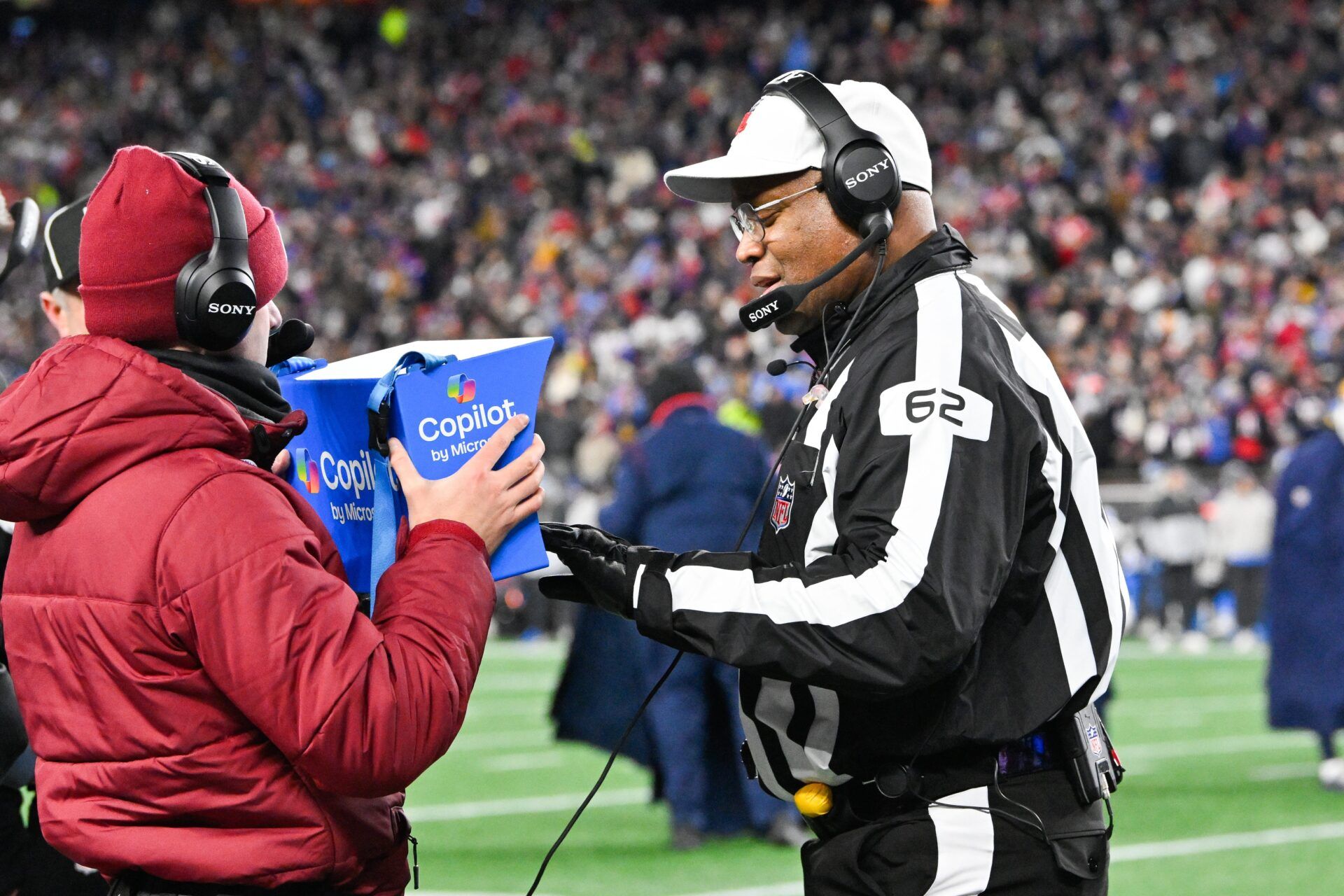
The NFL won’t be handing ball-spotting duties to a computer anytime soon, and Troy Vincent wants fans to understand why. In a conversation with PFSN during Super Bowl 60’s media week, the league’s executive vice president of football operations drew a clear philosophical line: technology can assist officials, but the moment of forward progress will always require a human being standing over the pile, making a call.
“You have to keep in mind that you still have a human element [that] will always exist,” Vincent said. “Where’s the ball spotted and where’s the progress stop?”

Why the NFL Says Perfect Ball Tracking Still Isn’t Enough
Most of the public debate treats this as a technology problem waiting on a technology solution. Get the chip accurate enough, add enough cameras, and the machines can take over. Vincent rejects that framing. His argument isn’t that the tech is too primitive. It’s that even flawless ball-location data only solves part of the equation. When forward progress stopped and where the relevant body part hit the ground are judgment calls that can’t be reduced to coordinates.
“Once the ball [is] placed, now all the technology [works],” Vincent said, describing how the league used 17 virtual measurements during the regular season with the Hawk-Eye system. But he pushed back on the notion that the system was running on every snap: “There were people that actually thought that there was a virtual measurement on every snap, and that’s not the case.”
The NFL confirmed the Hawk-Eye system as its primary line-to-gain measurement tool for the 2025 season, deploying six 8K cameras across all 30 stadiums to replace the chain gang. But the system still depends on officials placing the ball first. Hawk-Eye measures distance after a human spots the football. It doesn’t tell the official where to put it.
Sony Hawk-Eye’s North America commercial director Justin Goltz told Front Office Sports the league is targeting 2030 for potential automated ball-spotting capability, calling it “maybe one of the hardest problems to solve in sports.”
READ MORE: Super Bowl 60 Predictions: Predicting the Winner, Final Score, MVP, and More
An NFL official speaking alongside Vincent reinforced the point: “The chip in the ball married with optical tracking can help get better… but that’s only part of the equation.” On forward progress plays, knowing the ball’s absolute location with perfect precision still “isn’t enough.” Punt tracking, where the ball’s location in space is all that matters, works well. A quarterback sneak into a wall of bodies is a different animal.
What the NFL Has Tested With the Chip in the Ball
That same official also offered a revealing detail about the league’s experimentation with football sensors. When asked whether chips could be placed at both ends of the ball rather than just the center, he explained the NFL has already tested multiple chips.
“We’ve tested multiple chips in the ball,” the official said. “You don’t actually need that if you have a very precise chip. If you have orientation, you can do math and know where the nose of the football would be.”
That’s a notable admission. The RFID chip currently embedded in every NFL game ball, provided by Zebra Technologies, has a margin of error of up to 6 inches, according to Zebra. That’s more than half the length of a football. Knowing the ball’s orientation could theoretically narrow that gap, but the official framed the improvement as long-term and supplementary.
“I think it will be an input in the long term to help the process, but it can never be the process because there are those other elements that go into spotting the football,” the official said.
MORE: Conservatives Call for Boycott of Super Bowl 60 Over Bad Bunny’s Halftime Show: ‘ENOUGH IS ENOUGH’
That word, “input,” captures the NFL’s position better than anything else. Technology is welcome as a tool. It will never be the decision-maker. For a league that watched tennis eliminate line judges and MLB approve automated ball-strike challenges for 2026, Vincent’s stance amounts to a declaration that football is fundamentally different. The physicality, the pile, the obscured ball, the subjective nature of forward progress: all of it creates a problem that cameras and chips can improve but not solve.
Whether fans frustrated by controversial playoff spots accept that answer is another question entirely. But Vincent isn’t hedging. He’s telling you the human isn’t going anywhere.