
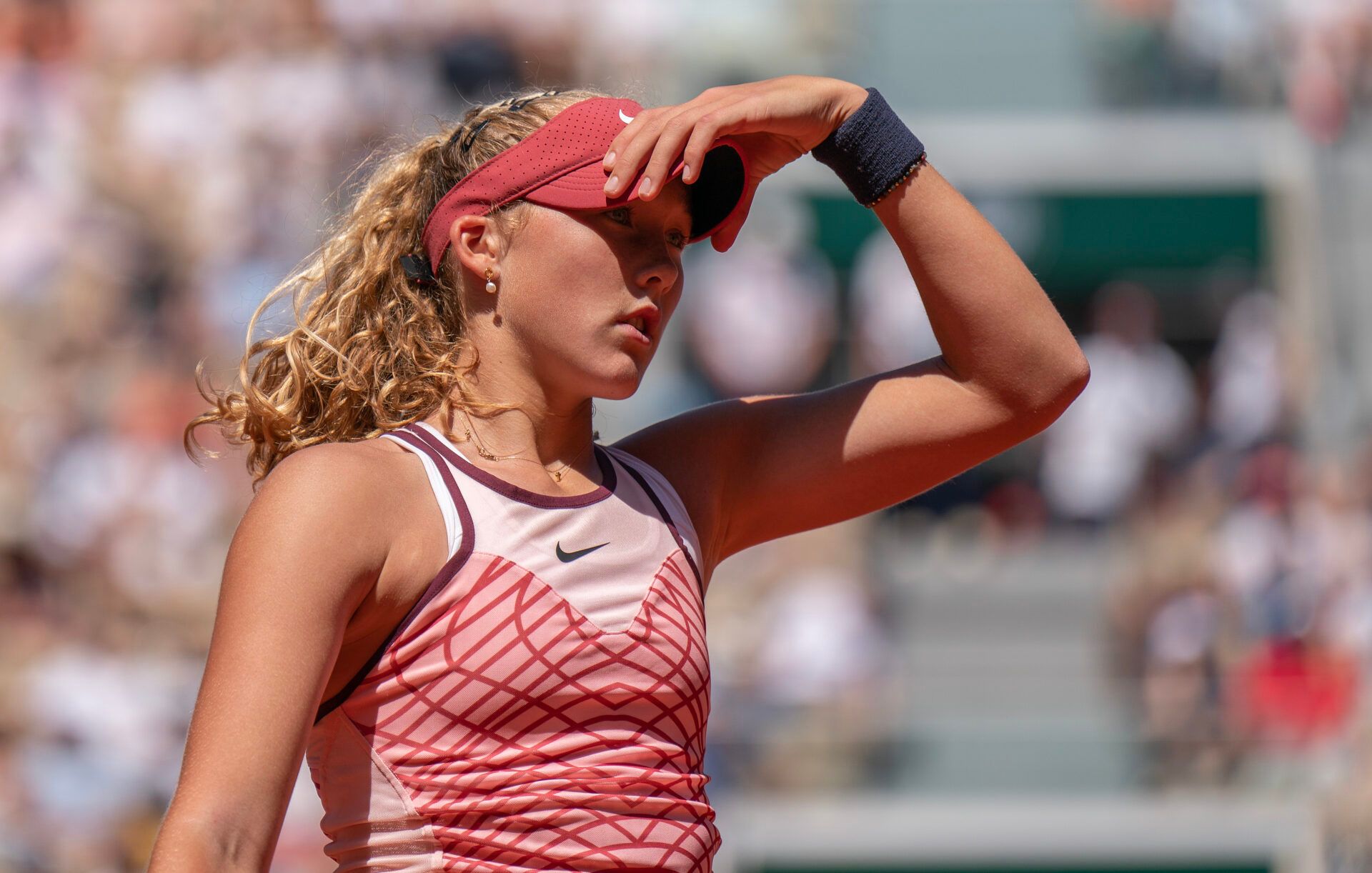
The controversy surrounding Electronic Line Calling (ELC) on clay courts has reached a boiling point at the Madrid Open, with Mirra Andreeva becoming the latest player to speak out. Following a heavily disputed automated call during her recent match, the teenager engaged in a tense argument with the chair umpire. She demanded that humans be allowed to override the technology, as top players, including Alexander Zverev and Elena Rybakina, are losing faith in the automated system’s accuracy on the dirt.
Mirra Andreeva Demands Human Overrides for ELC on Clay
On Thursday, Andreeva edged past Hailey Baptiste 6-4, 7-6 (8) to reach the Madrid Open final. During a crucial moment in the match, she was left stunned when the automated system called a ball “in” despite a clear physical mark indicating it was wide. Aware that the umpire was completely reliant on the machine, Andreeva still pleaded her case, asking the chair umpire: “I understand the decision can’t be overturned, but what can we do as players?”
Following the match, the Russian made her position on the matter clear, advocating for a hybrid system in which umpires can intervene when the technology clearly fails.
“I looked at the mark, and it was at least five centimeters out. … If you ask me, I think it would be ideal, especially on clay, if the umpire could come down and check the mark themselves. That would make a lot more sense to me,” she said.
Mirra Andreeva commented on the ELC incident in the match against Hailey Baptiste in Madrid:
“If you ask me, I think it would be ideal, especially on clay, if the umpire could come down and check the mark themselves. That would make a lot more sense to me.”
[BB Tennis] pic.twitter.com/cutEntM3je
— til polarity’s end 🎾⚡#SpallettiEra⚡⚫⚪ (@lildarkcage) April 30, 2026
The inability to challenge obvious errors has left players feeling helpless. “But if it happens on a tiebreak, the umpire said you just have to accept it and move on,” Andreeva added. “And I’m like, ‘OK, I’ll accept it and move on … but afterwards I think I’ll go and have a word with someone.'”
How Automated Line Calling Has Become a System-Wide Problem
The debate over automated calling has been brewing for months. Starting last year, ELC became compulsory across all ATP Tour events, phasing out human line judges.
Last year in Madrid and Stuttgart, respectively, Zverev and Aryna Sabalenka were handed unsportsmanlike conduct warnings for pulling out their smartphones during matches to photograph disputed ball marks after the chair umpires refused to manually inspect the clay.
However, in Sabalenka’s case, she was protesting a human error after the chair umpire, Miriam Bley, manually checked the mark and agreed with a line judge’s incorrect “out” call.
Sabalenka admitted she still prefers the machines. She acknowledged the ELC made an “obvious” mistake for Zverev in Madrid but called her Stuttgart situation much worse.
“My situation was much worse because the referee actually got down, checked the mark, and called it out, where it was obviously in,” Sabalenka explained. “Right now I prefer the Hawk-Eye system. I trust it more with most of the referees. … I think maybe it’s better, so less tension between the player and the referee.”
Earlier in the Madrid Open, world No. 2 Rybakina furiously demanded the umpire check a missed call during the second set, saying, “Are you kidding me? This is not a joke. The system is wrong. … I won’t trust it at all, because there was no mark even close to what the TV showed.”
Meanwhile, the only Grand Slam tournament refusing ELC is the French Open, which argues that manually checking physical marks is the only accurate method for clay courts. This recent chaos in Madrid seems to be proving Roland Garros right.
