
While the Davis Cup and Billie Jean King Cup have continued to captivate fans even days after the start of the North American hard-court swing, another eagerly awaited team event is around the corner. The 2025 Laver Cup will run from September 19 and feature a star-studded lineup. With excitement building around the event, understanding its format is essential, and here’s everything you need to know.

How Does the Format of the 2025 Laver Cup Look?
The Laver Cup’s unique format adds extra excitement. The eighth edition of the event in San Francisco will see Team Europe, guided by new captain Yannick Noah, face off against Team USA, led by fellow new captain Andre Agassi. The tournament unfolds over three days across five thrilling sessions.
View this post on Instagram
The tournament contests singles and doubles matches in best-of-three sets with ad scoring. If the first two sets are split, the third set is played as a 10-point match tiebreak. Each player competes in at least one singles match in the opening two days, but is limited to two singles matches total. In fact, a minimum of four players must play doubles, with no doubles combination repeated.
The tournament also features an intriguing rule: teams must announce their lineups a day before the match day. Friday’s lineup is revealed Thursday afternoon, while Saturday’s and Sunday’s lineups are announced an hour after play concludes the previous day. Moreover, the match-ups are finalized by exchanging lineup cards between the captains, Noah and Agassi.
What Would Be the Squads for the 2025 Laver Cup?
The Laver Cup grants automatic spots to the three top-ranked players from Europe and the World, according to ATP singles rankings after Roland-Garros. Team Europe’s 2025 roster includes World No. 1 Carlos Alcaraz, World No. 3 Alexander Zverev, World No. 11 Holger Rune, and World No. 13 Casper Ruud, aiming to extend their five-title legacy.
Moreover, debutant Jakub Mensik and last year’s alternate Flavio Cobolli would add much-needed depth to the squad.
View this post on Instagram
Two-time champions Team World also present a formidable lineup, spearheaded by World No. 5 Taylor Fritz and World No. 8 Alex de Minaur. Francisco Cerundolo, Alex Michelsen, Joao Fonseca, and Reilly Opelka add depth and versatility to the squad.
Another vital element for both squads will be their alternates, with Czech Tomas Machac joining Team Europe and American Jenson Brooksby joining Team World. They will be involved in all team activities and are eligible to replace any sidelined player during the three-day contest.
Who Wins the Laver Cup?
While the format is a defining feature of the tournament, other elements make the Laver Cup equally compelling.
The scoring system in this three-day showdown adds plenty of intrigue. A win on Friday counts as one point, Saturday as two, and Sunday as three. The first team to reach 13 points out of 24 claims the Laver Cup. If the score is tied at 12-all, a decisive doubles match with ad scoring and a tiebreak determines the winner.
Are Laver Cup Results Included in Official Head-to-Head?
As a certified ATP tournament, the Laver Cup records all match results in official player stats. Although no ranking points are awarded, each match affects players’ head-to-head records.
Who Has the Most Laver Cup Titles?
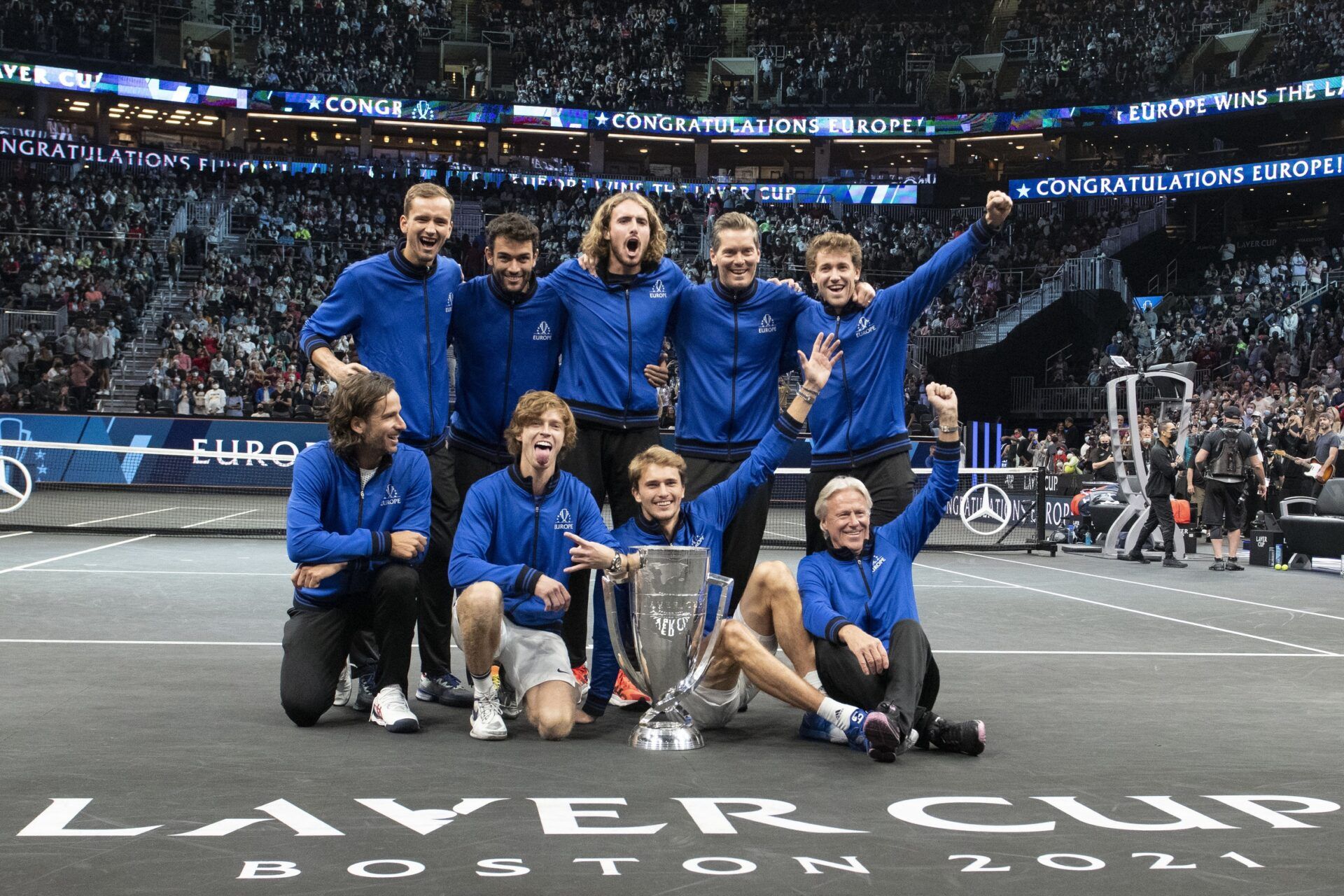
A look at the tournament’s history shows Team Europe’s outright dominance over the men in red. In the seven editions so far, they have claimed the title five times, including the inaugural event in Prague (2017), followed by triumphs in Chicago (2018), Geneva (2019), Boston (2021), and most recently in Berlin (2024).
Meanwhile, Team World, despite winning the event twice, have largely struggled against the men in blue. They broke through in London in 2022 and successfully defended the title in Vancouver in 2023.
What Else Should You Know About the Laver Cup?
The Laver Cup takes place on one hard court in either a retractable-roof stadium or indoor arena, alternating locations between Europe and the rest of the world. Players earn appearance fees based on ATP rankings post-Roland-Garros, and each member of the winning team gets $250,000. However, nothing is awarded to the losing team.
