
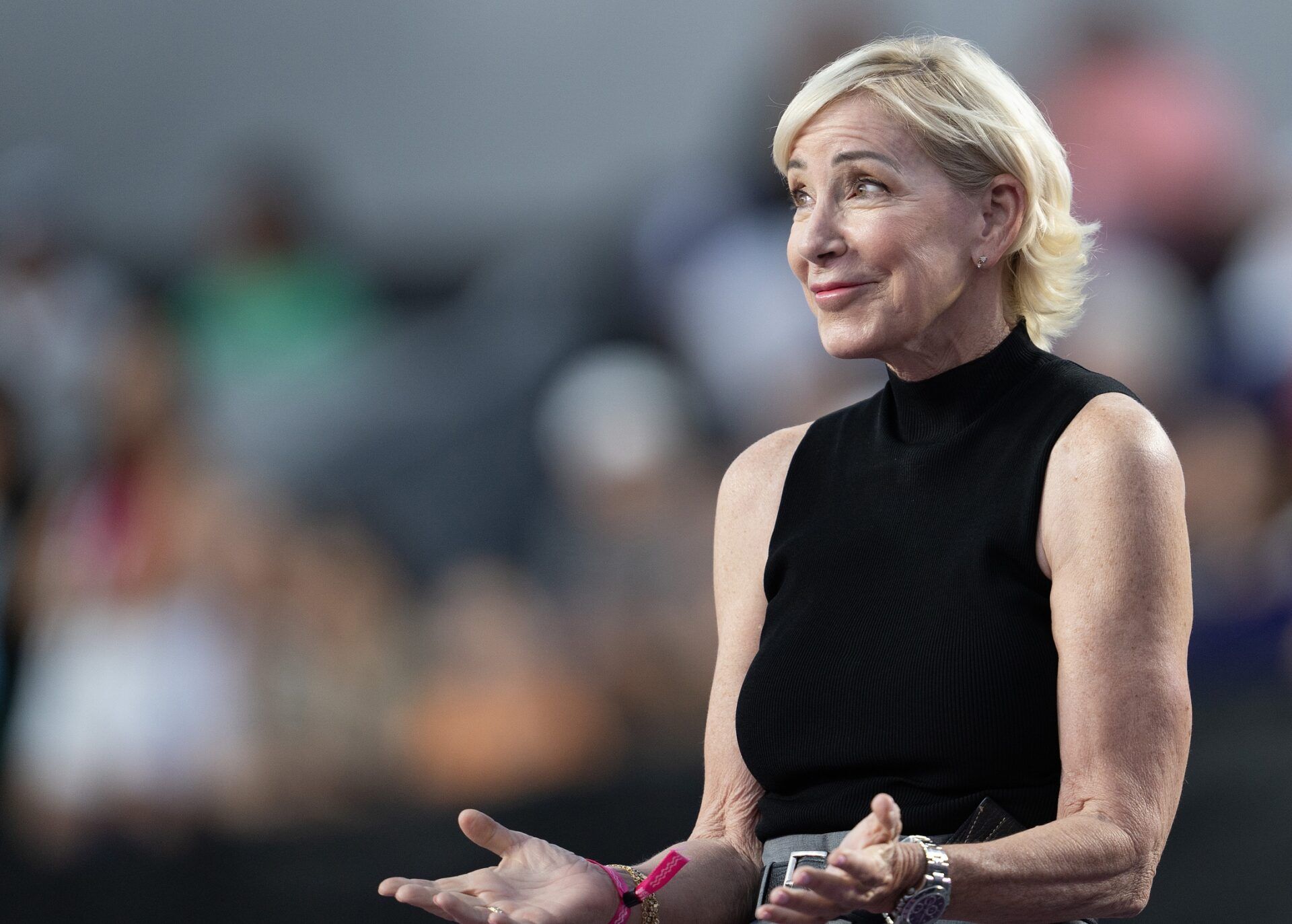
Tennis fans were quick to point fingers at Chris Evert during a dramatic US Open showdown, but they got the wrong target.
The tennis legend found herself defending against false accusations of biased commentary during Taylor Townsend’s intense three-set battle with Barbora Krejčíková, which the Czech player won 1-6, 7-6 (13), 6-3.

How Did Chris Evert Respond to Allegations of Bias in Favor of US Athlete Taylor Townsend?
The controversy started when Eric Barnes, a user on X, slammed the eighteen-time Grand Slam singles champion for what he perceived as unfair treatment of Krejčíková.
“Chris, I loved watching you, but the way you’re commenting about the CZE girl is just evil,” he wrote on the social media platform. “We know your bias is with Townsend, but try to mask it, would you?”
Evert replied promptly, making it crystal clear that Barnes had the wrong person entirely. “I AM NOT COMMENTATING THAT MATCH!” wrote the 70-year-old.
I AM NOT COMMENTATING THAT MATCH!!!!!!!!🙄 https://t.co/8odXDl75fe
— Chris Evert (@ChrissieEvert) September 1, 2025
The mix-up became even clearer when another user pointed out that the commentator was, in fact, former top-10 player CoCo Vandeweghe and not Evert. The user ‘TedB’ wrote, “That was CoCo. She is a bit snarky. Not the class act that Chrissy is.”
Despite retiring from professional tennis nearly 36 years ago, Evert has stayed connected to the sport through commentary and is usually brought on board to share her insights during majors.
Why Has Chris Evert Faced Commentary Criticism at Previous Tournaments?
While this particular accusation was misplaced, Evert has genuinely faced scrutiny for her commentary work at previous events. These incidents show why some fans might be quick to assume she’s involved in controversial broadcasts.
At last year’s US Open, Evert drew criticism for claiming Karolína Muchová, who made the semifinals, “plays like a guy”. “She plays like a guy. She wants to play like a guy. The guys have bigger serves than the women, they have better volleys for the most part, they move a little bit better,” Evert said.
The remark sparked a backlash from players like Ons Jabeur and Nick Kyrgios, who criticized it as gender stereotyping. Evert later apologized for her “delivery” and clarified that she did not intend to offend.
This year brought fresh controversy during the French Open final between Aryna Sabalenka and Coco Gauff. Evert faced backlash for her allegedly repetitive remarks throughout the broadcast. Some fans also accused her of being biased against Sabalenka in that encounter, which Coco won to seal her second major trophy.
The criticism continued at Wimbledon, where Evert came under fire for making assumptions about Emma Raducanu crushing over an ATP star during the Brit’s third-round encounter against World No. 1 Sabalenka.
Fans also called her out for her subpar commentary during the Wimbledon semifinal clash between World No. 1 Sabalenka and American tennis sensation Amanda Anisimova. “Chris Evert giving excellent advice to Anisimova: ‘Don’t make unforced errors.’ If only Amanda would have thought of that! Genius!” one fan quipped sarcastically.
The backlash intensified from there. Viewers piled on with sharper criticism of her broadcast style. “My God, get Chris Evert off the air. She’s fangirling and simping so hard for Sabalenka, it’s sad,” one fan wrote. Other fans mocked Evert for offering what they felt was obvious advice to Anisimova during that match.
These recurring controversies help explain why some tennis fans might quickly assume Evert is behind any questionable commentary. While Evert remains a pioneering figure in the sport, her transition to the commentary booth has consistently divided opinion. For many viewers, her insights carry the authority of a legend. For others, her delivery and remarks too frequently cross into bias, clichés, or unnecessary speculation.
