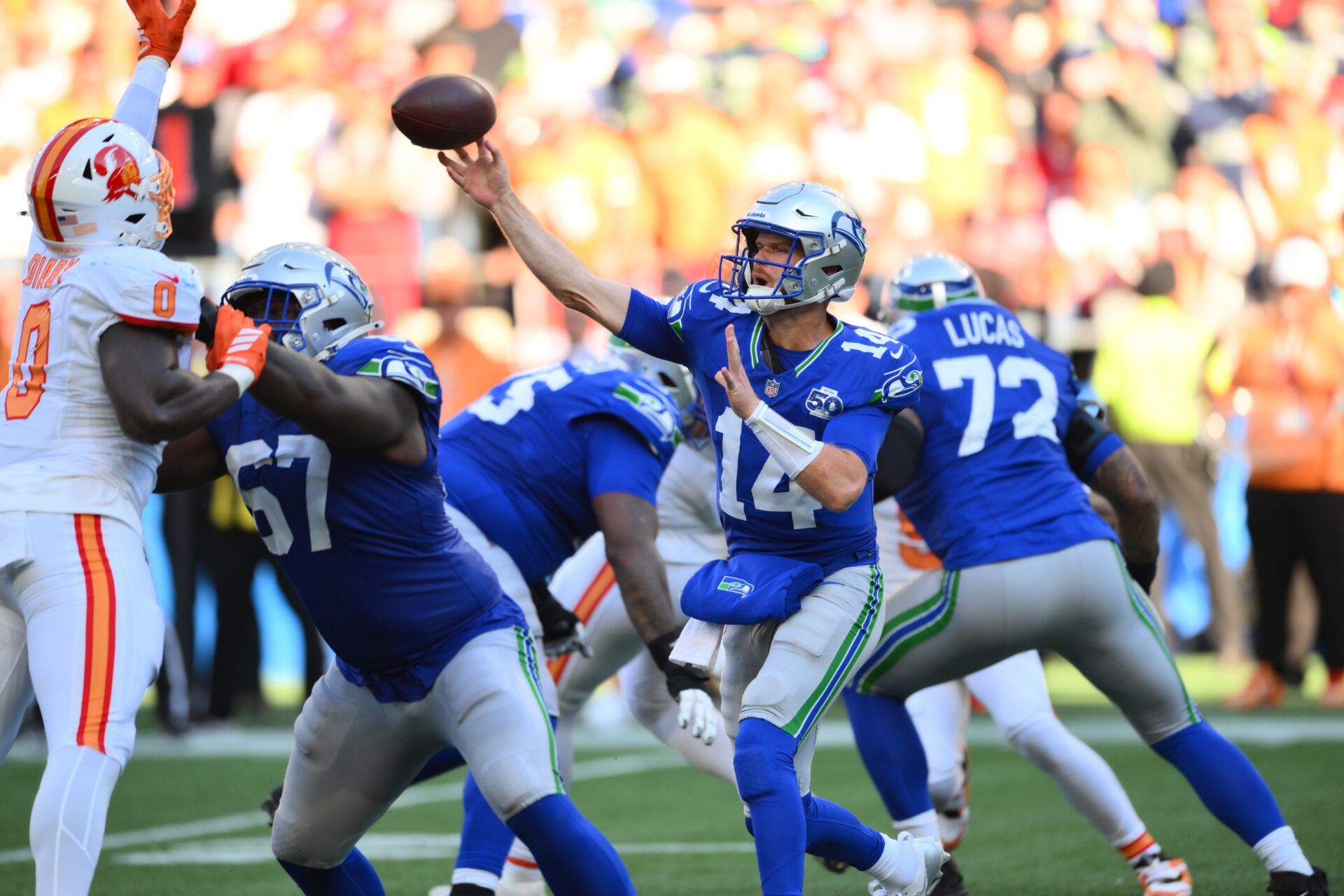
Sam Darnold’s record-shattering performance for the Seahawks wasn’t enough to keep Seattle from falling in a 38-35 shootout to the Buccaneers, but the data from PFSN reveals something far more meaningful than a single result.
Darnold put up the highest QB Impact score of any player this week, an 87.4 — the best of his 81-game career. Despite the loss, PFSN’s advanced metrics make one thing clear: Darnold is elevating Seattle’s offense and providing the kind of value that the scoreboard alone can’t tell.

How Did Sam Darnold Deliver an Elite Performance?
Darnold’s day wasn’t just good by Seattle standards; it was elite by any NFL measure. His 0.74 EPA per dropback led the league this week, and he sustained a 0.66 EPA per dropback even when pressured, which is his second-best pressured EPA rate since 2019, trailing only a mark he set two weeks prior against New Orleans.
These numbers highlight rare efficiency, especially given how pressure usually disrupts quarterback play and shrinks passing windows. According to PFSN metrics, very few quarterbacks have produced at this level under duress.
Complementing these elite efficiency numbers, Darnold completed 28 of 34 passes for 341 yards and four touchdowns, turning almost every opportunity into positive yardage. The QB Impact score from PFSN, which combines efficiency, situational context, and decision-making, awarded him an 87.4, ranking first this week and marking the highest grade of his career.
The PFSN metric identified that Darnold not only executed well when given time but also thrived under pressure, a domain where many otherwise high-performing passers see dramatic drop-offs.
What makes this even more interesting is the historical rarity of what unfolded: Seattle became just the fourth team since 2023 to lose while their quarterback posted the highest QBi grade for the week. This points to a deeper truth in PFSN’s data; sometimes, even a career-best showing at the game’s most important position isn’t enough when the supporting cast can’t match that excellence.
MORE: PFSN’s QB Impact Dashboard
Notably, in those three other instances (the Jets in Week 1 this year with Justin Fields, the Bengals in Week 5 of 2024 with Joe Burrow, and the Chargers in Week 10 of 2023 with Justin Herbert), unique defensive breakdowns or turnovers made the difference, much like Seattle’s defensive struggles and late-game interception did on Sunday.
Head coach Mike Macdonald shouldered the blame for Seattle’s defensive collapse: “Our guys played extremely hard, fought all the way to the end. I told the team, ‘This game is my responsibility, okay? You’ve got to give Tampa Bay a lot of credit, but I have to be better with our defensive gameplan, our execution, and how we call it.’”
Tampa Bay’s 426 yards of offense, 370 of them through the air, were the most surrendered by a Macdonald-coached unit since he took over, further highlighting just how much Darnold had to overcome to keep the Seahawks in the game. Seattle was staggering by the final whistle, down to six fully healthy defensive backs and missing several starters on defense.
The #Bucs–#Seahawks game on Sunday was the first in NFL history where both QBs threw for 325+ yards and completed 80% or more of their passes.
• Baker Mayfield: 29/33 (87.9%) for 379 yds
• Sam Darnold: 28/34 (82.4%) for 341 yds
The former #1 & #3 pick in the 2018 NFL Draft. https://t.co/NaJxezkneS pic.twitter.com/GRNb09loxp
— Ari Meirov (@MySportsUpdate) October 6, 2025
In this context, Darnold’s output stands out even more: He was matching a red-hot Bucs offense stride for stride while Seattle’s defense was, by necessity, putting backups in the toughest possible matchups.
The decisive play came with under a minute left, after Darnold’s interception set up Tampa Bay’s game-winning field goal. Darnold called it “completely on me,” noting he tried to throw the ball away under pressure from Antoine Winfield Jr., but ultimately, he acknowledged that protecting the ball in that situation is non-negotiable.
Still, PFSN’s data demonstrates that while quarterbacks are often judged harshly for singular late-game mistakes, consistent impact throughout a game can (and should) tell a different story. Darnold’s combination of passing efficiency, poise under pressure, and leading the offense to 35 points justifies PFSN’s high rating, even as the Seahawks dropped to 3-2.
So, what does PFSN’s unique data tell us that the box score cannot? Most weeks, a performance like Darnold’s would nearly guarantee a win, but football is inherently unpredictable. PFSN’s metrics highlight just how well Darnold played, under circumstances that would have undone most quarterbacks.
For Seattle, this game is a data point that shouldn’t be lost in the noise of a tough defeat, because if Darnold can keep producing like this, those losses will be rare, and the Seahawks’ upside remains as high as any team in the league.