
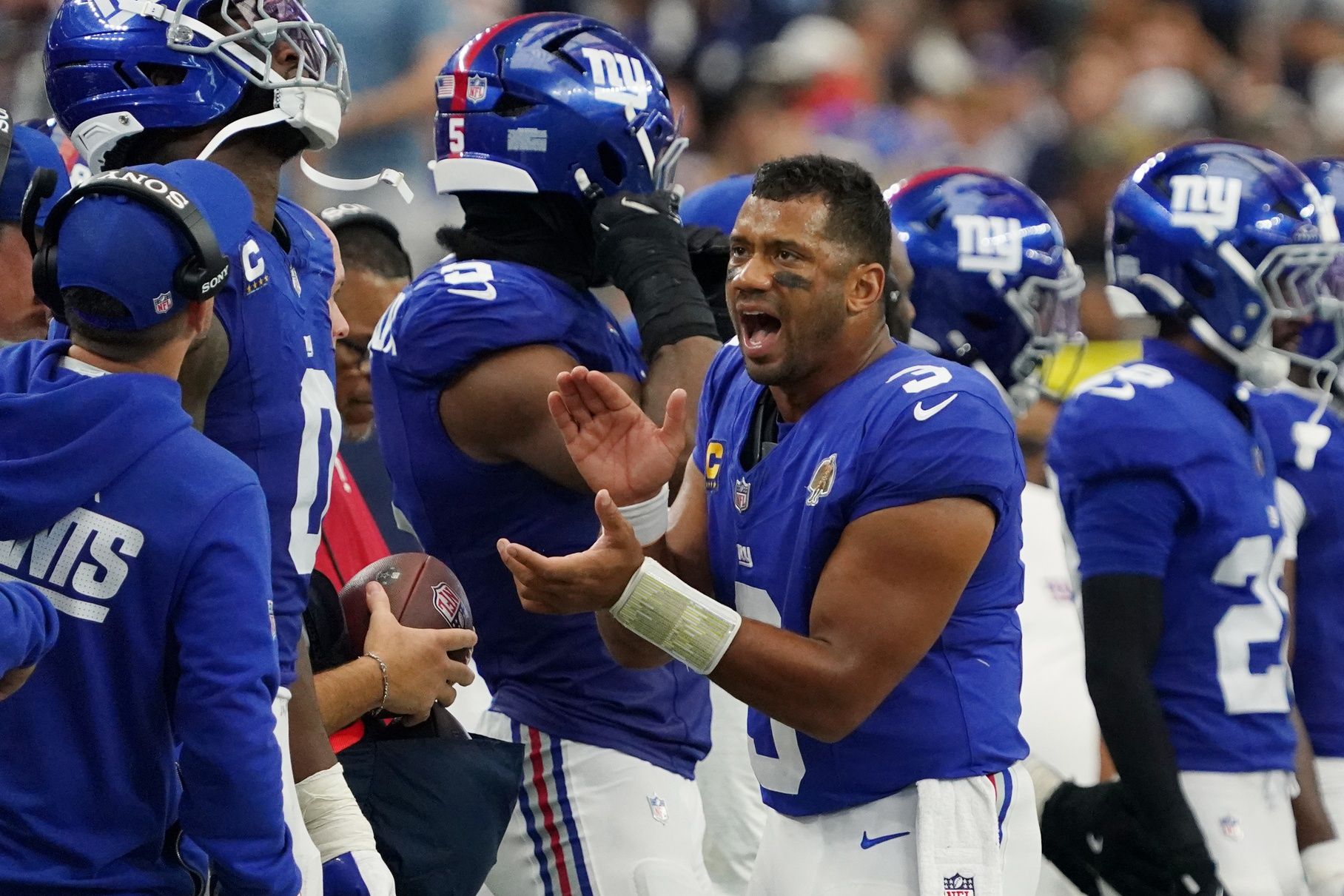
While Kansas City Chiefs QB Patrick Mahomes usually inspires visions of fourth-quarter heroics, it is New York Giants QB Russell Wilson who enters Week 3 as the NFL’s most reliable late-game passer this season.
According to exclusive PFSN tracking, Wilson leads the league with a pristine 1.00 EPA per dropback in one-score fourth-quarter and overtime situations. Mahomes, by contrast, sits all the way down at 25th, producing -0.27 EPA per dropback in those same scenarios. The data realigns how we think about end-of-game execution and which quarterbacks have moved the needle when it matters most this season.
Can Russell Wilson Give the Giants A Chance Against Patrick Mahomes’ Chiefs?
PFSN’s proprietary QBi metric puts fresh context around quarterback play by combining passing and rushing outputs with specific weighting. The formula not only values stable inputs like clean-pocket efficiency and designed run success, but it also layers in a “clutch” component. That is where Wilson currently separates himself from the rest of the league. Across late-game action in close contests, he has been flawless at finishing drives and sustaining efficiency, earning the highest possible clutch score within the dashboard.
The narrative around Wilson has shifted over the past few seasons, with many arguing he was past his prime. Yet PFSN’s data indicates otherwise when the game is on the line. That 1.00 EPA per dropback means each of his late-game actions is directly contributing to a point or more for his offense on average. In statistical terms, that level of impact is unprecedented sustained efficiency over a meaningful sample.
Mahomes, on the other hand, has struggled in the same spots this year. His -0.27 EPA per dropback suggests that drives stall or regress with him at the wheel late in competitive games so far. While Kansas City’s offense has often thrived in aggregate, the situational data paints a different picture. Teams now have evidence that keeping things close enhances the chances of limiting Mahomes’ effectiveness.
To put these numbers in context, these rankings are very different from what we saw last season. During the 2024 regular season, Mahomes ranked ninth in this clutch stat, while Wilson ranked 29th with the Pittsburgh Steelers. The fact that they have flip-flopped is interesting, although it’s worth noting that it’s obviously a small sample size.
QBi gives fans and teams a better way to measure quarterback play than rating systems rooted strictly in completion percentage or passer rating. By balancing efficiency with context, QBi reveals a truer picture of who excels situationally. Importantly, not all plays count the same. A 10-yard throw on first-and-10 in the second quarter does not carry the same weight as a 10-yard strike on third-and-8 in crunch time.
That is what sets Wilson’s start apart. He has shown stability in clean-pocket throws, paired with strong decision-making in late-down situations and high-leverage drives. Meanwhile, his designed rushes, the plays scripted specifically to put the ball in his hands on the ground, have succeeded at the type of consistency that PFSN’s weighting system rewards. When adding the clutch multiplier, his grade rises above peers who might look better in box score stats but come up short in closing moments.
MORE: PFSN’s 2025 NFL QB Impact Grades
Mahomes’ ranking near the bottom of the late-game list does not mean he is playing poorly overall. In broader QBi, he still grades out as one of the league’s better quarterbacks. But PFSN data emphasizes specific areas where output is lagging. His pressure performance has been inconsistent, and his behavior in must-pass situations has tilted toward negative EPA. These trends matter because defenses are more comfortable sending pressure late against a player who has not punished it with precision in close contests this season.
Beyond the individual comparison, PFSN’s focus on stable factors shows how fragile win probability can be when quarterbacks stumble late. Teams leaning on defense alone cannot expect to sustain wins if their quarterback’s QBi evaporates in the clutch. Wilson’s steadiness signals the Giants’ ability to finish drives in pivotal moments, while Mahomes’ struggles open a new angle for opponents planning to keep Kansas City contained.
The fact that Wilson and Mahomes are on opposite ends of the spectrum in this stat also provides some added intrigue entering the Week 3 Giants-Chiefs matchup on Sunday Night Football.
As the season unfolds, QBi leaderboards will sharpen in value. To qualify, quarterbacks must average at least 15 plays per game and play in half their team’s contests. This ensures the sample sizes behind the grades are meaningful.