
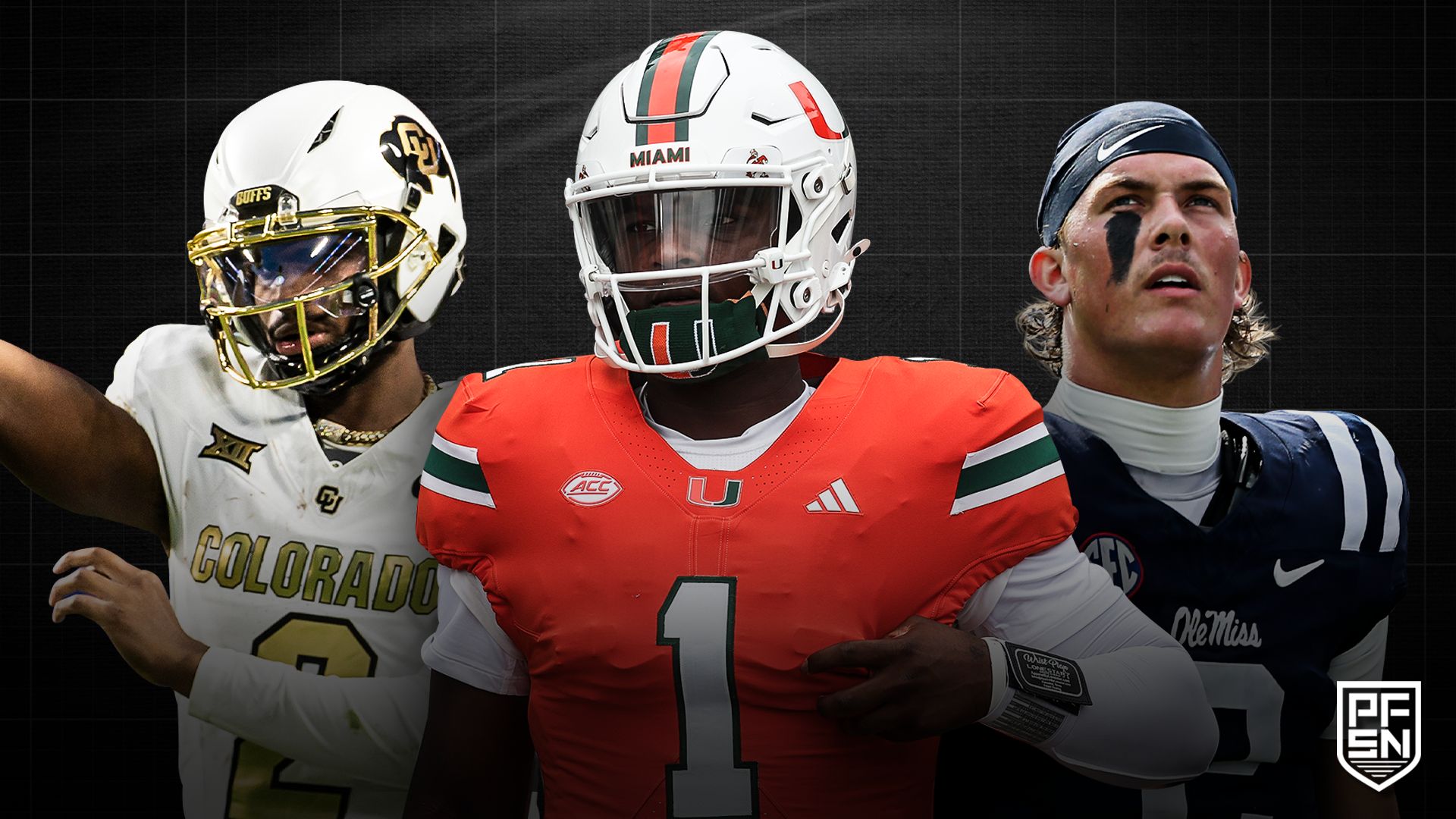
How did your team do? The NFL draft has come and gone, meaning that we’ve taken one large step toward the 2025 regular season. It’s an exciting time, and that’s even more true if your team drafted a quarterback who could turn around the entire organization.
With that in mind, of those teams with nothing but hope on the horizon, who did the best for themselves at the quarterback position? Here’s a look at the top signal callers and how they project moving forward. Included in this equation is not only the raw talent of the QB in question, but the situation he finds himself in, from coaching staff to supporting cast.
1) Tyler Shough, New Orleans Saints
The 40th overall pick in the draft landed in a perfect spot and is the quarterback that most has my attention when trying to project this class for the next handful of years.
First of all, he joins a team with far more talent than their 5-12 record suggests. They won nine games in 2023, a projection that could hold this year, understanding that 2024 was undone by poor luck on the health front.
Kellen Moore was hired away from the Super Bowl champion Eagles this offseason, and his offensive mind is something I’m comfortable banking on. He’ll turn 37 years of age this summer, and if things go according to plan, he’ll be tied to Tyler Shough for an extended period of time, a level of continuity that simply isn’t common for these young QBs.
Moore, of course, knows this side of the ball. As a player, he was the first signal caller in FBS history to win 50 games. Heck, he threw for nearly 15,000 yards and 142 touchdowns (28 interceptions) during his time at Boise, a run that happened to see the NCAA rename the award for the best QB in his honor.
I expect him to be enamored with the arm talent of Shough, and given the health concerns circling Derek Carr, we might get to see this connection sooner rather than later.
GM Mickey Loomis, in April, said that the 34-year-old Carr has “an issue with his shoulder” and that he’s hoping to have clarity soon. I’m no expert, but you know in scary movies when you hear ominous music ahead of a scene and you kind of know where things are headed?
Yeah, it felt like that.
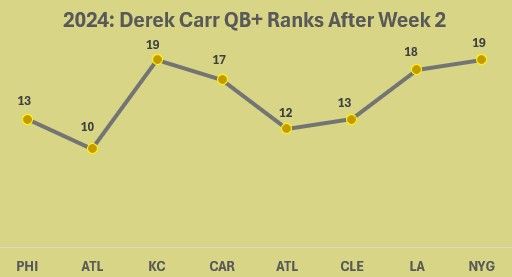
Even a healthy Carr has been little more than ordinary (UFA in 2027). In 2021, he ranked 16th in our QB+ metric, a ranking he repeated the following season. He dropped off to 20th in 2023 before making a rebound last season (13th), though that comes with a bit of an asterisk.
He missed seven games, and that season-long grade was very much influenced by the hot start, that short window of time where the Saints looked like the greatest offense of a generation.
As it turns out, that was more matchup-driven than anything.
New Orleans was the third team to select a quarterback in this draft, and that comes with the expectation of early career reps. Whether Carr is ready to come by camp or not, I expect Shough to be coached up in a meaningful way from the jump, and the cupboard is far from bare.
Rashid Shaheed is entering his age-27 season and Chris Olave age-26, a dynamic nucleus of pass catchers that should allow, assuming health, Shough’s strengths to shine bright. With a former quarterback helping him out, I’d be surprised if the gunslinger DNA isn’t weaponized in a major way.
When you mix physical upside with situation and support, Shough, for me, has as good a chance at anyone in this class to make a major impact on the NFL over the next handful of years.
2) Jaxson Dart, New York Giants
GM Joe Schoen following the trade up to go get Jaxson Dart and the plan when it comes to acclimating him to the professional game:
“Jaxson will get a fair amount of reps with the threes, and maybe you’ll see him in there, sprinkle him in when he doesn’t even know he’s supposed to go in there, just to see how he reacts being in a different atmosphere. He won’t know when or why.”
MORE: 2026 NFL Mock Draft
After the Daniel Jones experiment fell flat, there’s a level of urgency in the Big Apple that I think works in the favor of the rookie. Yes, it’ll come with some bumps and bruises, but he’s on a roster with two veteran quarterbacks and two skill pieces with whom he can develop with in Malik Nabers (already the franchise’s record holder for receptions in a season) and Tyrone Tracy Jr. (just the fifth running back over the past decade drafted in the fifth round or later to rack up 1,100 total yards and six scores as a rookie).
Jaxson Dart has easy arm strength and has tape full of big time throws like this one. Accuracy and power and stemming from a snappy, quick release.
There isn’t a throw he can’t make and he knows it. pic.twitter.com/7yTDyUx73e
— David Syvertsen (@Ourlads_Sy)
Brian Daboll, the 2022 Coach of the Year, is an offensive-minded 50-year-old who was with the Buffalo Bills during Josh Allen’s first four seasons – a run in which the reigning MVP went from inaccurate kid from Wyoming to universally feared NFL asset.
Dart isn’t Allen, but he doesn’t have to be. He has a coach who figures to be around for his development, skill position help, and mentors at the position that aren’t going to be threatened by him being mixed in.
Throughout the draft process, Dart drew comparisons to Brock Purdy, and I think that’s enough – Purdy was put in a position to succeed next to talented teammates, and he led this team to the Super Bowl less than 15 months ago.
I think there’s more growth potential in New Orleans, but Dart should have every chance to make this city forget about the fact that they’ve had one winning season over the past eight, once he gets the chance to run the show.
3) Cam Ward, Tennessee Titans
You may have expected the first overall pick to be first on this list, but let’s take a wide range look at this.
Cam Ward was deserving of his status atop this draft class, and he’s likely going to be a starter in this league for a long time. He has great touch as a passer and the ability to scramble with his eyes downfield, a skill that often takes years to develop at the professional level.
His physical makeup allows him to make just about every throw you could ask for, and he showcased a plus-IQ during his time in Miami.
But is his profile that much better than the others in this class to overcome an iffy supporting cast?
READ MORE: 2025 NFL Power Rankings (Post-Draft)
The Titans are going to be overpaying Calvin Ridley this season and likely two more ($16+ million dead cap hit if they want to get out of his deal after this year). They brought in a version of Tyler Lockett that is little more than replacement level and lack depth behind those two questionable top options.
Tennessee likely has two more years with Tony Pollard, a player they owe nearly $13 million to despite him potentially not being the best running back on this roster. The offensive skill support around Ward is ordinary at best, and the 21st-ranked offensive line that saw the Titans allocate nothing more than 167th overall pick in the draft doesn’t project to do him any favors.
We saw Jayden Daniels succeed in a big way last season, but that was because he was able to elevate talented players who were already there. Terry McLaurin was widely regarded as a future WR1, Austin Ekeler was pigeonholeed into a specific role that was perfect for him, and Washington finished with the seventh-best offensive line.
I’m not sure Ward has any of those things, and without Daniels’ game-changing athleticism, I’m having a hard time seeing him impact winning in a major way in the short term.
Things will change with time, and the hope is that Tennessee can successfully build a contender around Ward, but right now, this feels like adding a really nice couch to a living room that doesn’t yet have walls.
4) Will Howard, Pittsburgh Steelers
Will Howard is something of a prototype prospect as he checks the basic boxes that franchises place great importance on. If you were to ask a front office what they wanted their quarterback to look like, 6’4”, 230+ pounds with big game experience and a mix of mobility and arm strength would probably cover most of the responses.
Howard has all of that.
He’s raw when it comes to his ability to read defenses, and that is what needs the most work. Pittsburgh’s offensive line graded as 25th for us last season, and if that’s not improved, no quarterback is going to stand much of a chance.
They weren’t especially active during free agency in addressing the line and didn’t look that way once during the NFL Draft, thus making the short-term outlook iffy at best, but none of us expect Howard to be sitting atop of this depth chart when training camp opens.
That’s why I like this move.
Howard is likely to get a redshirt year. Regardless of who he is behind, the ability to sit for a year can have value, especially if the offensive line isn’t set up for a rookie to have success right now. With George Pickens, DK Metcalf, Jaylen Warren, and Kaleb Johnson, the skill positions are an area of strength, and I think it’s fair to believe that will be the case entering the 2026 season as well.
Howard is very sound mechanically, and his ability to dominate at OSU last season (4,010 yards and 35 TDs) after spending four years at Kansas State was a nice stepping stone. The difference from THE Ohio State University to the NFL is far greater than what he went through last year, but the developmental step forward was needed and provides me with hope that, with a year of seasoning, he can be ready to lead one of the most stable franchises in professional sports.
T-5) Dillon Gabriel / Shedeur Sanders, Cleveland Browns
Kevin Stefanski has won multiple Coach of the Year awards, and he is going to have to live up to every ounce of that resume to make this situation work. Dillion Gabriel (94th overall pick) was picked 50 spots ahead of Shedeur Sanders (144th), but this profiles as a coin flip situation due to the lack of draft capital spent on both.
There’s desperation in Cleveland – Deshaun Watson is being paid like a solution that he’s clearly not, Joe Flacco is currently just as close in age to Deion as Shedeur, and Kenny Pickett’s fifth-year option has already reportedly been declined. It’s a mess in every sense of the word, but there’s hope.
Qunshon Judkins was drafted with the hopes that he could be a bellcow in the post Nick Chubb era, Jerry Jeudy came into his own as a WR1 last season (90 catches for 1,229 yards), and this defense has the potential to be a top-5 unit. This isn’t a franchise coming off of a three-win season that is bereft of potential – they’ve just been unable to put the pieces together for extended stretches, and the QB position is a serious reason why.
So, who gets the keys to the car?
It stands to reason that Gabriel will get the first look in training camp this summer. He’s undersized and left-handed, two unique traits that require a distinct offensive plan. The fact that Cleveland was comfortable in trading away the second overall pick for a selection that was never going to net them a QB and that they seemingly jumped the line on Gabriel based on projections, I think we can assume that they are ready to tailor a plan around the former Duck.
He’s not a perfect prospect, but his strong arm and general maturity as a passer should make him a quick study from the pocket with the ability to make plays with his legs serving as a nice bonus.
Sanders owns a similar profile, and that should aid in the offensive install. Of course, he being a righty impacts the details when it comes to receiver alignment and offensive line responsibilities, but the skill sets are similar enough that the same general offense should be suitable for both.
I’ll be watching this situation with a close eye as the fall approaches – no matter what you think of Gabriel and Sanders, both are going to need NFL level reps to have any chance of succeeding this season and that means that the team is either going to compromise the growth of both by splitting reps this summer, or lean in one direction sooner than later.