
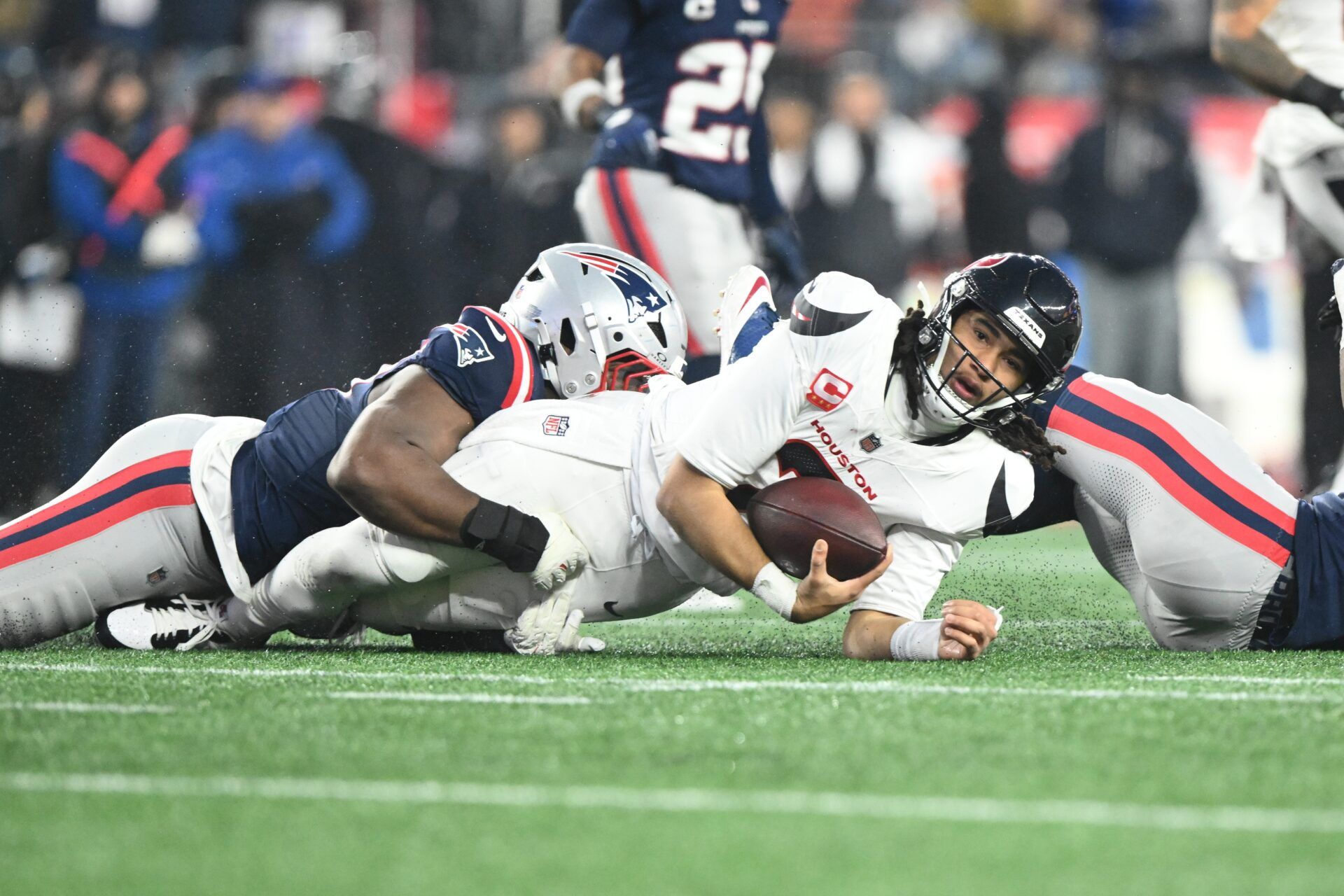
The end of the Houston Texans’ season created several questions within the league, most of which center on C.J. Stroud. Stroud’s difficulties during the playoffs were evident to all who watched. Across two contests, Houston’s offense deteriorated in a manner inconsistent with its regular-season performance.
Especially towards the end of the year, the Texans were playing consistently sound football, but in the postseason, their offense took a significant step back. Former Pro Bowl quarterback Robert Griffin III introduced an alternative perspective, redirecting the discussion away from play-calling and roster composition.
Robert Griffin III Points Out Major C.J. Stroud Issue
The Divisional Round defeat to the New England Patriots highlighted the Texans’ shortcomings. Houston anticipated that its defense could compensate if the offense minimized errors. Turnovers increased, and a team constructed for playoff success appeared unprepared for the heightened pressure.
However, repeated self-inflicted mistakes, including several interceptions by Stroud, put the team at a disadvantage and placed too many demands on a defensive unit that had performed at a high level throughout the season.
Griffin put out an X post with the caption, “C.J. Stroud played terrible and hasn’t looked like himself in a long time. There’s no excuse for having 5 ints and 5 fumbles in 2 playoff games and he knows that. After watching the tape again on a human level, I believe CJ Stroud never fully recovered from his Week 9 concussion.”
The post also had a video from the “Outta Pocket” podcast, where Griffin broke down every little circumstance that led to the Texans losing their Super Bowl shot.
The former Pro Bowl quarterback started with some advice: “C.J. honestly needs to get back to the basics. It will help him secure his bag. You know, he had a Super Bowl-ready defense, and he could not carry the offense. To me, Houston needs the best version of C.J. Stroud; they need to give him a better offensive line. I know that.”
CJ Stroud played terrible and hasn’t looked like himself in a long time.
There’s no excuse for having 5 ints and 5 fumbles in 2 playoff games and he knows that.
After watching the tape again on a human level, I believe CJ Stroud never fully recovered from his Week 9 concussion. pic.twitter.com/yCtmrV2Tcr
— Robert Griffin III (@RGIII) January 20, 2026
Griffin then pointed out the apparent issue, saying, “He needs more explosive playmakers on the outside, and at running back and at the wide receiver. Not having Nico Collins and Dalton Schultz down the stretch hurt him massively. I know that.”
However, he did not lift all responsibilities off Stroud’s shoulder, saying, “But you can’t go out and play that way and then come out and have all the endorsement deals and all this stuff going on.”
The Concussion and Its Effect on Stroud’s Performance
Upon reviewing game footage, Griffin proposed that Stroud may not have fully recovered following the concussion sustained in Week 9. This observation was presented not as an excuse but as a plausible explanation for Stroud’s atypical performance. He ranks 19th on the PFSN NFL QB Impact metrics and ranked much higher mid-season.
“C.J. Stroud needs to go into hibernation, work on his craft, and come back out swinging next year. And this leads me to what to me is the biggest problem. I never think C.J. ever recovered from the concussion in week 9 versus the Denver Broncos,” he said.
As a player who has had his fair share of concussions in his career, Griffin pointed out, “Concussions are something that can have lingering issues. He missed 3 games, that’s how bad his concussion was…. He hasn’t looked comfortable, he hasn’t looked in rythm, he hasn’t looked like the same DOTY specialist that we are used to seen him be.”
This tweet aligns with the visual evidence from game film. Stroud’s timing appeared inconsistent, with instances of holding the ball excessively, followed by hurried throws into contested areas. He looked uncomfortable in the pocket the entire game, and even routine plays required increased effort from the signal-caller.
He said, “So what I will suggest for C.J. Stroud is going to get his brain looked at, and I don’t mean it jokingly at all,” and suggested an organization that helps with brain mapping and corrective exercises.
Griffin’s argument is particularly relevant in this context. The effects of concussions are not always immediately apparent and cannot be seen with the naked eye. A quarterback may be medically cleared to participate, yet continue to experience diminished processing speed, reduced comfort in the pocket, or uncertainty in decision-making.
