
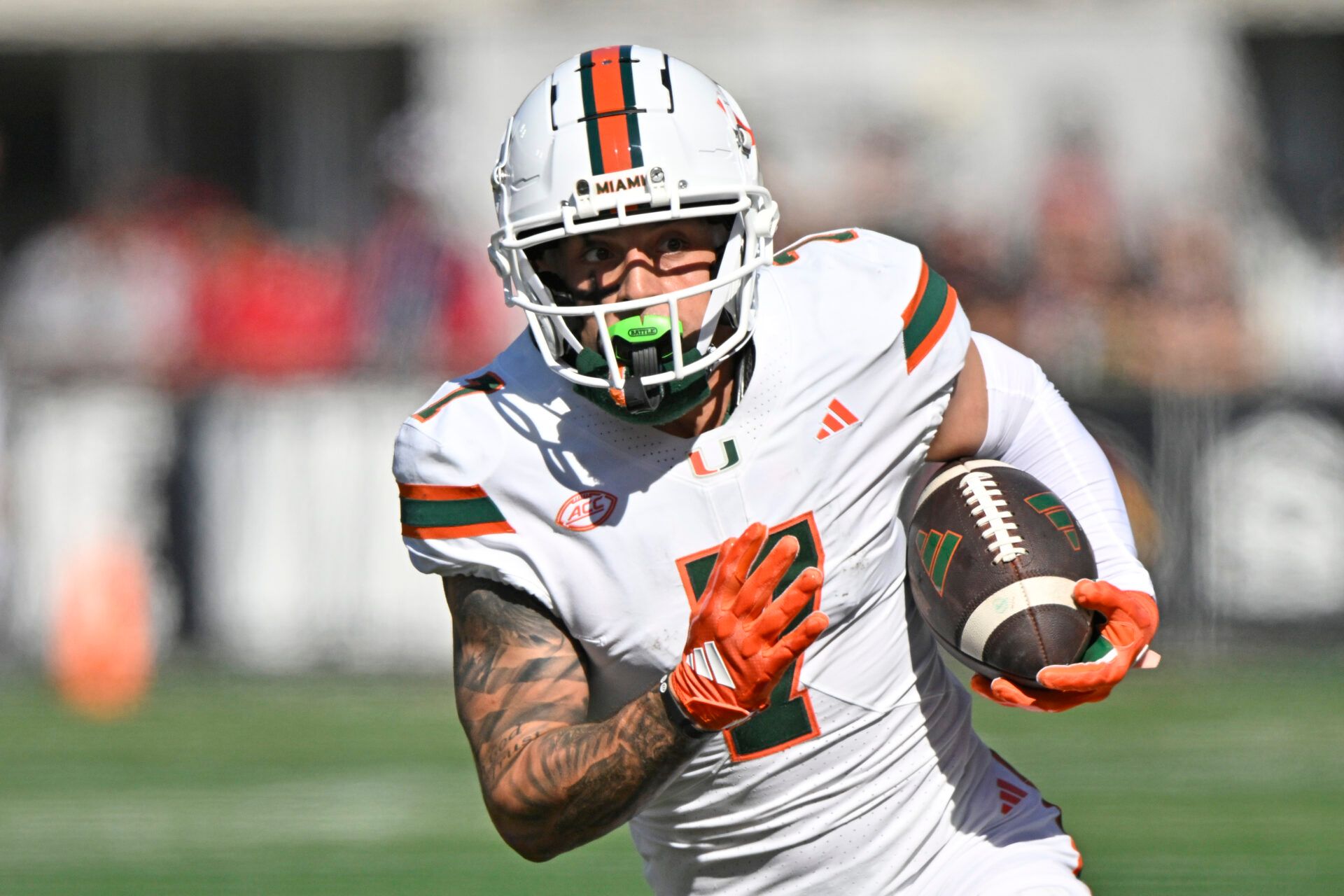
The NFL Draft grabs headlines, but it’s the days that follow where teams often uncover their most surprising contributors. In a league defined by opportunity, undrafted free agents enter training camp with one goal: to prove they can play. With depth charts far from set and preseason reps up for grabs, these players have an opportunity to make their mark.
We’ve highlighted one UDFA from each team who could sneak onto the 53-man roster – and potentially play a meaningful role during the 2025 season.
Arizona Cardinals: Elijah Simmons, DT, Tennessee
The Arizona Cardinals’ defense finished as one of the worst in the NFL a season ago (ranked 27th in PFSN’s Defense+ metric). The run defense was porous, ranking 28th in success rate. Despite adding veteran Calais Campbell and drafting Walter Nolen III, this unit must continue adding depth to its defensive front.
Elijah Simmons brings a unique blend of size, strength, and explosiveness that makes him a potential difference-maker on early downs at the next level. Built like a massive tree stump at 6-2, 340 pounds, Simmons explodes off the snap and immediately creates problems for interior offensive linemen.
Though he didn’t log a high snap count at Tennessee, there’s no shortage of tape showing him overwhelming opponents and muddying up run lanes. Simmons isn’t likely to contribute much on passing downs, but he could add value against the run as a space-eater who can take on double teams.
Atlanta Falcons: Cobee Bryant, CB, Kansas
The Atlanta Falcons’ defense left much to be desired in 2024, especially against the pass. They ranked 25th in pass defense success rate (51.9%) and 27th in EPA per dropback allowed (-0.12). Atlanta lacks depth at cornerback, and they were able to sign a player who most thought would get drafted.
Cobee Bryant is a wiry but fiercely competitive cornerback with the instincts, ball skills, and confidence to influence games from Day 1. What he lacks in bulk, he makes up for in energy, anticipation, and a knack for creating turnovers. His 13 interceptions and 22 pass breakups in college didn’t come by accident. Bryant consistently reads route combinations and quarterback intentions with veteran savvy, particularly in zone coverage where his football IQ shines.
MORE: 2026 NFL Mock Draft
While he may be overmatched at times by bigger receivers in man coverage, Bryant’s ability to close quickly, disrupt throws, and create momentum-changing plays stands out. He’s an emotional tone-setter who refuses to back down, and that intensity is a quality that Raheem Morris should appreciate.
Baltimore Ravens: Chandler Martin, LB, Memphis
Eric DeCosta and the Baltimore Ravens came away from the 2025 NFL Draft with another impressive haul. They addressed every pressing roster need, but they could stand to add more competition at linebacker, especially after losing Malik Harrison and Chris Board to free agency.
Chandler Martin is a throwback-style inside linebacker who thrives on physicality, effort, and instincts. He plays fast and aggressively, with a downhill trigger that allows him to shoot gaps and deliver forceful hits. He’s a dependable tackler in the box, with the strength to take on blocks and hold his ground in tight spaces.
Though his shorter frame and average lateral agility limit his range and block-shedding consistency, Martin’s football IQ, toughness, and nose for the ball make him a high-effort player capable of contributing early on special teams and as a rotational linebacker on early downs. His ability to get after the quarterback (7 sacks in 2024) could earn him a spot in Baltimore.
Buffalo Bills: Kelly Akharaiyi, WR, Mississippi State
The Buffalo Bills may not have an elite receiving corps, but that didn’t stop the offense from averaging 29.5 points per game (2nd in the NFL) last season. Buffalo added Joshua Palmer, Laviska Shenault Jr., and Kaden Prather through free agency and the draft, but everyone has to earn their spot, right?
Kelly Akharaiyi is a physically well-built receiver who flashes just enough tools to carve out a depth role in an NFL offense. Though his top-end speed and suddenness are below average by pro standards, Akharaiyi brings size, toughness, and flashes of functional quickness that could help him develop into a reliable possession target.
While he’s not a vertical threat, Akharaiyi could find a niche on short and intermediate routes, especially if he learns to consistently win with positioning and body control on contested catches.
Carolina Panthers: Luke Kandra, OL, Cincinnati
The Carolina Panthers’ offensive line had mixed results in 2024, finishing 19th in our OL+ metric. After not drafting any offensive lineman in the 2025 NFL Draft, they could be looking for one of their UDFAs to play their way into a roster spot.
Luke Kandra is a technically refined interior offensive lineman whose blend of experience, toughness, and movement skills make him a strong developmental candidate. A two-year starter at Cincinnati and a former Louisville transfer, Kandra put together back-to-back standout seasons that earned him All-American and All-Big 12 honors while anchoring one of the top rushing offenses in college football.
At 6’5” and 318 pounds, Kandra combines a powerful core with active hands and a consistent motor. His game is built on reliability and intelligence — rarely penalized, allowing just one sack over 24 starts, and showing the ability to process stunts and blitzes at a high level. His anchor strength can be tested by bull rushers, and he occasionally plays too high, but his fundamentals give him a solid floor as a depth piece who could develop into a starter.
Chicago Bears: Power Echols, LB, North Carolina
If it weren’t for a volatile offense, the Chicago Bears’ defense could’ve fared better than they did last season. The fact that they still finished 13th in Defense+ is promising, though. Despite a strong linebacker duo of Tremaine Edmunds and T.J. Edwards, there could be an open competition for the backup roles.
Power Echols is a high-energy linebacker with proven production, athletic range, and special teams upside — all traits that give him a real shot to stick in the league. A three-year starter at North Carolina, Echols racked up over 100 tackles in back-to-back seasons and showed consistent durability, leadership, and motor from the second level.
While he doesn’t have prototypical size or elite play strength, Echols plays fast and aggressively, especially when working in space. He shows the lateral quickness to track outside runs and the ability to match up in coverage. Those traits could make him an intriguing sub-package linebacker for the Bears.
Cincinnati Bengals: Seth McLaughlin, C, Ohio State
There’s no denying how dangerous the Cincinnati Bengals’ offense is. With Joe Burrow throwing the football, and Ja’Marr Chase, Tee Higgins, and Chase Brown at his disposal, they can put points on anyone. The offensive line is holding them back, though (29th in OL+). Ted Karras is the starter in the middle, but injuries happen and depth should be a priority.
MORE: Buccaneers Cut 4 Players To Make Room For UDFA Signings, Including Colorado Star Shilo Sanders
Seth McLaughlin is a technically sound, mentally sharp center with high football IQ and a strong track record of starting experience at two powerhouse programs. Despite suffering a season-ending Achilles injury late in 2024, McLaughlin’s body of work, particularly his breakout year at Ohio State, makes him a compelling prospect who could thrive in the right scheme.
McLaughlin’s game relies on leverage, footwork, and anticipation rather than brute force, making him an ideal fit for zone-based offenses that emphasize mobility and technique over pure strength. At 6’4″, 304 pounds, McLaughlin doesn’t overwhelm defenders at the point of attack, but he plays with excellent balance, hand placement, and core strength. He moves well in space, consistently climbs to the second level. If cleared medically, McLaughlin offers plug-and-play potential as a backup center with the long-term upside of a starter.
Cleveland Browns: Adin Huntington, DL, Tulane
Any defensive line that is led by Myles Garrett is going to be dangerous. Throw Mason Graham into the mix, and you have a disruptive inside-outside combination. Cleveland finished with a 40% pressure rate without blitzing last season (best in the NFL). While none of the UDFAs will compete for a starting job, one in particular could carve out a rotational role.
Adin Huntington was one of the most explosive, high-upside athletes in this year’s defensive line class. While he may not fit the traditional mold at any one position — lacking ideal length to consistently play the edge and the mass to anchor inside — his elite athletic traits and relentless motor make him a unique chess piece for modern NFL defenses.
A true disruptor, Huntington thrives when he wins early in the rep. His initial burst off the ball is elite, often allowing him to shoot gaps, stress offensive linemen with his speed, and generate backfield pressure before the play develops. Huntington would inject more athleticism in the Browns’ defensive front and offer exciting sub-package and special teams value right away.
Dallas Cowboys: Traeshon Holden, WR, Oregon
The Dallas Cowboys have been waiting a long time for a legitimate wide receiver to play opposite of CeeDee Lamb, who has consistently paced the team in targets (152 in 2024) and has developed into one of the NFL’s elite wideouts. They may not find it with this group, but with a thin WR room, there’s a clear path to playing time.
Traeshon Holden brings the physical profile and competitive edge that NFL teams covet in wide receivers. With a sturdy 6’3″, 215-pound frame and the versatility to line up both outside and in the slot, Holden has the makings of a reliable possession target. Though he doesn’t possess blazing speed, his ability to uncover against zone coverage and work the middle of the field could make him a dependable option.
Holden’s game is built on physicality and football IQ. He’s an instinctive route-runner with the size to shield defenders and the footwork to separate with sharp breaks. Holden scored a touchdown roughly every seven catches over his college career, highlighting his red zone value. Beyond his receiving skills, Holden’s commitment as a blocker adds real value. He’s not afraid to get physical in the run game, which enhances his case.
Denver Broncos: Jerjuan Newton, WR, Toledo
The Denver Broncos’ offense surprised a lot of people last year. In Bo Nix’s first season under center, they averaged 22.7 points per game (11th in the NFL). The unit doesn’t have a legit No. 1 receiver, and there could be room on the depth chart for more dynamic playmakers.
Jerjuan Newton exited Toledo as one of the most accomplished receivers in program history. The all-time leader in touchdown catches for the Rockets (36), Newton consistently elevated his game each season. What makes Newton especially intriguing is his combination of production, consistency, and versatility. He can win at all three levels of the field.
Newton’s sharp route-running, strong hands, and ability to make plays in the middle of the field likely caught the eye of Sean Payton. Newton thrives after the catch as well, ranking 21st nationally in YAC.
Detroit Lions: Caden Prieskorn, TE, Ole Miss
Sam LaPorta is the unquestioned TE1 for the Detroit Lions. However, the No. 1 offense in our Offense+ metric likes to use tight ends, and the right player could compete with Brock Wright for playing time behind LaPorta.
Caden Prieskorn is a versatile tight end prospect with the frame, toughness, and experience to contribute in a traditional in-line role. Prieskorn’s value lies in his reliability and toughness. He’s a trusted red zone and possession target with strong hands and excellent concentration in contested catch situations. Though not the most explosive route-runner, he understands spacing and shows a knack for settling into soft spots in zone coverage.
As a blocker, Prieskorn brings size and functional strength but still needs to improve his technique and consistency to fully transition to the NFL level. Still, his dependability, physicality, and blocking upside give him a clear path to competing for a roster spot on Dan Campbell’s squad.
Green Bay Packers: Jamon Dumas-Johnson, LB, Kentucky
The Green Bay Packers’ defense was solid last season, finishing top 10 in Defense+. The unit features a strong young linebacker duo in Quay Walker and Edgerrin Cooper. They have their spots on lock, but it will be interesting to see who earns the backup roles in camp.
Jamon Dumas-Johnson enters the NFL with a championship pedigree and a proven track record of production at the highest level of college football. He brings physicality, experience, and leadership to the linebacker position.
Though his 2024 season at Kentucky lacked consistency and was hindered by inefficiency and a midseason injury, Dumas-Johnson still showcased the physical tools and football IQ that made him a standout in the SEC. He’s a downhill thumper who excels near the line of scrimmage. While he doesn’t possess elite sideline-to-sideline speed or the burst to be a three-down coverage linebacker, Dumas-Johnson’s strengths as a run defender and occasional blitzer could make him a valuable piece in a rotational role.
Houston Texans: Eli Cox, C, Kentucky
The Houston Texans’ offensive line struggled mightily in 2024, finishing dead last in our rankings (F grade). They were bad in both pass protection and the run game. Houston ranked 31st in run block success rate. After trading away Laremy Tunsil and Kenyon Green, depth up front is of utmost importance.
Eli Cox brings leadership, experience, and positional versatility to the NFL — traits that make him a strong candidate to contribute early as a backup interior offensive lineman. A sixth-year senior and two-time team captain, Cox was a consistent presence on Kentucky’s offensive line, with extensive starting experience at both guard and center in the SEC.
Cox tested well with a 5.02 40-yard dash and 32.50″ vertical jump. He plays under control in space and does a good job sustaining blocks by running his feet through contact, especially when working as a combo or help blocker. Cox’s shorter arms and occasional lapses in recognizing stunts and blitzes can make him vulnerable against quick, disruptive defenders. But his toughness, football IQ, and consistent motor help mitigate some of those limitations.
Indianapolis Colts: Landon Parker, WR, Troy
Wide receiver may be the hardest position on the Indianapolis Colts for a UDFA to crack a spot, with a strong group featuring Michael Pittman Jr., Alec Pierce, Josh Downs, and Adonai Mitchell. However, there could be a role for a player with world-class athletic traits.
While Landon Parker didn’t post eye-popping numbers in college, finishing with just 27 catches for 350 yards in his final season at Troy, his raw athleticism has caught the attention of NFL scouts and evaluators. Despite the modest production, Parker emerged as Troy’s second-leading receiver in 2023 and used the pre-draft process to boost his profile significantly.
At Troy’s Pro Day, Parker measured in at 6’2″, 211 lbs and delivered a standout performance in athletic testing. He ran a 4.40-second 40-yard dash, posted a 38.5″ vertical jump, an 11’1″ broad jump, and an elite 6.68-second 3-cone drill. That would’ve placed him among the best at the position in multiple categories at the NFL Combine. Parker’s athletic upside, size, and ability to contribute on special teams make him an intriguing developmental prospect.
Jacksonville Jaguars: Cam’Ron Silmon-Craig, S, Colorado
The Jacksonville Jaguars’ pass defense improved down the stretch in 2024, but the unit ranked 31st in pass defense success rate from Weeks 1-11. The front office bolstered the safety group by adding Eric Murray in free agency, but versatility could boost a player’s chances to become a depth piece.
Cam’Ron Silmon-Craig may not check every box from a size or speed standpoint, but his instincts, toughness, and versatility give him a strong foundation to contribute at the next level. A compact and physical defender, Silmon-Craig consistently plays bigger than his frame suggests, bringing a fearless, downhill mindset and the ability to line up both in the box and in deep coverage.
Silmon-Craig a high-IQ player with a natural feel for the game, and his tape shows a defender who’s always around the football. He truly shines in zone coverage and brings a tone-setting presence as a run defender. His competitive fire could help him earn his keep on special teams and as a depth piece early on. Reuniting with college teammate Travis Hunter could also bring out the best in him.
Kansas City Chiefs: Jake Briningstool, TE, Clemson
Travis Kelce isn’t retiring yet. But that doesn’t mean the Kansas City Chiefs should ignore the tight end position. Kelce turns 36 next season, and he’s coming off one of the worst statistical seasons of his career. Patrick Mahomes loves targeting his tight ends, and one UDFA in particular could challenge Jared Wiley for reps behind Kelce and Noah Gray.
Jake Briningstool isn’t the most physically imposing tight end, but his toughness, route-running intelligence, and natural receiving ability make him a reliable option in the passing game. While he may not be a true in-line blocker or an elite separator against man coverage, Briningstool consistently finds space against zone looks and excels at making tough catches.
A fluid mover with strong hands and good body control, Briningstool works well in the intermediate areas of the field. With traits like these, the Clemson product could eventually find his way on the field for third downs and red zone opportunities.
Las Vegas Raiders: Jah Joyner, EDGE, Minnesota
The Las Vegas Raiders entered the offseason needing more playmakers on the defensive side of the ball. They ranked just 25th in pressure rate without blitzing. The Raiders need more juice on the edge to help Maxx Crosby and Malcolm Koonce.
Jah Joyner is a long, athletic edge defender with clear flashes of potential. While his game still lacks polish in several areas, Joyner’s blend of length, effort, and gradual improvement throughout his college career offers reason for optimism.
Standing at 6’5″, 265 pounds with long arms and a relentless motor, Joyner has shown he can generate pressure when given space to operate. Though he’s not the most explosive or bendy pass rusher, he uses his reach to create leverage on the edge. His technique is raw, but his length, effort, and flashes of pass-rush upside give him a chance to carve out a role as a rotational edge defender.
Los Angeles Chargers: Myles Purchase, CB, Iowa State
The Los Angeles Chargers finished the 2024 season with a top 5 defensive in our Defense+ metric. The unit features plenty of young talent, especially in the secondary, where Tarheeb Still and Cam Hart shined as rookies. One of this year’s UDFAs could make an impact on the back end as well.
Myles Purchase brings a physical, hard-nosed style of play that projects well to the next level — particularly on a Jim Harbaugh-coached team. Though the Chargers have talent at nickelback, the position is so valuable in today’s NFL that adding depth can’t hurt. A standout tackler and high-effort competitor, Purchase has the tools to thrive as a slot corner or rotational defensive back in sub-packages.
Purchase has also shown solid instincts in pass coverage. Whether in coverage or supporting the run, his physicality at the point of contact stands out. He’s not a top-end athlete, but his frame, tackling ability, and football IQ give him a solid floor. Those traits could also get him on the field as a special teamer.
Los Angeles Rams: Willie Lampkin, OL, North Carolina
While the Los Angeles Rams’ offensive line isn’t elite, they were still a solid unit last season despite battling injuries. Strengthening the unit by adding versatility and depth to the interior could help boost the ground game.
Willie Lampkin might not fit the NFL’s size mold for an offensive lineman, but his game tape tells a different story. Despite being just 5’10” and 270 pounds, Lampkin consistently dominated at both Coastal Carolina and North Carolina, starting 61 career games across three positions and proving to be one of the most technically sound and versatile interior linemen in the 2025 draft class.
Lampkin’s game features elite technique, relentless effort, and rare athleticism. While his size will naturally raise questions, his performance at the Senior Bowl proved he can compete against NFL-caliber talent. His play strength, football IQ, and competitiveness help close the physical gap, and his positional flexibility makes him a valuable depth piece for the Rams.
Miami Dolphins: Andrew Armstrong, WR, Arkansas
It sounds like Tyreek Hill is staying put, and with him and Jaylen Waddle, the Miami Dolphins still have one of the best wide receiver duos in the league. Malik Washington should also see an increased role in 2025. A big-bodied threat could add a different element to the passing attack, though.
Andrew Armstrong may not be the flashiest wide receiver in this draft class, but his production, physical traits, and catch-point prowess make him a compelling pickup. At 6’4″ and over 200 pounds, Armstrong brings rare length and a massive catch radius to the boundary receiver role that you simply can’t teach.
Armstrong thrives in contested situations and has reliable hands. Despite his limited athletic testing and a dip in touchdown production in 2024, his ability to perform against high-level competition speaks volumes. The Dolphins lack size at wide receiver, and Armstrong could create matchup problems against smaller corners.
Minnesota Vikings: Logan Brown, OT, Kansas
The Minnesota Vikings already boasted a top 10 offensive line last season. They got even stronger this offseason by adding Will Fries and Ryan Kelly to the interior. With a rock-solid foundation, the Vikings may have found the perfect developmental prospect.
A former five-star recruit and multi-sport athlete with a rare blend of size, length, and athleticism, Logan Brown finally put it all together in his final season at Kansas. At 6’6″, 311 pounds with nearly 35-inch arms, Brown checks every physical box teams look for at the tackle position.
Brown is a powerful blocker who has shown flashes of dominance in the run game. His pass protection is still a work in progress, but he has highly coachable tools, which offers upside heading into the NFL. Brown is far from a finished product, but he gets to learn behind one of the best offensive lines in the game.
New England Patriots: CJ Dippre, TE, Alabama
Drake Maye has established himself as the quarterback of the future for the New England Patriots, and the front office has made it a priority to put him in the best position to succeed. With plenty of depth at wide receiver, there could be an intriguing battle brewing at tight end.
CJ Dippre is just the kind of tight end who can find his way onto an NFL roster because he does a little bit of everything well. At 6’4″, 262 pounds, Dippre offers a sturdy presence as both a blocker and short-to-intermediate receiver. While he doesn’t have elite speed or suddenness, he makes up for it with toughness, awareness, and functional athleticism.
Dippre shows up on tape as a reliable chain-mover who thrives in contested-catch situations. He’s not a flashy route-runner, but he consistently finds ways to get open. He’s technically sound as a blocker and displays a toughness that Mike Vrabel looks for.
New Orleans Saints: Marcus Yarns, RB, Delaware
Alvin Kamara is still a dynamic three-down playmaker, but he’ll be 30 when the new season kicks off. With Kamara as the catalyst, the New Orleans Saints ranked ninth in rush success rate in 2024. With Kendre Miller, Devin Neal, and Clyde Edwards-Helaire, there’s a bit of a logjam at running back, so it might take a special weapon to carve out a role.
Marcus Yarns is an exciting dual-threat running back, showcasing both versatility and the potential for big plays. Even though he played at the FCS level, his statistics are impressive: over 2,000 rushing yards, more than 800 receiving yards, and 34 total touchdowns.
Yarns has a knack for evading defenders in open space, using his speed to hit big plays and take advantage of mismatches in the passing game. As a smooth, one-cut runner, he displays natural acceleration, allowing him to turn the corner or turn a short screen pass into a long gain. His ability to line up as a receiver adds even more value to his game. He may not be the biggest back in this draft class at 5’11 and 195 pounds, but his agility and skills can create mismatches, similar to Alvin Kamara.
New York Giants: Makari Paige, S, Michigan
The New York Giants’ defense fell off down the stretch, but they ranked in the top half in Defense+ for much of the 2024 season. A few bright spots emerged in the secondary with rookies Dru Phillips and Tyler Nubin. With limited depth, another young DB could make a name for himself.
Makari Paige brings the kind of size, versatility, and football intelligence that makes him an intriguing NFL safety prospect. A four-year contributor for Michigan, Paige played a central role in one of the nation’s most complex and effective defenses. At 6’4″, 208 pounds, Paige has rare length for a safety and moves like a much smaller player.
Paige’s ability to operate in multiple roles made him a chess piece for Michigan and speaks to the versatility he could add to the Giants’ defense. He also offers immediate special teams value while developing into a rotational defender.
New York Jets: Jamaal Pritchett, WR, South Alabama
The New York Jets’ offense will look very different in 2025. The Aaron Rodgers era is over, and that also meant the departure of Davante Adams. This leaves a hole in the wide receiver room alongside Garrett Wilson. New York drafted Arian Smith, but another speedster could make a splash.
Jamaal Pritchett is an explosive, versatile receiver with the type of dynamic playmaking ability that translates well to the modern NFL. Though undersized at 5’9″, 175 pounds, Pritchett brings game-breaking speed, elite vision in the open field, and special teams upside. In 2024, he dominated the Sun Belt Conference, leading in both receptions (91) and receiving yards (1,126) while tying South Alabama’s single-season record with nine touchdowns.
Pritchett thrives on manufactured touches that allow him to operate in space. He’s a reliable YAC threat, and his vision allows him to turn modest gains into chunk plays. The same traits that make him a dangerous receiver also show up in the return game. His ability to contribute in multiple ways could earn him a spot.
Philadelphia Eagles: Hollin Pierce, OT, Rutgers
The Philadelphia Eagles have a well-documented history of developing offensive line talent under Jeff Stoutland. Despite falling outside of the top 10 in OL+ a season ago, this unit is one of the most complete in the NFL. You can never have too much talent in the trenches, and the depth they could have would be a luxury.
Hollin Pierce is a rare physical specimen at offensive tackle, standing 6’8″ and 342 pounds with massive 36.5″ arms. He offers an intriguing blend of size, strength, and discipline that could translate well to the pro level. A four-year starter at Rutgers with 50 consecutive starts under his belt, Pierce brings high-end experience, having faced elite Big Ten defensive fronts.
Pierce’s frame can overwhelm defenders, and he uses it to his advantage in the run game and pass protection. While top-tier NFL speed may give him trouble out the gate, his raw power and elite length make him an ideal developmental tackle for an already strong unit.
Pittsburgh Steelers: Sebastian Castro, S, Iowa
The Pittsburgh Steelers opted not to attack the safety position in the 2025 NFL Draft. However, there is a need for depth there, behind Minkah Fitzpatrick and DeShon Elliott. Despite adding veteran Juan Thornhill in free agency, the Steelers could still afford to upgrade with versatility.
Sebastian Castro is a high-IQ, high-motor safety who thrives near the line of scrimmage and brings a fearless, downhill play style that fits well in zone-heavy or sub-package schemes. Though he may not offer elite athletic traits or deep coverage range, Castro makes up for it with sharp instincts, physicality, and consistency.
While his man coverage ability and overall speed may limit his ceiling as a true hybrid safety, his aggressive mindset and short-area quickness make him a useful chess piece. Castro plays fast and hits hard, and that’s how the Steelers want to play ball.
San Francisco 49ers: Corey Kiner, RB, Cincinnati
The San Francisco 49ers’ rushing attack is led by one of the best in the business in Christian McCaffrey. However, the injury bug struck again in 2024 after a career year in 2023. The Niners are looking to replace Jordan Mason, who was the team’s leading rusher last season, and one of the UDFAs has a similar running style.
Corey Kiner may not be the flashiest back in this draft class, but he’s one of the most reliable and hardest to bring down. A compact, physical runner with excellent contact balance, Kiner consistently churns out yardage between the tackles and rarely goes down on first contact. He’s a patient, downhill runner who thrives in traffic and keeps his legs churning to extend plays.
Despite lacking elite burst or long speed, Kiner produced back-to-back 1,000-yard seasons at Cincinnati and ranked among the nation’s best in missed tackles forced. His lack of breakaway speed limits his upside as a big-play threat, but he’s built for the physicality of the pro game. He has a chance to outperform 5th-rounder Jordan James.
Seattle Seahawks: Zy Alexander, CB, LSU
The Seattle Seahawks’ defense thrived in the first year under new head coach Mike Macdonald. The unit ranked 6th in Defense+ after finishing 29th the previous season. The secondary is already a pretty strong group, led by Devon Witherspoon, Riq Woolen, and Julian Love. Still, they could add much-needed depth with a corner who surprisingly went undrafted.
Zy Alexander offers a blend of size, athleticism, and football instincts that make him a strong candidate to contribute early. At 6’2″ and nearly 200 pounds, he has the frame teams covet on the outside, and he knows how to use it.
Alexander’s 13 career interceptions across FCS and SEC play demonstrate his knack for being around the football. He will have to refine his technique in press coverage, but his combination of size, instincts, and production makes him an ideal fit for Mike Macdonald’s defense in Seattle.
Tampa Bay Buccaneers: Jake Majors, OL, Texas
The Tampa Bay Buccaneers selected six players in this year’s draft, but none of them were offensive linemen. That leaves the window open for a UDFA to potentially earn himself a spot on the 53-man roster.
Jake Majors may not check every box physically, but his high football IQ, technical polish, and pass protection ability give him a legitimate path to playing time at the next level. A four-year starter who set a Texas record with 56 career starts, Majors anchored one of college football’s most efficient offenses, consistently displaying poise, intelligence, and toughness in the heart of the Longhorns’ line.
Majors displays good hand placement and core strength, and he has enough athleticism to operate in space. Despite his physical limitations, he is technically sound and plays with tenacity. He could carve out a role as a plug-and-play depth option.
Tennessee Titans: Xavier Restrepo, WR, Miami (FL)
After selecting Cam Ward with the No. 1 overall pick, the Tennessee Titans’ front office made a concerted effort to surround him with weapons, spending three picks on pass-catchers. Still, Calvin Ridley and Tyler Lockett are the only proven receivers on the roster, so there’s an opening for new competition.
Xavier Restrepo’s 4.83 Pro Day 40-yard dash raised red flags and caused his draft stock to slip, but he plays faster on film. He consistently wins with precision, toughness, and football IQ, which could allow him to thrive as a slot receiver in the NFL.
Restrepo’s physical limitation may cap his upside at the next level, but can be a reliable chain-mover and win matchups on the insider. He was the go-to weapon for Ward at Miami (11 touchdowns and six 100-yard games), and that familiarity could bode well for his chances to make the roster and get on the field sooner rather than later.
Washington Commanders: Robert McDaniel, CB, Jackson State
The Washington Commanders’ defense made strides in 2024, but they were still susceptible to big plays through the air. With the midseason trade for Marshon Lattimore, Mike Sainristil’s emergence, and the 2025 selection of Trey Amos, there’s reason for optimism. Adding some versatile chess pieces could go a long way to solidifying the unit, though.
Robert McDaniel emerged as one of the most physically intriguing HBCU prospects in the class. He brings a blend of size, speed, and physicality that NFL teams look for in a developmental safety and special teams contributor. A true tone-setter in the box, McDaniel thrives when he’s able to play downhill. His speed shows up on tape, and doesn’t shy away from contact.
McDaniel can sometimes be over-aggressive, and he’s far from a finished product but his raw tools, versatility, and more have to be enticing for Dan Quinn and Joe Whitt Jr. He was a disruptor at the college level and comes with plenty of upside for a defense on the rise.