
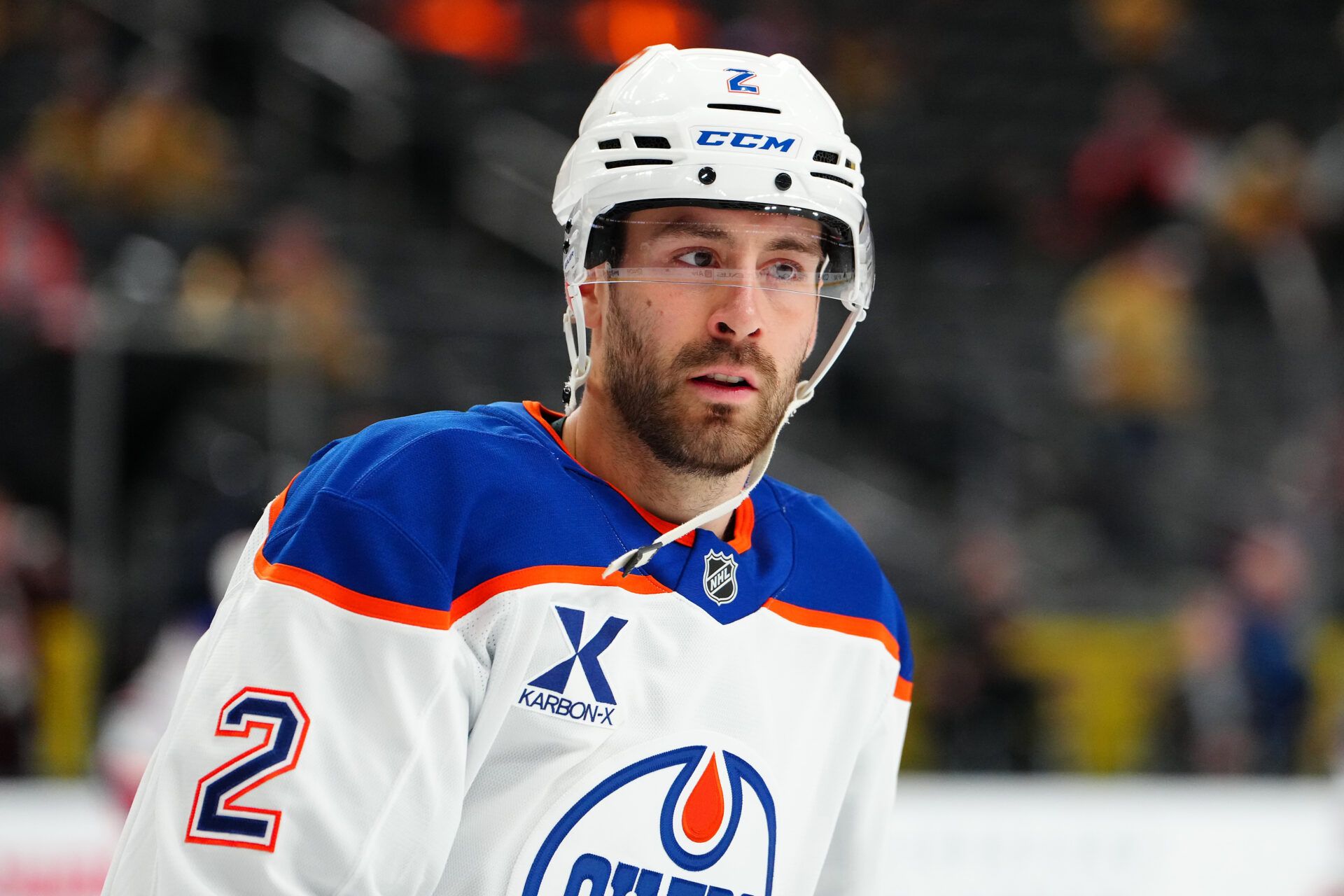
The Edmonton Oilers took a bold step with Evan Bouchard, and that decision still draws strong reactions across the league. His place on the roster has not shifted, even as questions around his contract continue to arise. The team has backed its plan on defense without hesitation, making its stance clear.
That keeps the spotlight on how analysts now judge the value of this deal.
Is Evan Bouchard’s Contract a Bargain for the Oilers?
Bouchard signed a four-year, $42 million extension in June 2025, carrying a $10.5 million cap hit through the 2028-29 season. He remains a core player for the Oilers, and there were no serious trade talks involving him before the March 6 deadline. Instead of moving him, the team added Connor Murphy to improve its defensive depth while keeping Bouchard in the same important role.
NHL insider Sean McIndoe, in his recent column for The Athletic, reviewed the contract in detail and explained why it brings both value and concern.
MORE: Connor McDavid’s Player Safety Criticism Triggers Demands to Boot Out DoPS Head George Parros
He wrote, “The case that it’s a bad contract: Bouchard has the offensive numbers to justify his deal. The question is whether the rest of his game is good enough, or whether his defensive shortcomings hold him back from ever being a truly elite blueliner.”
This concern remains part of the discussion, especially when comparing him to other high-paid defensemen. McIndoe also pointed out that Bouchard is not widely seen among the top five defensemen in the league, even with his cap hit.
He raised a direct question about roster value by noting whether a player at that salary should miss out on Team Canada selections in favor of names like Colton Parayko or Travis Sanheim. These comparisons have kept the debate active.
At the same time, McIndoe made it clear that the contract is not a major problem. He wrote, “The case that it might be OK: The game is played at both ends of the rink, and both elements matter. In the last three years, Bouchard trails only Cale Makar and Quinn Hughes in blue-line scoring.” That level of production keeps his value high, especially on a team that relies on offensive support from the blue line.
Players like Cale Makar and Quinn Hughes remain the standard in that area, but Bouchard’s numbers place him close behind. He is also still in his mid-20s, which gives him time to improve his defensive play. McIndoe noted that the contract term gives the Oilers flexibility, since it does not extend deep into his later years.
The Oilers’ actions support that view. They have focused on building balance around Bouchard instead of replacing him, including adding support for players like Connor McDavid on special teams and at even strength. His role remains important in their system.
ALSO READ: Leon Draisaitl’s Injury Layoff Could Extend to NHL Playoffs, Per Oilers HC
Bouchard has recorded 77 points in 68 games this season, leading all NHL defensemen. His defensive play has also improved, with fewer turnovers and stronger results in key situations. These changes have helped strengthen his overall impact.
McIndoe summed up his view by writing, “I don’t love this one, but I don’t think I can call it truly bad.” This line captures where the contract stands, as it continues to bring both questions and value for the Oilers.
