
In a world driven by instant gratification, being afforded grace and patience for development is rare – – especially in football, where these qualities are often missing from a player’s journey.
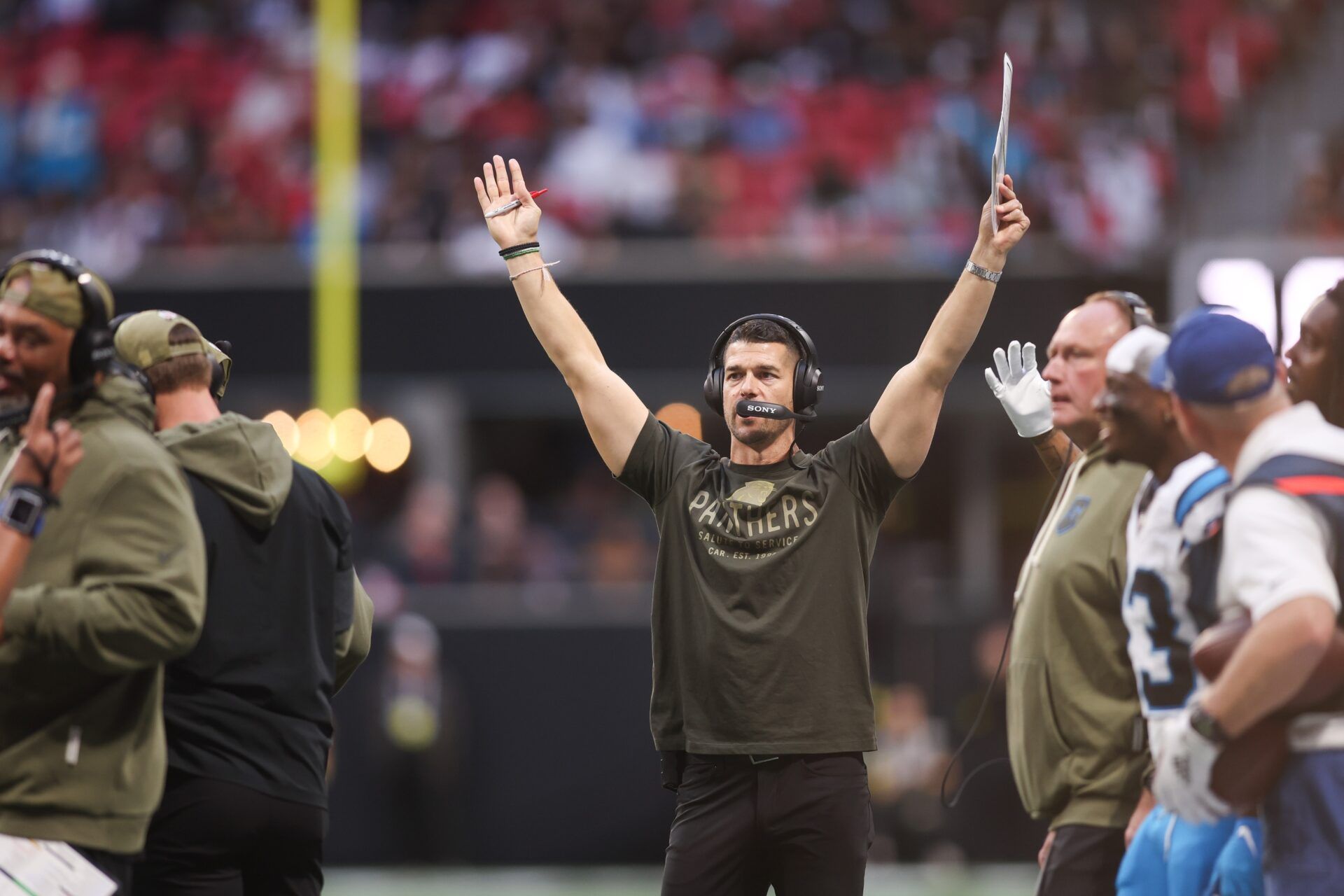
That same story is unfolding now for Carolina Panthers second-year head coach Dave Canales.
The 44-year-old Canales earned a reputation as a ‘quarterback whisperer’ after productive seasons with Russell Wilson, Geno Smith, and Baker Mayfield. When the Panthers hired him in 2024, the consensus was that he was brought in to ‘fix’ former first-overall pick Bryce Young.
However, Canales’s hiring was not just to revitalize Bryce Young; it was to lead the entire Carolina Panthers team, reflecting the argument that real growth in football is about collective progress, not just individual turnaround.
He was tasked with leading the Panthers to become their best and to win more than five games in a season. Now, a season and a half into his tenure, he’s showing increased comfort in his position.
How Dave Canales Has Developed as the Panthers’ Head Coach
In Tarantino fashion, we begin in the present day with an excerpt from Panthers’ Dave Canales in Monday’s presserwhen asked to give his takeaway from reviewing his play-calling, saying:
“So that has to be the continued commitment to find what works that day, knowing there will be some core stuff that shows up and comes out weekly. But we have to look at each opponent specifically and say, okay, how are we going to attack them and what are they giving us.”
The Panthers finished the 2024 season with five wins, a historically poor defense, an underwhelming passing offense, and a solid-enough rushing attack. A result that had become as Carolina as a four-piece Bojangles’ Supremes combo meal. But it was an improvement on the previous season’s total of two, under an “all-star” coaching staff.
Canales’ impact extends to all three phases of the Panthers’ game. His energy is felt across the team, even as he strategically empowers his coordinators, such as Ejiro Evero on defense and Tracy Smith on special teams, to lead their units.
To illustrate how Canales exemplifies this broader development, the following examines his influence on the offense as well as his overall impact as a leader.
Adapting the Scheme to the Personnel, Not the Personnel to the Scheme
The Panthers’ head coach rarely misses an opportunity to remind that “first and foremost, it starts up front.”, as he did once more on Monday.
The first piece of evidence to introduce into Canales’ development is the variation and modernization of the Carolina run game.
Leaning on Chuba Hubbard as the bellcow and Miles Sanders on third-downs and in relief, the 2024 run scheme consisted of 55.4% (inside zone 39.5%, outside 15.9%) zone concepts, 21.7% man/duo, 2.9% power, and 0.7% counter runs.
After moving on from Sanders and adding Dowdle and Etienne, Carolina upgraded its running backs, opening room for more innovation.
This season, Carolina’s rushing scheme has comprised 47.1% zone (30.1% inside, 17.1% outside), 25% man/duo, 7.2% power, and 6.5% counter concepts.
Dowdle is the NFC’s leading rusher with 833 yards and five touchdowns.
The offense uses less 11 personnel and more 12 personnel, while also incorporating a wider variety in pre-snap motions.
The implementation of pre-snap inserts has introduced multiple angles that Canales can work back to within his offensive designs by adding an additional blocker or changing the entry point and leverage to a playmaker’s route.
Panthers’ Passing Game Emphasizes a Starting Point and Versatility
For a unit that has a No. 1 overall pick playing quarterback, two first-round wide receivers, a former top-six pick at left tackle, and two handsomely paid guards to fortify the interior pocket, the pass game has largely been disappointing.
Canales candidly spoke about his approach to the passing game in Week 11 on Monday, explaining,
“Again, as I have said before, we try to create a focal point of the pass game knowing [Wide Receiver] T-Mack [Tetairoa McMillan] will get targeted in some way, shape, or form. When you create that, then you can kind of tilt the field a little bit and find other opportunities.”
The Panthers’ deep-pass game has been missing in action, with only 8.3% of Bryce Young’s attempts meeting criteria. The lack of an effective intermediate attack has been just as critical to the underwhelming performance of the Carolina air game.
This season, Carolina has dealt with injuries on offense. The offensive line has featured eight different starting units in the first eleven weeks. Jalen Coker missed six weeks with a soft tissue injury suffered in training camp. Xavier Legette missed two games with his own hamstring issue.
Canales refused to make excuses for the Panthers’ pass game woes and routinely accepted accountability.
He also maintained his belief in the players. With his full roster healthy, he showed adaptability in Week 11, after showing rigidity and offering insubstantial remedies the week prior.
The most compelling article of evidence was rookie Tetairoa McMillan’s usage from the slot.
An area that McMillan had performed well from in limited exposures this season, Canales confirmed the intentionality of the adjustment when asked, saying, “Yes. Just trying to move him around, trying to make sure that he doesn’t get the hard down every play.”
Canales continued to break down his understanding of how being adaptive bred success, adding,
“He’s seeing different coverages and maybe try to get him a little access knowing that we can also rely on him to win some one-on-ones out there, but that becomes a really difficult position for the receiver as you’re trying to protect all the angles of the cut for the receiver.”
The result was a franchise record set by Bryce Young for most passing yards in a game (448), and eight catches, 130 yards, and two receiving touchdowns for McMillan. McMillan earned an 83.3 score (third-best) per PFSN’s WRi.
And also the Panthers’ sixth win of the season.
It’s Bigger Than Football, and That’s How the Football Improves
Canales builds genuine relationships with the players in the locker room and treats each return from injury as a personal triumph, often valuing it more than a potential performance boost for the team.
When Legette scored a touchdown in Week 5 against the Dolphins, Canales said he “was about to cry” because of how happy he felt for the second-year wideout who had gotten off to an auspicious start to the season.
The feeling of appreciation was returned by Legette, proving the bond that Canales and his staff have created in the Panthers’ locker room. Legette told reporters, “That shows me that he really believes in me, he cares for me…I want to play with guys like that, play for coaches like that.”
Canales embraces a “player-led” philosophy, which includes hearing firsthand about player preferences and what works for them. That’s what Hubbard and Dowdle did, per Mike Kaye for The Charlotte Observer, following a sluggish start on the ground and a 0-2 record to open the 2025 season.
Hubbard suffered an injury in Week 4 that caused the in-that-moment RB1 to miss the next two weeks. Rico Dowdle produced 473 total yards of offense in that span, organically creating a ‘good problem’ for Canales.
This situation serves as a microcosm of Canales’ impact as a head coach. His thoughtful and grateful navigation of roster challenges has positively impacted both personnel decisions and team morale.
Following the Week 9 home loss to the Buffalo Bills, Canales spoke glowingly of Hubbard’s impact on the culture and team identity, while acknowledging the duties of his position, telling reporters,
“Chuba has meant a lot to this organization, certainly to the identity we want to build our team on. Wanted to give Chuba an opportunity to go out there and continue to impact our team in a positive way. We cannot ignore the fact that Rico has been exceptional in a couple games, and in the opportunities he’s had in the last two weeks.”
The process for first-time head coach Dave Canales hasn’t been and won’t always be smooth. He currently reacts more than he anticipates but continues to collect data and learn.
Clock management and situational decisions need refinement. Handling play-calling and head coaching is a demanding task, and perhaps was initially overwhelming.
Maybe Canales will even consider another new preseason approach.
However, I’m reminded of a phenomenally insightful feature written by Jourdan Rodrigue for The Athletic, in which she details the relationship between former Boise State coach Chris Petersen and Sean McVay, the head coach of the Los Angeles Rams.
In the piece, Rodrigue quotes former Boise State defensive backs coach Jimmy Lake as saying, “First and foremost for Chris Petersen, it was making sure the culture and the connections were right. That said a lot. Then all the X’s and O’s fell into place.”
Results and statistics are easier to quantify and argue over. But Dave Canales is focusing on the people, emphasizing trust, and laying a meaningful foundation.
Asked how he felt after the overtime victory in Atlanta on Sunday, Canales said, “I love this group. I love the physical nature that we play with. I’m proud of the effort. I have been for over a year and a half now.”
As for the Panthers’ players, and if they’ve bought in? Dave Canales iterated, “What we’re waiting for is for these guys to take the wheel, and to say, ‘This is our team, coach, we got it’. I had a bunch of guys coming out of the locker room today saying, ‘We got this. We got this’. They’re just reaffirming.”
