
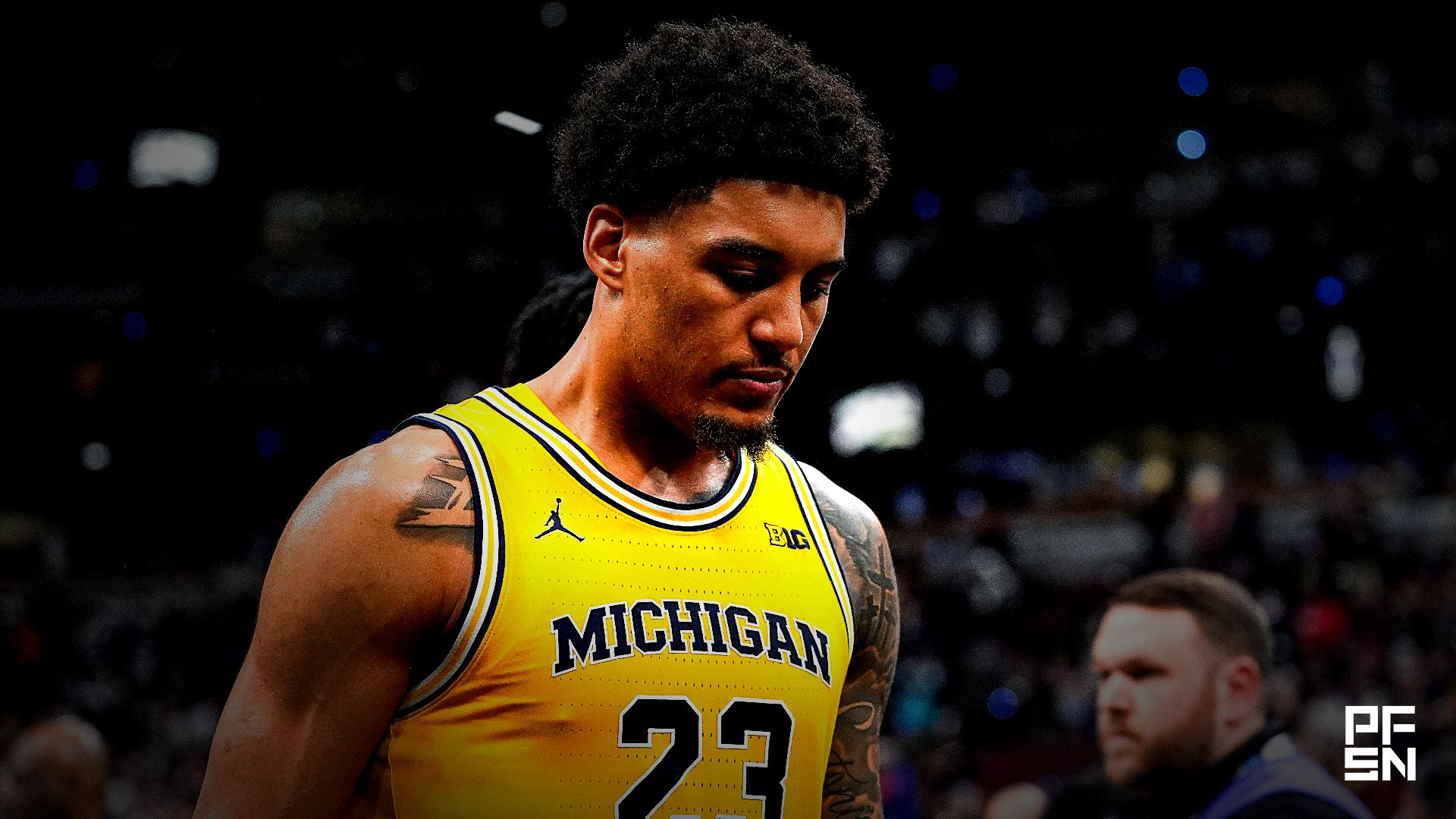
Michigan earned a No. 1 seed in the Midwest Region on Sunday night, and nothing about the Wolverines’ 31-3 season suggests the selection committee got it wrong. Yes, Purdue knocked them off in the Big Ten Championship.
Yes, the bench went cold when it mattered. But Dusty May’s club has been the most consistent team in college basketball since mid-February, and these PFSN Men’s CBB Power Rankings reflect exactly that. With the NCAA Tournament field officially set, here’s where every contender stands heading into March Madness.

1) Michigan Wolverines
Depth issues popped up in the loss to Purdue for the Big Ten Championship (eight bench points on 3-of-15 shooting in 48 minutes), but this team has earned more than enough equity. They’ve been atop these power rankings for over a month now and enter the tournament viewed as such.
The Wolverines set a Big Ten record with 19 conference wins, went unbeaten in true road games, and feature one of the most imposing frontcourts in the country behind Big Ten Player of the Year Yaxel Lendeborg, Morez Johnson Jr., and 7-3 center Aday Mara.
Michigan’s No. 1 seed in the Midwest starts in Buffalo, where they’ll face the winner of UMBC and Howard. The path through the region is navigable, and Michigan’s physicality should travel. This is the team to beat until someone proves otherwise.
2) Duke Blue Devils
Most teams can win when they have their best, but few can knock off quality competition with their C+ game. Duke is an exception. The Blue Devils won the ACC title over a very talented Virginia team in a game in which they missed 17 of 25 triples and saw Cameron Boozer shoot 3-of-17 from the field. That’s an ugly stat line, and they still cut down the nets.
The 2025 version of this team had more raw talent, but this group appears destined to do more damage in the NCAA Tournament. Duke grabbed the No. 1 overall seed and landed in an East Region loaded with UConn, Michigan State, and Kansas.
Jon Scheyer won’t lack for challenges, but the Blue Devils’ ability to win when things aren’t falling is what separates championship-caliber teams from pretenders.
3) Purdue Boilermakers
Four of their five starters scored 14-plus points in the Big Ten title game to upend Michigan. Braden Smith was aggressive as a scoring threat early, which opened up the playmaking we know him for, with 11 assists and zero turnovers. That’s an absurd line in a championship setting. Purdue’s A-game is up there with any team in the country: can we see it for six straight games?
As a No. 2 seed, the Boilermakers have the talent and the backcourt to reach the Final Four. The question has always been consistency with this group, and Sunday’s performance was the kind of emphatic answer that builds real belief heading into the bracket.
4) Arizona Wildcats
Took a Houston punch late on Saturday and responded. Arizona was plus-13 in free throw attempts and was the aggressor from the jump: this team has proven more than any that they can beat a variety of teams in a variety of ways. Tommy Lloyd’s squad has 12 wins over AP Top 25 opponents this season — a staggering number that speaks to the breadth of their resume. The Wildcats earned the No. 1 seed in the West and their ability to adjust on the fly makes them one of the scariest draws in the field. The profile screams Final Four floor, national championship ceiling.
5) Illinois Fighting Illini
A second overtime loss to the Badgers, their fourth OT loss in five weeks overall, ended Illinois’ Big Ten tournament, but they continue to score at an elite rate, and that will matter in the NCAA Tournament. This is one of the more matchup-dependent teams on this list. Counting them out isn’t wise, but in the wrong matchup, they could be one-and-done.
The offense can carry them deep, but if the other end doesn’t tighten up against a team that can control tempo, the Illini are vulnerable. Their No. 3 seed in the South gives them a real path, but the ceiling hinges on whether the defense can hold up for four straight weekends.
6) Nebraska Cornhuskers
Nebraska fell at the hands of Purdue on Friday in a pathetic offensive showing, going 39 percent from the field, 4-of-9 from the free throw line. We really haven’t seen something like that from the Cornhuskers in quite some time, and that has me largely looking past this defeat, but four made free throws in a high-leverage game is concerning.
As a No. 4 seed, Nebraska has the defensive chops to grind out Tournament wins, and the regular-season body of work is strong enough to earn trust. The question is whether Friday’s shooting woes were an outlier or a warning sign about what happens when the pressure ratchets up.
7) Louisville Cardinals
Sometimes you have to lose the battle to win the war. Louisville elected to sit star Mikel Brown Jr. for the conference tournament, and they bowed out early with a loss to Miami. If the freshman is deemed anywhere close to full strength, this profile is going to be one that undershoots the true potential of this team in a survive-and-advance setting.
Pat Kelsey has built something real in Year 2, and the Cardinals earned back-to-back NCAA Tournament bids for the first time in over a decade. This team’s ceiling is directly tied to Brown’s health. If he’s right, Louisville is dangerous enough to reach the second weekend and beyond.
8) Iowa State Cyclones
The Cyclones were better than Arizona for the majority of their game on Friday night, but they fell at the buzzer. Milan Momcilovic was excellent (28 points on 18 shots), but the team missed four of eight free throws and got virtually nothing from the bench (three points across 48 minutes).
The flaws are evident, but the strengths can overcome them on most nights: this is a team with national championship dreams, and I’m not here to deny them of that.
Iowa State lands as the No. 2 seed in the Midwest and has the defensive identity to survive close games. T.J. Otzelberger’s system doesn’t need a deep bench if the starters are playing 35-plus minutes at this level, and they’ve proven they can.
9) Michigan State Spartans
Sparty enters March Madness having lost two straight, but their ability to create their own offense by bringing down their own misses makes them a threat in any matchup. Need proof? Jaxon Kohler, Carson Cooper, and Jeremy Fears combined for 64 points in the regular season finale against Michigan.
Tom Izzo’s program doesn’t need a history lesson about what it can do in the Tournament. This is a No. 3 seed in the East with the physicality and experience to make life miserable for anyone on the other side of the bracket. Two losses to close the regular season and conference tournament aren’t ideal, but Izzo teams have a way of finding another gear when the lights get brightest.
10) Gonzaga Bulldogs
The ‘Zags handled business in the WCC tournament and got 21 points from Mario Saint-Supery in the title game. This isn’t one of the 10 most talented rosters in the country, but in terms of mean expectations on any given night, their floor ranks alongside most of those seeded ahead of them. Mark Few’s program runs on system and preparation, and as a No. 3 seed, Gonzaga profiles as a nice leverage pick on the three line. Don’t expect flashy wins, but expect competence in every game and the occasional performance that reminds you this program has been here before — many, many times.
11) Texas Tech Red Raiders
The production void left by JT Toppin has become clearer lately, with three straight losses heading into the NCAA Tournament. But the guard tandem gives this team a chance in any game that gets played with pace. Christian Anderson is comfortable shouldering a heavy workload, and Donovan Atwell’s sweet left-handed stroke always seems to be perfectly calibrated.
This team had Final Four dreams at full strength, and while that’s not the case anymore, they can get as hot as anyone for stretches of time. A No. 5 seed in the Midwest means Texas Tech will need to win shootouts early. Fortunately, this backcourt is built for exactly that.
12) Arkansas Razorbacks
Upsets paved the way to an SEC Tournament win, and while Darius Acuff’s shot-making was the clippable highlight, how about the 11 assists? That’s now 11 straight games with at least five dimes, and that mature profile for a freshman is how deep tournament runs happen.
John Calipari finally has a point guard running his system the way he wants, and the Razorbacks’ late-season surge earned them a No. 4 seed. Arkansas doesn’t have the most talented roster in the field, but they’re playing their best basketball at the right time, and Acuff’s ability to create for others gives them a dimension most mid-seeds lack.
13) Saint Louis Billikens
The loss to Dayton was chaotic at the end, but if you defend without fouling, that moment never happens. As a result, 24 of Dayton’s 70 points came at the line. This has been a .500 team for the past month, and while their early-season resume will have them dancing, their recent form makes them a tough click.
Sign up for our FREE March Madness betting newsletter that will carry you through everything bracket-related: from beating your co-workers to best bets and so much more!
Saint Louis landed as a No. 9 seed and could draw Michigan in the second round. The Billikens need to rediscover the version of themselves that ripped off wins in November and December, because the team that showed up in February and March isn’t scaring anyone.
14) UConn Huskies
After looking close to unbeatable for three months, the Huskies are taking on some water. The 20-point loss to St. John’s on Saturday is the latest example, but they had to outlast Seton Hall to close February and fell at Marquette a week later.
Any team in the country is going to lose when they miss 16 of 19 triples and commit 17 turnovers: chalk up the loss as a blip, though the blips are becoming more routine at the worst possible time.
Dan Hurley’s group earned a No. 2 seed in the East, and the talent is undeniable. But the trajectory over the last three weeks is heading in the wrong direction, and that East Region bracket, with Duke looming, leaves zero margin for error.
15) North Carolina Tar Heels
This team has talent, but without Caleb Wilson, they lack upside. They fell to Clemson in their first ACC Tournament game, and we saw their variance on full display — 31 points in the first half and 48 in the second. Henri Veesaar can dominate for stretches, but he’s got a lot on his shoulders entering the NCAA Tournament.
North Carolina grabbed a No. 6 seed and opens against VCU, but the ceiling feels capped without their star. Hubert Davis will need Veesaar to be superhuman, and the supporting cast to find consistency that hasn’t been there lately.
16) Wisconsin Badgers
The Badgers downed Illinois for the second time in five weeks before bowing out to Michigan in a thriller at the Big Ten tournament. You could argue that the Nick Boyd/John Blackwell backcourt is as dangerous as any in the country, and that makes this a team to watch over the next two weeks, even without an elite seed.
Wisconsin landed as a No. 5 seed in the West, and its three signature wins (at Michigan, at Illinois, and vs. Michigan State) prove they belong on this stage. Boyd’s experience in March (he took FAU to the Final Four in 2023) is the kind of intangible that shows up when games get tight.
17) Tulsa Golden Hurricane
The 13-point loss over the weekend at the hands of Wichita State was a black eye, but not overly surprising. Their three-point count was more than double that of their free-throw count in the loss, and that profile introduces plenty of variance.
You take the good with the bad, and the bad ultimately came at the worst possible time for their tournament dreams. Tulsa will head to the NIT as a No. 1 seed after falling short of the Big Dance, a tough pill to swallow for a group that was in the at-large conversation for much of the season.
18) Alabama Crimson Tide
They got knocked off by a good Ole Miss story in the SEC tournament, but any team that leans into their style the way the Tide does can do damage. Alabama ranks among the absolute elite in terms of pace, three-point rate, and turnover percentage.
Even if the defense is inconsistent, if they’re clicking on the offensive end, this team can score 85-plus on any team in the nation. As a No. 4 seed, the Tide has the firepower to torch anyone through the first weekend. Whether they can string together enough stops to survive a second-weekend opponent is the real question.
19) Iowa Hawkeyes
This profile has holes, but the defense is better than years past, and that has allowed this team to play just about everyone tight thus far this month. Close games don’t get you anything in terms of results, but with one of the best guards in the nation running the show in Bennett Stirtz, this is a team that isn’t far from strong results.
Iowa’s bracket positioning as a No. 9 seed means they’ll need to pull an upset early, but Stirtz is the type of player who can single-handedly elevate a team in a one-game setting.
20) SMU Mustangs
If BJ Edwards is truly back, my numbers back this team as one to watch. The resume has been uneven for two months now, and if Edwards is compromised, the upside is limited. That said, they’ve hung with strong competition this season, and a little added offensive firepower could make them sneaky dangerous.
SMU heads to the First Four in Dayton, where they’ll need to beat Miami (Ohio) just to reach the Round of 64. Still, if Edwards is healthy, this roster is better than its seed suggests.
21) Saint Mary’s Gaels
The Gaels lost to Santa Clara in the WCC tournament, but a team that rebounds at an elite rate like this is capable of competing at a high level. They need to convert those boards into scoring opportunities to truly make noise, but Paulius Murauskas can put the ball in the bucket in a variety of ways, and that gives this team a reasonable Tournament ceiling.
As a No. 7 seed, Saint Mary’s has the floor to survive the first weekend and the rebounding edge to make life uncomfortable for teams that don’t crash the glass with the same intensity.
22) Miami Hurricanes
The ‘Canes rarely threaten opposing defenses from the outside, and that flaw was evident in their tournament loss to UVA. The percentage was low (4-of-20), but it was more than that: it was the uncomfortable nature of having to shoot 20 in the first place.
If Miami can stay close, they can compete with anyone, but the second they fall behind by a few possessions in the second half, the offense gets tight in a hurry. A No. 7 seed gives them a reasonable first-round draw, but the ceiling is dictated by shot-making that hasn’t been there consistently.
23) Vanderbilt Commodores
The Commodores ultimately ran out of gas against Arkansas in the SEC Championship as Tyler Tanner struggled (3-of-15 from the field). This team can score in waves, and while they are streaky, beating Tennessee twice and Florida once in an eight-day window proves that those streaks can last for extended periods of time.
As a No. 5 seed, Vanderbilt has the talent to make noise, but the question is which version of this team shows up. When Tanner is on, the Commodores can hang with the best in the country. When he’s not, they’re fighting uphill.
24) Virginia Cavaliers
Virginia gave Duke all they wanted and then some in the ACC title game, and while they ultimately fell short, they showed well for themselves.
Holding Cameron Boozer to 13 points on 17 shots is quite the accomplishment, and it didn’t come out of nowhere: this defense holds one of the highest block rates in the sport, and that makes them a viable pick against any team that is at risk of missing triples in bulk.
Virginia’s No. 3 seed in the Midwest means they’ll be a trendy upset pick for anyone who watched them nearly take down the No. 1 overall seed on Saturday.
25) Ohio State Buckeyes
This isn’t a perfect team, but behind Bruce Thornton, they battle for all 40 minutes. They put real pressure on Michigan in the Big Ten tournament, and the range of John Mobley Jr. really makes this an interesting team to track.
They aren’t going to be favored to do damage, but this is a team that is certainly capable of knocking off high-end opponents. As a No. 8 seed, Ohio State profiles as one of those first-round matchups no top seed wants. Thornton has the experience and the composure to keep the Buckeyes competitive deep into the second half, and that’s where upsets are born.