
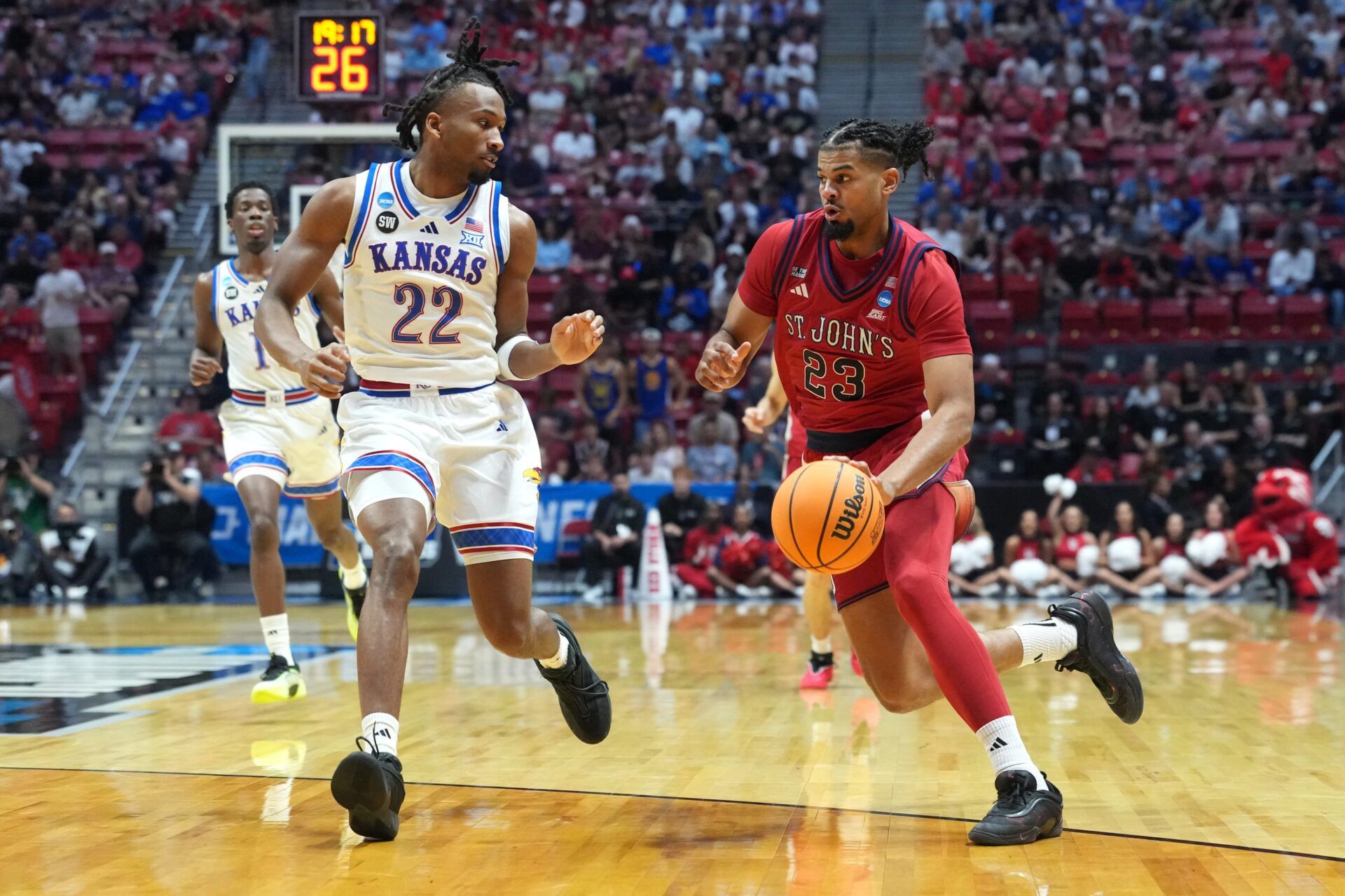
The spotlight on Darryn Peterson has again intensified, but this time following Kansas’ early exit from the NCAA Tournament. Widely projected as a top pick in the 2026 NBA Draft, the freshman guard entered March Madness with huge expectations.
However, his potentially final collegiate performance has sparked debate about his readiness to be the No. 1 overall selection. Analysts are now weighing his immense talent against concerns about consistency and impact in high-pressure moments. Among those voicing strong opinions is ESPN analyst Seth Greenberg, who did not hold back in his evaluation.

Seth Greenberg Questions Darryn Peterson’s No. 1 Pick Credentials
Kansas’ 67-65 loss to St. John’s in the Round of 32 marked what is likely Peterson’s final college game. While he led the team with 21 points, his efficiency and overall control of the game left room for criticism. Speaking on “Get Up,” Greenberg acknowledged Peterson’s natural ability but emphasized that elite prospects must deliver in defining moments.
“He’s an incredible talent. He’s an incredible prospect. Having said that in that game, on that stage, against that team (St. John’s), I wanted him to go all Darius Acuff Jr. I wanted him to take over the game. Five for 15 wasn’t efficient,” Greenberg said.
“To me, sometimes he just disappeared in the game. The guy is a ridiculous shot maker. He can do it all. He can catch it, he has a middle game, he shoots the three, but he doesn’t work as hard as he needs to work to get freed up.”
Greenberg’s comments reflect a broader expectation placed on top-tier prospects: the ability to dominate when it matters most, especially in the NCAA Tournament. Beyond just the stat line, Greenberg raised deeper concerns about Peterson’s approach within games. Despite Peterson’s complete offensive skill set, the analyst suggested that he does not consistently put himself in positions to maximize his impact.
“So Darryn Peterson, special talent, but in that environment, in that game, a game you must win against St. John’s, you need to take over the game. You need to have that mentality like [Darius] Acuff Jr. had the other night. And I just did not see that, and that is my concern for Peterson, and that’s why I would not take him number one,” Greenberg added.
“The guy is a ridiculous shot-maker… but he doesn’t work as hard as he needs to. … That is my concern for Peterson, and that’s why I would not take him No. 1.”
—@SethOnHoops on Darryn Peterson after Kansas’ season-ending loss to St. John’s 👀 pic.twitter.com/RowA3LPP83
— Get Up (@GetUpESPN) March 23, 2026
The criticism after his exit only highlighted a key talking point in Peterson’s evaluation: whether his effort and consistency match his undeniable talent. The Jayhawks star’s season was not without challenges, as the freshman dealt with injuries. He previously addressed those struggles, offering insight into what he endured behind the scenes.
“I was hurt for the majority of the year,” he said, via B/R. “I went through some really bad stuff. I wasn’t really myself for real until like the end of the year.”
That context adds nuance to his performance, as his late-season form may not fully reflect his overall potential. Still, questions about durability and consistency have become part of his draft profile.
Nevertheless, Peterson remains firmly in the conversation as a top-three pick, with no clear consensus on who should go No. 1 overall. The debate also includes other elite prospects, including BYU’s AJ Dybantsa and Duke’s Cameron Boozer, making this one of the more open draft races in recent years.
Peterson’s evaluation will likely hinge on how teams interpret his combination of talent, adversity, and areas for growth. If he can convince franchises that his inconsistencies were situational rather than fundamental, his stock could stabilize. Ultimately, his long-term success may depend less on where he is drafted and more on how he develops at the next level.
