
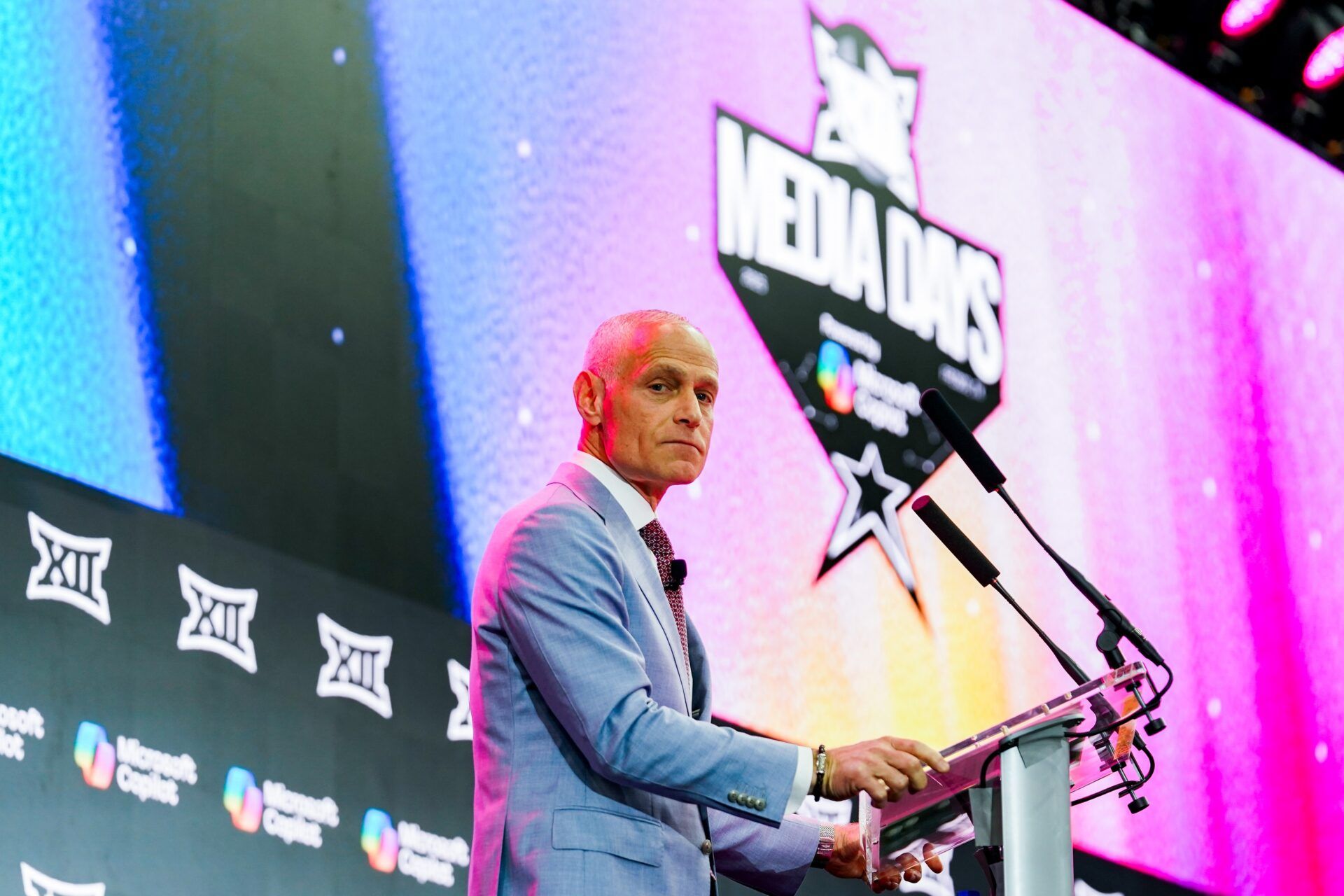
Following the health news from two of the conference’s biggest names, Big 12 Commissioner Brett Yormark has broken his silence.
When speaking to On3 journalist Brett McMurphy, Yormark spoke about Colorado football coach Deion Sanders’ cancer recovery and Kansas basketball coach Bill Self’s heart procedure, revealing how these health scares have reshaped his thinking about wellness in college athletics.

How Did Brett Yormark Respond to His Star Coaches’ Health Crises?
Big 12 Commissioner Brett Yormark didn’t hold back his relief when speaking to On3’s Brett McMurphy.
“I’m incredibly relieved to hear that Coach Prime has been successfully treated and is recovering,” he stated. “His message today, encouraging everyone to be proactive with their health, was inspiring, and I look forward to him being back on the sidelines this fall.”
In light of Deion Sanders’ announcement that he underwent a bladder removal to eliminate cancer there, Big 12 commissioner Brett Yormark reached out with a message of support. He released it in a statement exclusive to On3’s Brett McMurphy. https://t.co/QYUKZtc0G1
— Christy McMurphy Favors (@ChristyFavors3) July 29, 2025
The commissioner’s words carried weight beyond typical administrative support. He extended similar sentiments to Kansas’ Bill Self.
“I also want to extend my best wishes to Coach Bill Self for a full and speedy recovery. Coach Prime and Coach Self are legends in their respective sports, but more importantly, they are exceptional human beings and impactful leaders of young men.”
Yormark’s response goes deeper than standard conference politics. Sanders’ cancer recovery and Self’s heart procedure represent more than just coaching challenges – they highlight the human side of college athletics’ biggest personalities.
What Did Sanders and Self Reveal About Their Health Battles?
Sanders’ July 28 press conference delivered a sobering message wrapped in his trademark directness. The Colorado coach revealed his bladder cancer diagnosis came through a routine test, transforming what could have been a normal checkup into a life-saving discovery.
“Please, get yourself checked out. Especially us African American men,” Sanders urged. “I’m not just talking to the brothers, I’m talking to my Caucasian brothers, my Hispanic brothers, my Asian brothers… everybody and my sisters… Because it could have been a whole ‘nother gathering if I hadn’t.”
The reality of Sanders’ situation hit home in practical ways. According to the press conference, he “lost 25 pounds” during treatment and now relies on a sideline porta-potty during games.
However, his gratitude overshadowed any inconvenience. Sanders shared how fortunate he felt that his condition was discovered early, expertly diagnosed, and finally cured.
Meanwhile, Self’s health scare took a different but equally serious path. The Kansas coach was hospitalized for “concerning symptoms” that led to a heart procedure requiring two stents.
He stated, “I want to thank all the amazing doctors and nurses at LMH Health for the excellent care I received during my stay there. I feel strong and am excited to be home. Our team has had a productive summer and looks forward to our batteries being recharged and prepping for this upcoming season.”
How Will These Health Recoveries Impact the Big 12’s Future?
Both coaches are set to return for their respective seasons, providing stability for their programs and the conference. Self, the 62-year-old, two-time national champion (2008, 2022) and nine-time Big 12 Tournament winner, remains committed to coaching Kansas, despite past health setbacks that sidelined him for the 2023 tournaments.
For Yormark, these recovery stories present an opportunity beyond just getting his star coaches back on the sidelines. Sanders’ advocacy for regular health screenings aligns with the commissioner’s vision for promoting wellness awareness throughout the Big 12.
The conference now has two powerful voices championing proactive healthcare. Sanders and Self serve as living examples of how early detection and proper treatment can save careers and lives. Their experiences will likely influence how the Big 12 approaches health and wellness initiatives for coaches, staff, and student-athletes in the future.
These recovery narratives also strengthen the conference’s image, showcasing resilience and leadership that extends far beyond wins and losses. With both coaches returning healthy and motivated, the Big 12 enters the 2025-26 season with renewed appreciation for what truly matters in college athletics.
