
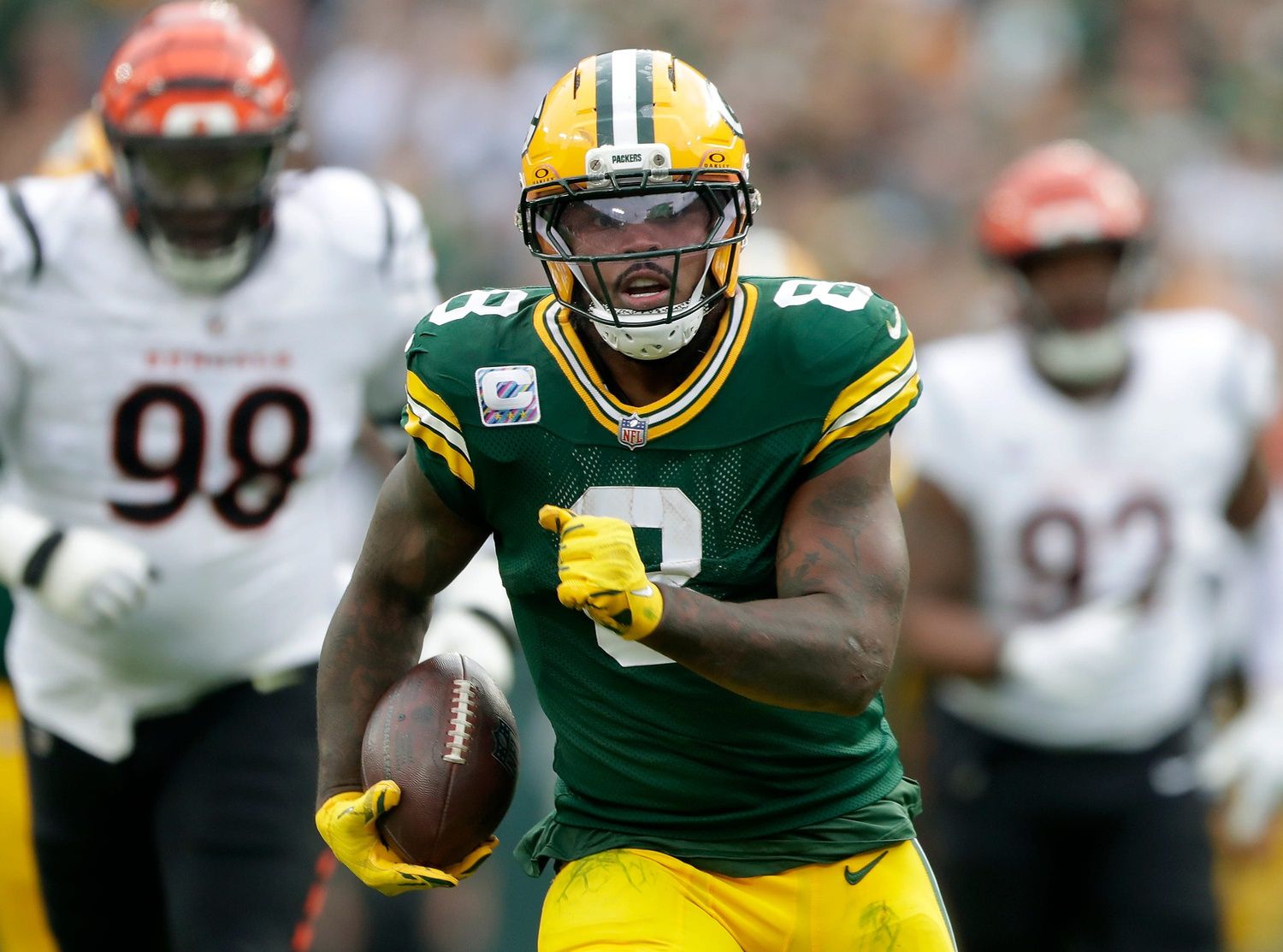
The Green Bay Packers left New Jersey with a win but also renewed concern over their lead running back.
Josh Jacobs’ knee injury, triggered when his knee slammed into the MetLife Stadium turf, turned an ordinary play into a lingering problem that now sits at the center of a broader player-safety discussion. His reaction afterward made clear that the moment carried more weight than a single missed half.

Josh Jacobs’ Frustration Highlights Longstanding Surface Concerns at MetLife Stadium
Jacobs did not hold back when evaluating the field conditions. Speaking to reporters, via Matt Schneidman of The Athletic, he described MetLife Stadium’s surface as “Definitely the worst. Always been the worst.”
He added that if he ever returned, he would avoid discussing it in advance because “I talked about it all week, how bad it was, and it bit me in the a**.”
His comments underscored how strongly players feel about the quality of certain artificial playing surfaces and how quickly concerns can escalate after an injury.
Before exiting, Jacobs logged seven carries for 40 yards, helping the Packers build early rhythm in a game they ultimately won 27-20. Emanuel Wilson closed things out with an 11-yard scoring run, but the offense lost its primary driver after halftime.
Medical tests this week brought relief. Team updates confirmed that Jacobs suffered no structural damage, diagnosing the injury as a knee contusion rather than anything requiring surgery or an IR stint. The team labeled him week-to-week, leaving open the possibility he could return Sunday.
Jacobs’ value to the Packers this season is reflected even more clearly in PFSN’s RB Impact metric. He holds an RB Impact Score of 81.9 with a B- grade, ranking 12th among running backs for the 2025 season. Through 10 games, PFSN places him 103rd overall in its multi-year database.
His workload has been heavy: 169 rushing attempts, 648 rushing yards, and 11 rushing touchdowns, with an average of 3.8 yards per carry and 28 receptions on 35 passing-game targets. Those numbers illustrate why even a temporary setback carries real consequences for a Packers offense navigating injuries elsewhere.
His sharp criticism of MetLife Stadium’s surface connects to a much larger issue. The venue is shared by the Giants and Jets, which creates enough revenue to support higher-quality playing conditions. Yet turf changes have become tangled in collective bargaining, with owners holding firm until the NFLPA concedes something meaningful.
The stadium will install grass for next summer’s FIFA World Cup, but that does nothing for NFL players in the present.
Jacobs’ frustration reflects longstanding concerns that extend beyond one bruised knee. His injury may have been a matter of timing, but the reaction it sparked shows how the debate over turf, safety, and team investment continues to shape conversations inside locker rooms.
