
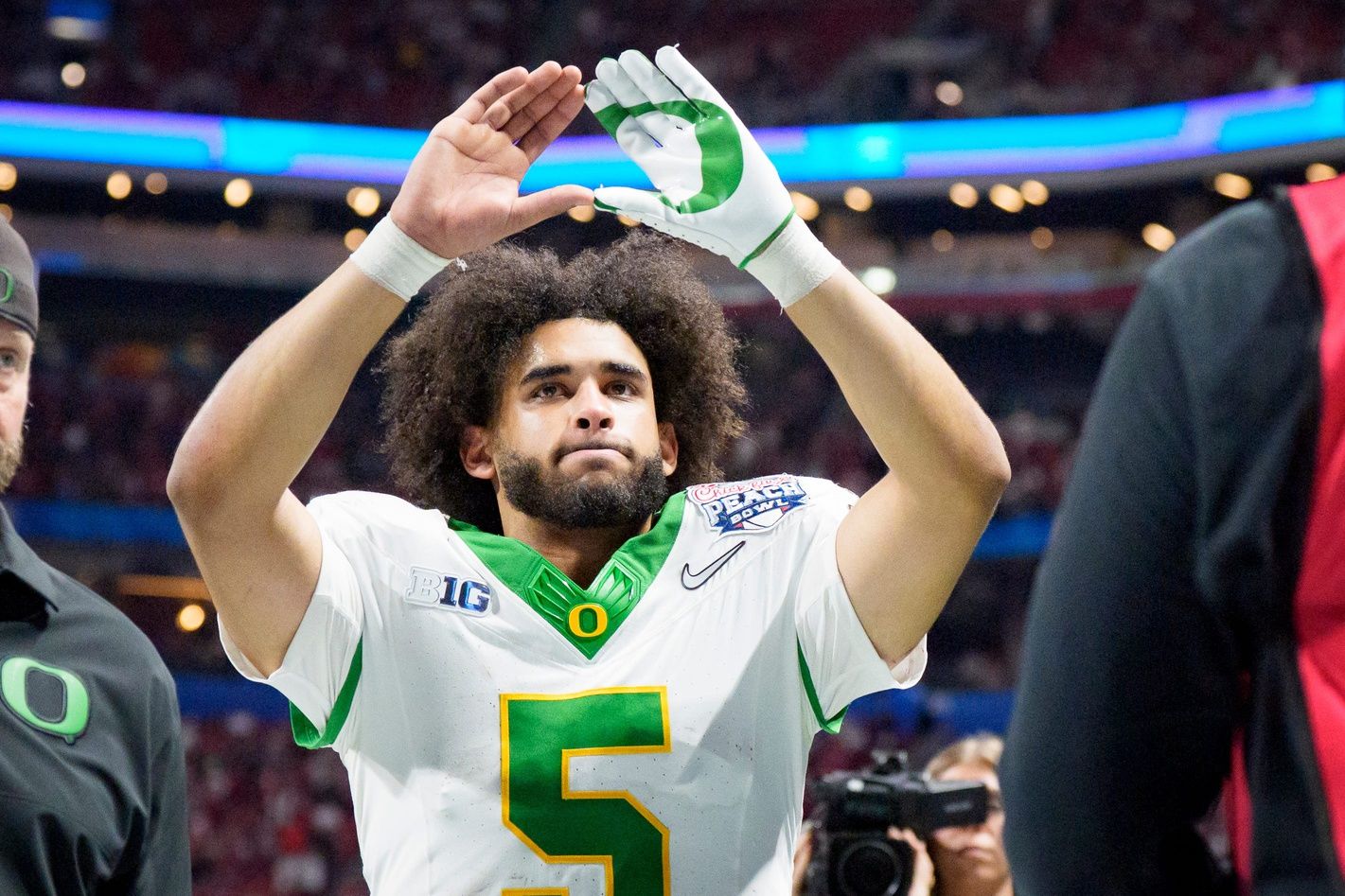
The New York Jets entered the 2026 draft cycle hoping the quarterback question might finally come into focus. Instead, a decision made thousands of miles away reshaped their outlook. Dante Moore’s choice to return to Oregon did not just alter draft boards. It reopened deeper questions about timing, risk, and the Jets’ fragile future.

Dante Moore’s Decision Forces the Jets Into a Risky Waiting Game
ESPN insider Adam Schefter reported that Oregon quarterback Dante Moore will return to school for the 2026 season, bypassing what many believed was a chance to be selected near the top of the NFL Draft. The decision immediately affected teams drafting early, particularly the Jets, who currently hold the second overall pick.
Moore’s announcement became a focal point on The Dan Patrick Show, where former Jets quarterback and 1988 NFL MVP Boomer Esiason offered a counterintuitive take. “I think the Jets lucked out,” the four-time Pro Bowler said, later adding that Moore was making “a $50M bet on himself.”
“I think the Jets lucked out. I think Dante Moore is making a $50 million bet that, would be hard for me to do that… I think he made the right decision.”
– @7BOOMERESIASON on Dante Moore returning to Oregon, and what’s next for the #Jets. pic.twitter.com/2DTzUdyg4E
— Dan Patrick Show (@dpshow) January 15, 2026
Esiason explained he had publicly advised Moore to remain in school, pointing to the need for more experience before making the leap.
That financial framing stemmed from reporting by ESPN’s Pete Thamel, who noted Moore could have secured close to $50 million in guaranteed money had he entered the draft and been selected second overall. Matt Clapp of Awful Announcing relayed Esiason’s remarks, underscoring how rare it is for a quarterback to turn down that level of security.
Moore’s on-field production explains why the decision carried so much weight. The 6-foot-3, 206-pound sophomore from Detroit threw for 3,565 yards during the 2025 season, tied for 12th nationally.
He added 30 passing touchdowns, tied for sixth, while throwing 10 interceptions. His 78.6 quarterback rating ranked 14th across college football, reinforcing both his upside and the belief that another year could raise his ceiling.
For the Jets, Moore’s return removes a potential answer at a moment of urgency. Head coach Aaron Glenn is coming off a three-win season defined by offensive dysfunction and instability at quarterback after Justin Fields failed to hold the job.
Those struggles were reflected in league-wide metrics. According to PFSN’s Offense Impact Metric, the Jets posted a score of just 58.7 in 2025, far below the league average of 74.2 and ranking 29th overall.
The Jets finished 3–14, received an “F” offensive grade, and ranked 29th for the season, with an overall ranking of 817, highlighting how far the unit lagged behind competitive teams.
With Moore out of the picture and uncertainty surrounding other quarterback options, the Jets may be forced to select the best non-quarterback available at No. 2. That path raises difficult questions about Glenn’s job security and how the Jets eventually find a franchise passer.
Moore’s decision does not fix the Jets’ quarterback problem. But it may have spared them from tying their immediate future to a player still viewed as unfinished. In that sense, Esiason’s argument resonates. Sometimes, missing out is not a loss. It is a pause.
