
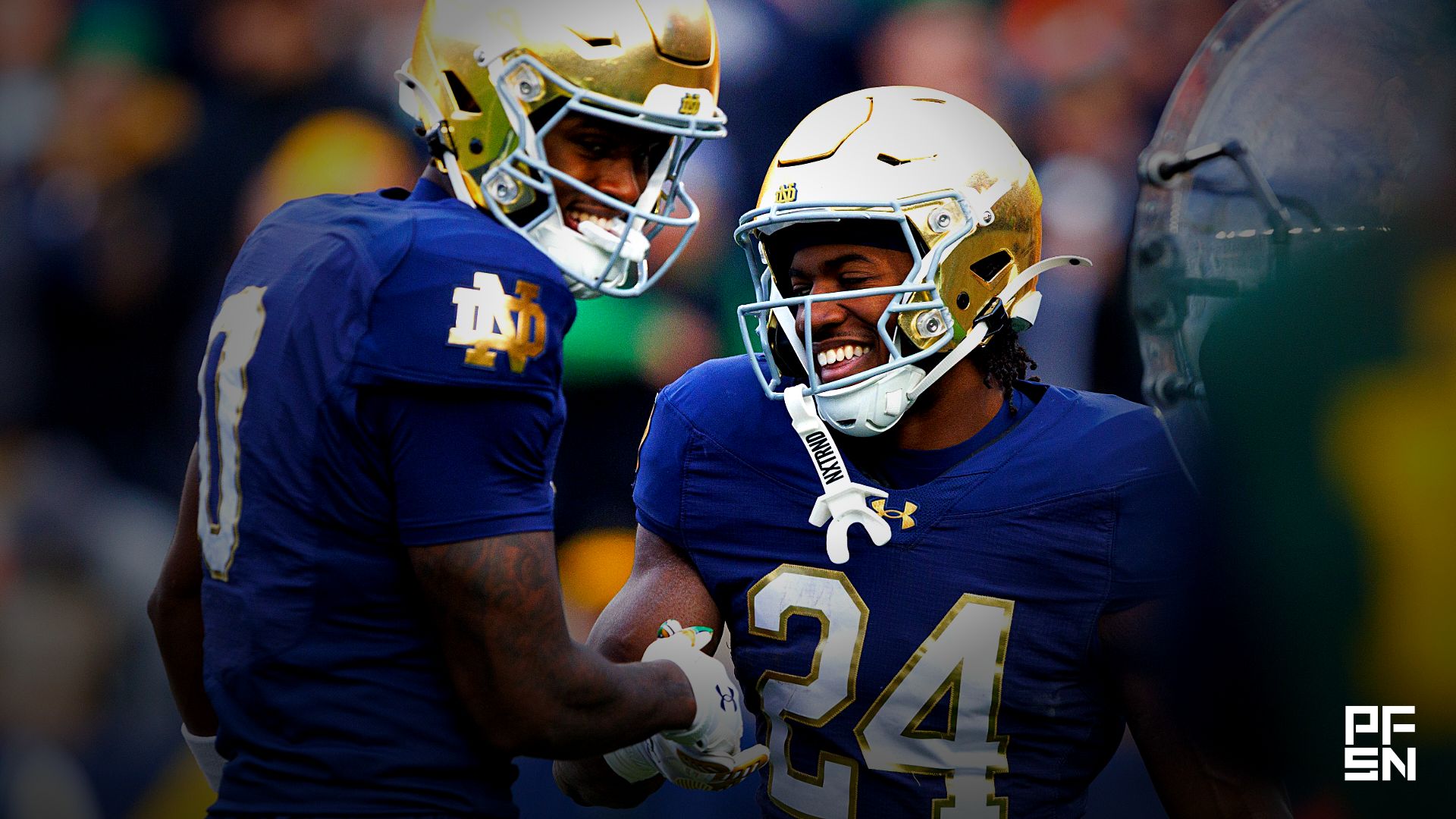
The Seattle Seahawks closed Round 1 of the 2026 NFL Draft by spending the 32nd overall pick on Jadarian Price, a Notre Dame running back most evaluators graded as a Day 2 prospect. PFSN’s consensus grade for the pick landed at D-.
For more hot takes, recaps, and analysis, make sure to tune into PFSN’s Football Debate Club throughout the entire three days of the NFL draft.

Jadarian Price to Seahawks Fills a Role He Never Played at Notre Dame
The Seahawks did have a need at RB, as Kenneth Walker III departed for the Kansas City Chiefs in free agency after winning Super Bowl 60 MVP, and Zach Charbonnet faces an uncertain timeline after tearing his ACL in January.
The depth chart behind them featured George Holani and Emanuel Wilson, both rotation pieces. John Schneider needed a back, and he found one in price.
Whether the back he found can do the job is a different question. Price reached 15 or more touches in a single game just once across 41 college appearances and logged only 18 career targets in the passing game. He played behind Jeremiyah Love, the No. 3 overall pick who went to the Arizona Cardinals, and his Notre Dame role was complementary by design. With Charbonnet sidelined into the season, Price may have to function as the lead back from Week 1.
PFSN’s lead NFL draft analyst Ian Cummings flagged the value gap on the live 2026 NFL Draft “Football Debate Club” show, where he had Price 87th on his board.
“I can see the reasoning for it, but it’s a little rich,” Cummings said, arguing there’s “no value” in the pick given how high he went.
His scouting concerns went beyond the slot. Cummings argued Price isn’t quite the creative interior runner some evaluators had pegged him as, and he questioned whether the receiving production was anywhere close to where it needed to be for a first-round back. The frame Cummings landed on was a long-strider with vertical juice and cutting flexibility, but instincts that didn’t scream Round 1.
The per-touch numbers do have teeth. Price’s 21.2% explosive run rate paced the 2025 class, narrowly ahead of Love’s 19.6%. He averaged 6.0 yards per carry as a senior and returned 3 kickoffs for touchdowns in his career, including two of them in 2025.
The PFSN scouting report frames Price as compelling on his own terms, citing his blend of vision, foot speed, and cutting range, plus utility as a pass protector and a vertical threat. The grade isn’t about the player. It’s about the slot.
The Kenneth Walker III Replacement Question Without a Workhorse on Tape
Price and Love became the first running back duo from the same school taken as the first two backs off the board in a single draft in the common era, dating to 1967. The closest recent precedent is Arkansas in 2008, when Darren McFadden went No. 4 overall to the Raiders and Felix Jones went 22nd to the Cowboys. Jones never carried more than 185 times in a single season and finished his six-season career as a change-of-pace piece with 617 total attempts.
(Ronnie Brown and Cadillac Williams were both top-five picks in the 2005 NFL Draft after sharing the backfield at Auburn, but Cedric Benson went between them at No. 4).
The questions that followed Jones echo in Price’s profile. Workload concerns. Limited receiving production. A college role built on per-touch efficiency rather than volume. With Walker gone and Charbonnet rehabbing, Seattle needs a potential bell-cow, and Price’s tape doesn’t yet prove he is one.
Even Jacob Infante, who had Price 64th on his board, understood the front office conviction. “I get the vision,” Infante said, pointing to Seattle’s Super Bowl roster knowing what works for its offense. He still landed on Price as a clean Day 2 evaluation, citing the short-area quickness and toughness without the breakaway speed of Love or the third-down chops Seattle’s scheme will eventually demand.
If Mike Macdonald and Schneider are right, the 64th-ranked back becomes a 32nd-pick steal. If they’re not, Seattle spent the final pick of Round 1 on a kick returner with a complementary running profile.
Charbonnet’s knee will tell us a lot about which version we’re writing about by November.