
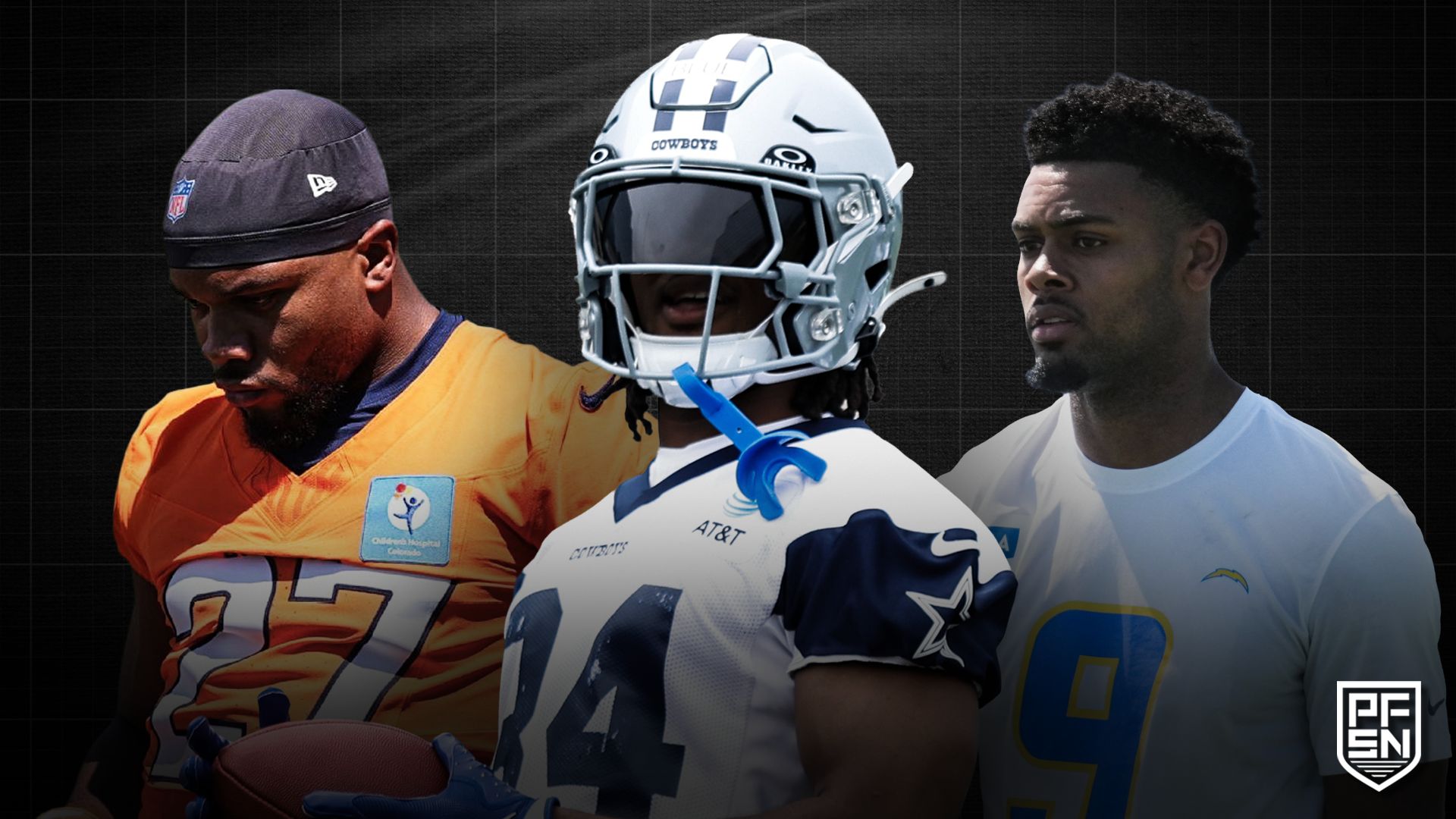
If there’s one thing fantasy managers love, it’s a good sleeper. Yet, today, finding sleepers in fantasy football is more difficult than ever before. Leaving no stone unturned, we’re going through all 32 NFL teams and pinpointing the best sleeper candidate on each.
Top Fantasy Sleeper From Every NFL Team in 2025
Arizona Cardinals: Trey Benson, RB
For the second consecutive year, Trey Benson is the Arizona Cardinals’ sleeper running back. Make no mistake about it, James Conner is the main back, and his role is unlikely to change from last season. He’s the guy. He can play on all three downs. As long as Conner is healthy, don’t expect much from Benson.
With that said, the Cardinals exhibited a real commitment to Benson as the potential next man up. Arizona may have extended Conner, but he’s still 30 years old with a checkered injury past.
It’s hard to envision any scenario where Benson overtakes Conner, or even cuts into his workload. However, if Conner were to miss time, Benson is the RB2 on a depth chart that includes Emari Demercado, DeeJay Dallas, and Michael Carter. Benson could be looking at pretty heavy usage if he were thrust into the lead-back role.
Although Benson only touched the ball 69 times in 13 games as a rookie, he’s still just 23 years old and only in his second season. There’s plenty of room to grow here. Benson deserves to be drafted as a solid handcuff, and his RB43 ADP is very fair.
Atlanta Falcons: Darnell Mooney, WR
This one is a bit of low-hanging fruit. Darnell Mooney proved his sleeper appeal last season. As the Atlanta Falcons’ WR2, Mooney caught 64 passes for 992 yards and five touchdowns. He averaged 12.1 fantasy points per game, putting him firmly in WR3 territory.
Mooney is unlikely to be an elite fantasy asset or a difference-maker, but he’s very much worthy of a spot on fantasy rosters.
Despite a strong 2024 season, Mooney’s ADP sits at WR50. Given that he’s the Falcons’ third-most talented offensive weapon behind Bijan Robinson and Drake London, Mooney is a strong bet to outperform his ADP.
Baltimore Ravens: Keaton Mitchell, RB
Justice Hill is the official RB2 of the Baltimore Ravens, but he’s not a sleeper. Hill is who he is. Even if Derrick Henry were to go down, Hill’s role would likely not change significantly. Sure, he’d see a few more touches, but he’d never be a featured back.
Keaton Mitchell, however, has that potential. Mitchell was starting to break out as a rookie before a torn ACL delayed his ascent. His recovery bled deep into the 2024 season, never really giving him a chance to get going. Before he got hurt, Mitchell displayed explosiveness and serious burst, even totaling 134 yards in his second career game.
We all know Henry is not human. Even at 31 years old, he’s shown no signs of slowing down, and there’s little reason to expect him to break down this year. Despite his size, Henry’s running style is very conducive to staying healthy, which is why he has only missed eight games due to injury in his career, all of them occurring when he broke his foot in 2021.
Mitchell will go undrafted in just about every redraft league. He’s technically the RB3 on his own team and unlikely to matter in fantasy. But football is unpredictable. If Henry does go down, Mitchell, not Hill, is the true sleeper of Baltimore’s backfield.
Buffalo Bills: Joshua Palmer, WR
Something tells me Joshua Palmer’s WR70 ADP won’t last because it doesn’t make sense. By no means should Palmer be some top 40 receiver or even drafted to be a fantasy starter, but we’re talking about someone who has proven himself time and time again.
Palmer, averaging 7.2 ppg last season, can easily be overlooked. The Los Angeles Chargers drafted Ladd McConkey, and he’s elite. In a low-volume passing attack, there wasn’t enough for anyone else, especially with Quentin Johnston taking a mild step forward.
Over the previous two seasons, Palmer admirably filled in whenever one or both of Keenan Allen and Mike Williams were injured and averaged 10.6 and 10.7 fantasy points per game in 2022 and 2023, respectively. Every fantasy manager would sign for that from a guy on the border of even being drafted in fantasy leagues.
Now with the Buffalo Bills, Palmer gets a QB upgrade to Josh Allen and is competing for targets with no one of consequence. Khalil Shakir is primarily a slot receiver, so the two do not overlap.
The Bills lack a true outside flanker, and Palmer has to be considered the favorite. He’s a better player than Keon Coleman. Palmer is a rare true WR sleeper who you can take in the final rounds of any fantasy draft.
Carolina Panthers: Jalen Coker, WR
The Carolina Panthers now have a clear WR1 in rookie first-rounder Tetairoa McMillan. He’s a virtual lock to lead this team in targets and be the top fantasy pass catcher.
Aside from McMillan and, of course, Chuba Hubbard in the run game, any potential tertiary fantasy option is wide open. Given the choice between a 35-year-old Adam Thielen, a first-round bust in Xavier Legette, or the upstart Jalen Coker, we’re going with the 2024 UDFA.
Coker didn’t even see the field until Week 4 and only played 8.7% of the snaps. He started producing in Week 5, giving him 10 games to amass 32 receptions for 478 yards and two touchdowns. By Week 10, Coker was a full-time player, but then an injury cost him another three games.
When on the field, Coker looked the part of an NFL receiver, and he had three weeks of 14+ fantasy points. In just 10 games (not counting Week 4), Coker had as many double-digit fantasy outings as Legette.
Jalen Coker pic.twitter.com/AAiwRkDOJE
— Ian Hartitz (@Ihartitz) January 25, 2025
Bryce Young showed marked improvement over the latter portion of the season. The Panthers should deploy a two-receiver set featuring McMillan and Coker, adding Thielen in the slot in 11 personnel.
Coker’s WR74 ADP puts him about 10 spots behind both Thielen and Legette. That’s wrong, making him another rare true WR sleeper.
Chicago Bears: Luther Burden III, WR
It’s hard to call a second-round rookie who got considerable hype a sleeper, but this isn’t a dynasty league. Luther Burden III has excellent long-term potential, but his rookie year outlook is suspect.
The Chicago Bears have a true WR1 in incumbent DJ Moore, last year’s first-round pick, and Rome Odunze, as well as they drafted this year’s top TE prospect, Colston Loveland, inside the top half of the first round. It’s asking a lot for Caleb Williams, who could barely support one fantasy-relevant pass catcher last season, to support four or five. That’s what makes Burden a sleeper, though.
Chicago’s offense is expected to see significant improvement with a major coaching upgrade, transitioning from Matt Eberflus to Ben Johnson. Williams now has a real coach and a full offseason to improve. Plus, there’s no guarantee Moore and Odunze stay healthy for an entire season. An injury to either one could open the door for Burden.
Historically, rookies have been great bets in fantasy, especially rookie wide receivers over the second half of their inaugural season. With a WR51 ADP, Burden is cheap to acquire. What if his talent is simply undeniable, and you get a WR2 for a WR5 price?
Cincinnati Bengals: Tahj Brooks, RB
Last season, the Cincinnati Bengals had a plan. It was Zack Moss as their power back and Chase Brown as the change-of-pace guy. As the season wore on, Brown proved to be significantly better than Moss, earning a larger role.
However, Moss was never supposed to go away. Unfortunately, a neck injury ended his season. With him gone, the Bengals certainly wanted a second back in the mix, but they didn’t have anyone good enough to justify putting on the field on the roster. Therefore, Brown was seeing literally 100% opportunity shares in some games. The volume was excellent for fantasy purposes, but not something any NFL team wants to do.
This year, Moss is back and should open as the RB2. However, he’s always been a replacement-level talent, at best. Cincinnati also brought back old friend Samaje Perine. He will likely have a role, possibly as a passing-down specialist, but there is no scenario where Perine takes over as the RB1 for an injured Brown.
Enter Tahj Brooks — the Bengals’ sixth-round rookie who was incredibly productive during his final two years at Texas Tech. Of note, Brooks also earned an 8.1% target share in one of those seasons, a bonus when assessing ways he might find the field in 2025.
We’ll need to monitor training camp reports and see if Brooks is climbing the depth chart, but he’s a safe bet to make the team. His RB73 ADP feels relatively high for a guy currently fourth on the depth chart. Nevertheless, he’s the name you want to remember if Brown were to miss time.
Cleveland Browns: Dylan Sampson, RB
There are multiple sleeper options for the Cleveland Browns. Jerome Ford was the lead back last season and has performed well filling in for Nick Chubb. Ford somehow managed to average 5.4 yards per carry on a terrible Browns offense last year, but as the starter in 2023, he posted 12.4 fantasy points per game.
The reason we’re going with Dylan Sampson as the Browns’ sleeper RB is because of what the team told us about their backfield during the NFL Draft. After using an early second-round selection on Quinshon Judkins, Cleveland used a fourth-rounder on Sampson.
If the Browns were comfortable with Ford in a prominent position, they wouldn’t have used two picks in the first four rounds on running backs. Instead, he had to take a pay cut to stay with the team.
Sampson is coming off a nearly 1,500-yard, 22-touchdown season at Tennessee. He’s a bit undersized at 200 pounds, but can serve as the change-of-pace back to Judkins. If Judkins were to get hurt, Ford would probably be the next man up, but Sampson is capable of forcing his way onto the field more.
Unfortunately, Sampson’s RB49 ADP is quite rich for the current RB3 on what will likely be one of the worst offenses in the NFL. He’s still the preferred sleeper RB on Cleveland, but his price dampens his appeal.
Dallas Cowboys: Jaydon Blue, RB
No team has embodied the phrase “running backs don’t matter” more than the Dallas Cowboys. It’s fascinating that they’re the team to disregard the position so much after using the No. 4 overall pick on Ezekiel Elliott in 2016, and it mostly worked out (at least to the extent that Elliott was an elite RB for five years).
Since then, though, Dallas has invested very little in the position. Last year, the Cowboys went into the season with Rico Dowdle as their RB1. Naturally, after letting him walk in free agency, they were widely expected to draft a running back, but they waited until the fifth round to do so.
The Cowboys are entering the season with an RB room of Javonte Williams, Miles Sanders, and Jaydon Blue. We should never be overly excited about a fifth-round pick, but no Round 5 rookie RB has as good of an opportunity as Blue.
Cowboys RB1 Javonte Williams last season pic.twitter.com/d1l0ooz70x
— Ian Hartitz (@Ihartitz) May 11, 2025
Once a promising rookie, perhaps injuries are to blame for sapping Williams’ ability. Regardless of the reason, he’s been dreadful since returning.
Behind him, we have Sanders, who has averaged 3.5 ypc over the past two seasons. Once a promising Philadelphia Eagles prospect (for those who bought in), now 28 years old, it’s a stretch even to call Sanders replacement level. He’s worse than that, earning only a 28.9% opportunity share on the Panthers last season.
Why not Blue? Both Williams and Sanders are on one-year deals. There’s no commitment to them. At just 21 years old, Blue should get a chance at some point. His RB50 ADP is more than reasonable, just be patient as he waits for his opportunity.
Denver Broncos: J.K. Dobbins, RB
Not every team has an appealing RB sleeper. The Denver Broncos, unimpressed by their running back room, made it a point to get their guy in the 2025 NFL Draft, selecting RJ Harvey in the second round.
Once they drafted him, it was hard to imagine anyone else becoming an impactful fantasy option. Last year, the combination of Williams, Audric Estimé, and Jaleel McLaughlin didn’t provide a single weekly fantasy starter. McLaughlin was a preseason sleeper with a little buzz, but he only gave us two usable weeks all season.
Denver was so ineffective that Sean Payton decided he wanted a completely new backfield. First, they drafted Harvey to be the lead back. Behind him, it makes sense that Payton didn’t want to use the cavalcade of misfits he had last season. So, the Broncos signed J.K. Dobbins.
Don’t let Dobbins’ presence scare you off of Harvey, but we did see him have several useful weeks last season (averaged 14.8 ppg in 13 games). If Harvey goes down, Dobbins is the clear favorite for lead-back duties. His RB54 (and climbing) ADP is very reasonable, and he’s one of the better handcuff running backs in fantasy this year.
Detroit Lions: Isaac TeSlaa, WR
It’s tough to imagine Isaac TeSlaa doing anything of note as a rookie. But it’s easier to imagine him being a surprise than it is for 31-year-old Tim Patrick suddenly returning to some level of relevance.
Amon-Ra St. Brown and Jameson Williams are very secure as the Detroit Lions’ top two receivers. With Sam LaPorta as the third option in the passing game and Jahmyr Gibbs one of the most electric players in the NFL, there isn’t much room for any sleepers.
The Lions had no surprise fantasy-relevant players last year and are unlikely to have any this year. However, if you’re going to pick someone, it would be the black box that is the rookie third-round pick.
Green Bay Packers: MarShawn Lloyd, RB
Let’s try this again with MarShawn Lloyd. The Green Bay Packers’ 2023 third-rounder was supposed to be the team’s RB2 behind Josh Jacobs, but he couldn’t ever get any momentum.
Lloyd’s rookie year got off to the worst possible start, with him suffering a hip injury at the beginning of training camp. Just as he was recovering from his injury, he strained his hamstring in the first preseason game. Then, after making his debut in Week 2, he sprained his ankle. Right as he was about to return two months later, Lloyd had to have an emergency appendectomy. It was one thing after another.
Heading into the 2025 season, though, the Packers did nothing to bolster their backfield. They are running it back with Jacobs, Lloyd, Emanuel Wilson, and Chris Brooks.
Wilson was the RB2 for most of last season, with Brooks getting some late-season action as well. But the team wants Lloyd to be their guy.
There’s no real upside in drafting Wilson or Brooks. If Jacobs were to get hurt and Lloyd were unavailable, Wilson and Brooks would form an uninspiring committee. Lloyd, on the other hand, at least has the black box upside of potentially being more of a feature back.
Lloyd’s RB61 ADP suggests he’s on the border of even being drafted in most leagues. If he can stay healthy, though, there is injury-contingent upside with Lloyd.
Houston Texans: Jayden Higgins, WR
The Houston Texans have several candidates who could qualify as sleepers. Basically, anyone in this passing attack not named Nico Collins.
With Stefon Diggs in New England and Tank Dell out until at least 2026, the Texans have an opening at WR2. In an attempt to fill it, they signed Christian Kirk, then drafted Jayden Higgins and Jaylin Noel.
Any one of these three could emerge as a viable fantasy WR3 as the guy opposite Collins. But if we’re going to bet on one, it should be Higgins.
While he’s not a prospect without flaws, Higgins has second-round draft capital, and his main competition is a player essentially making close to the veteran’s minimum in 2025, as well as his college teammate, whom he played ahead of.
Higgins has a WR55 ADP, making him relatively cheap and affordable in fantasy drafts. There’s room for a second fantasy-relevant member of this passing attack. It wouldn’t be a shock if it were Kirk or Noel, but Higgins is the best combination of price and opportunity.
Indianapolis Colts: Michael Pittman Jr., WR
Incredibly, Michael Pittman Jr. can be considered a sleeper just two years after posting near-WR1 numbers, averaging 15.6 ppg. Consider this the Anthony Richardson effect.
Pittman’s outlook for 2025 is bleak. He will be catching passes from either Richardson or Daniel Jones, neither of whom inspires much confidence. Last year, Pittman was outplayed by Josh Downs to the point that fantasy managers have elevated Downs’ ADP ahead of Pittman’s this year.
Over the past two seasons, Pittman has averaged 10.0 points per game with Richardson, compared to 15.8 ppg with other quarterbacks. If you’re drafting Pittman, you probably need to hope Jones gets in there at some point, which, to be fair, does seem likely. Both quarterbacks are likely to make starts this season.
What we know for sure is that Pittman is a talented receiver. He was almost a WR1 two years ago. Last year, he had horrible QB play and gutted out a back injury that was set to end his season, mere days before he miraculously changed his mind and finished out the year. At WR52, Pittman is probably worth the gamble.
Jacksonville Jaguars: Bhayshul Tuten, RB
Can we even call Bhayshul Tuten a sleeper? He, Travis Etienne Jr., and Tank Bigsby all have ADPs within five spots of each other. Technically, they’re all sleepers, and also none of them are.
Tuten qualifies the most because he’s a rookie fourth-round pick, whereas Etienne and Bigsby have had RB1 performances before. Etienne was an RB1 in 2023, and Bigsby was, by far, the best running back on the Jacksonville Jaguars in 2024.
Tuten has a few things going for him, though. While he wasn’t a high draft pick, he was drafted by the current coaching staff. The previous regime drafted Bigsby, and Etienne — who looked like he had no business even being in the NFL last season — was drafted by the coaching staff that was in place two regimes ago.
Jaguars run game was tough late last year pic.twitter.com/hIQrnumevW
— Hayden Winks (@HaydenWinks) May 30, 2025
Bigsby is rather one-dimensional, with very little to offer in the passing game, as evidenced by his 2.4% target share.
Tuten, meanwhile, has a great receiving profile, earning a 12.1% target share in 2023 at Virginia Tech. He’s also super fast, with a 98th-percentile speed score. If you’re betting on a Jaguars RB to outperform his ADP this year, bet on Tuten.
Kansas City Chiefs: Hollywood Brown, WR
This new version of Patrick Mahomes, a game manager who puts on his superhero cape only when necessary, is not exactly conducive to supporting a fourth fantasy-relevant pass catcher.
After Hollywood Brown returned from IR last year in Week 16, he was immediately involved, scoring 9.5 and 8.6 fantasy points, respectively, in his first two games back. Then, the Kansas City Chiefs valued him enough that, despite his limited reps, they held him out with every other key player in Week 18.
However, in the postseason, Brown didn’t do much with games of 6.5 and 3.5 fantasy points. Even so, he’s now entering his second season with the Chiefs and will, hopefully, have a fully healthy training camp and preseason this time around.
We’ve seen Brown give us a full season of WR2 production before. Given his price and the quarterback he’s attached to, fantasy managers could do worse than to throw a dart at Brown at his WR61 ADP.
Las Vegas Raiders: Jack Bech
The Las Vegas Raiders’ WR room is pretty wide open after Jakobi Meyers. Of course, Brock Bowers is technically the WR1, but it’s not as if Geno Smith hasn’t supported three fantasy options before.
Jack Bech is a rookie second-rounder with a rather unimpressive prospect profile. He also hails from TCU, a school that has never produced a quality NFL receiver.
Nevertheless, he does have the inside track to the WR2 role with his primary competition being Tre Tucker. At a WR68 ADP, it’s pretty inexpensive to take a shot on the unknown.
Los Angeles Chargers: Tre Harris, WR
For the second consecutive year, the Chargers spent a second-round pick on a wide receiver. It’s hard to do better than last year with McConkey, who is entrenched as LA’s alpha WR1. He’s going to dominate targets, and no one is threatening that.
As for the WR2, that’s an open competition between Johnston, old friend and new signee Williams, and rookie second-rounder Tre Harris.
Johnston took a significant step forward after a disastrous rookie year, but didn’t quite do enough to shed the bust label fully. The jury remains out, which is why the Chargers opted to draft another receiver as well as sign Williams.
Williams is 31 years old and coming off a season in which he showed a precipitous decline, catching 21 passes for 298 yards and one touchdown in 18 games played between the New York Jets and Pittsburgh Steelers.
Harris is an interesting prospect. He was immensely productive in his final season, but is an older rookie at 23 years old and didn’t break out until midway through his age-20 college campaign.
Even if you’re not bullish on Harris, he’s very affordable at his WR58 ADP. Don’t assume every prospect evaluation we have will be correct. If the value is there, Harris has legitimate sleeper appeal as the potential WR2 in a Justin Herbert offense.
Los Angeles Rams: Blake Corum, RB
It feels like there’s more buzz surrounding Jarquez Hunter this year than Blake Corum. That’s likely because Corum was considered a legitimate threat to Kyren Williams’ three-down back status last year and could not have underwhelmed more.
Corum earned just 65 touches all season, as he played one designated series each game and then only returned to action when Williams was tired. Naturally, the fantasy community is frustrated with Corum being of no value. So, they hype up Hunter as a backup Sean McVay would love.
Hunter is a fourth-round rookie who is poised to be third on the depth chart. Despite Corum’s struggles last season, there’s no indication that Hunter is any threat to Corum’s status as the RB2.
Neither of these backs has any value while Williams is healthy. However, in the event of a Williams injury, it’s hard to imagine anyone other than Corum being the next man up.
Corum’s RB60 ADP is just three spots ahead of Hunter. Sorry, but that’s wrong. That implies these backs are relatively equal, and either one could be the primary beneficiary of a Williams injury. Neither will have any standalone value, but if you’re looking to stash a handcuff in one of the best fantasy situations for a running back, go with Corum.
Miami Dolphins: Jaylen Wright, RB
This is an offense where the primary backup is questionable. We are neither confident in Jaylen Wright as the clear beneficiary of a De’Von Achane injury, nor that he can produce anywhere near the level of the starter.
With Raheem Mostert gone, Wright is undoubtedly the favorite for the RB2 role. However, the team signed Alexander Mattison, who has more experience, and they drafted Ollie Gordon II in the sixth round.
If Achane misses time, the most likely scenario is an ugly committee. It wouldn’t be the least bit surprising to see Wright as the between-the-20s back, Mattison near the goal line, and Gordon on passing downs.
Wright having an RB57 ADP is fair. Gordon at RB66 is ridiculous. This is an offense that likely won’t produce a potent fantasy back without Achane, but if you want to take a shot on a sleeper, it’s Wright.
Minnesota Vikings: Jordan Mason, RB
When talking about sleepers, it’s stretching the bounds of the term to call Jordan Mason one. He’s not exactly flying under the radar. Fantasy managers are well aware of the upside he offers.
The Minnesota Vikings never intended to feed 29-year-old Aaron Jones a career-high 255 carries. They didn’t have a choice, as the options behind him were uninspiring.
To remedy this issue, Minnesota made it a point to acquire Mason, who proved he could be a feature back when filling in for an injured Christian McCaffrey last year.
Mason checks all of the boxes of a backup running back, and we are highly confident that he would be the primary RB if the starter were to go down. He’s capable of producing at 80-90% of the starter, and he very likely has a standalone RB3 value even when Jones is on the field.
Mason is the exact type of backup running back fantasy managers should target. With an RB35 ADP, he belongs on as many of your rosters as you can get him on.
New England Patriots: Rhamondre Stevenson, RB
This is a unique situation, as it’s exceedingly rare for a sleeper RB from any team to be their starter. But make no mistake about it, TreVeyon Henderson is the future of the New England Patriots’ backfield.
Henderson is the Patriots’ RB to roster in both redraft and dynasty/keeper formats. However, the fantasy community seems to have collectively decided that Rhamondre Stevenson is getting thrown in the trash, which isn’t going to happen.
Even if it’s ceremonial, Stevenson will start for New England, likely for most of, if not the entire season. While Henderson is a strong bet to outproduce him from a fantasy perspective, that doesn’t mean Stevenson won’t have value.
Although the Patriots are not inclined to use him this way, Stevenson does have a three-down skill set. His 17.3% target share in 2022 was fourth in the NFL, and last season, he set a career-high 13.8 carries per game.
Even if Henderson makes himself undeniable, we’re still looking at 10-12 opportunities per game for Stevenson. Plus, he should be the goal-line back the entire season at 231 pounds while Henderson sits at 202. That alone will keep Stevenson’s RB3 value afloat.
Then, of course, we have the injury contingent upside. If Henderson goes down, we’re right back to Stevenson in a lead-back role.
Stevenson is a starting running back on an ascending offense with an RB37 ADP. At the very least, he should provide par value. At best, he maintains a more substantial percentage of this backfield than anticipated, or Henderson gets hurt, and we get an RB2 for an RB3 price.
New Orleans Saints: Rashid Shaheed, WR
For this one, the question is whether Rashid Shaheed is a sleeper, and why. Before getting hurt last season, Shaheed was averaging 12.6 fantasy points per game (3.0 more than Chris Olave). Are we sure Olave is that much better than Shaheed in fantasy (WR36 vs. WR54 in ADP)?
Shaheed opened the 2024 season with four games of at least 16.3 fantasy points. He’s volatile, reliant on splash plays, and is inexpensive.
The New Orleans Saints will be bad, but that means they are trailing and throwing. Plus, it’s not like they’re going to score zero touchdowns. Shaheed is a big play waiting to happen and costs next to nothing to acquire.
New York Giants: Wan’Dale Robinson, WR
There isn’t a clear sleeper on the New York Giants. While the QB play can’t possibly be worse than Jones and Tommy DeVito, there’s Malik Nabers, and then there’s everyone else.
Wan’Dale Robinson is technically the WR2, but he’s primarily a slot guy. That leaves Darius Slayton as the opposite flanker.
There will be weeks where Robinson sees a ton of underneath targets and is a PPR machine. There will be weeks where Slayton gets open downfield and puts up fantasy points on low volume. It won’t be easy to predict, and fantasy managers won’t likely want to start either.
Robinson gets the nod because his ADP is higher at WR72, putting him on the border of being drafted. Additionally, he’s younger and averaged a respectable 10.8 ppg last season.
New York Jets: Braelon Allen, RB
In Breece Hall’s first year coming off his ACL tear, they ramped him up slowly. But over the second half of the season, he was inundated with volume.
Then, last season, Hall ceded significant work to players like Braelon Allen and Isaiah Davis. The only reason Hall even reached 15.1 fantasy points per game is that he led the league in routes run and had a 13.8% target share.
Allen had an up-and-down rookie year, but is still the favorite for RB2 duties behind Hall. Last year, Hall battled injuries that he played through, and didn’t play particularly well. If he struggles again, Allen could see an increase in usage as a result. And if Hall gets hurt, Allen would be the presumptive starter.
An RB54 ADP is very fair for Allen. While he remains the preferred sleeper running back on the Jets, if Hall were to miss time, Allen would undoubtedly be mired in a timeshare with Davis.
Philadelphia Eagles: Will Shipley, RB
There is exactly a 0% chance any Eagles running back will have any fantasy value as long as Saquon Barkley is healthy. Last season, Barkley played 75.8% of the snaps (and did not play at all in Week 18) and saw a 78.7% opportunity share, third in the NFL. He led the league in carries, rushing yards, and fantasy points per game at 22.2.
Behind Barkley was Kenneth Gainwell, who had no standalone value. Yet, he was the guy fantasy managers would throw on the back of benches just in case Barkley went down.
Well, Gainwell is gone, and the only meaningful running back signing the Eagles made was A.J. Dillon, who missed all of last season with a neck injury. When we last saw Dillon, he was woefully inefficient, posting 3.4 yards per carry and an evaded tackles per touch rate outside the top 50.
Dillon is the veteran and may open the season second on the depth chart. But he’s a plodder on a one-year contract worth barely more than the veteran minimum.
Fantasy managers are keenly aware of the fact that Will Shipley offers far more upside than Dillon in the event of a Barkley injury. That’s why Shipley’s ADP sits at RB58, 33 above Dillon, who will not be on rosters in even the deepest of redraft leagues. He’s the true sleeper on the Eagles.
Pittsburgh Steelers: Pat Freiermuth, TE
Remember, after his rookie season in 2021, how Pat Freiermuth was poised to be the next big thing at tight end? As a rookie, Freiermuth averaged 9.5 points per game. He followed that up with 9.3 as a sophomore. Not a breakout, but not terrible, but then in his third season, he fell to 6.4, making him unrosterable.
Last season, however, Freiermuth bounced back to average 9.9 points per game. It was the best season of his career and borderline TE1 numbers. Yet, his ADP is way down at TE21.
The biggest problem for Freiermuth was the Steelers’ QB situation. Well, that’s fixed, at least for fantasy purposes. Aaron Rodgers likely won’t result in Pittsburgh being a serious contender or winning more games, but he’ll help the fantasy values of DK Metcalf, Jaylen Warren, and Freiermuth.
Unless Pittsburgh adds a legitimate WR2 or makes a move for Jonnu Smith, Pat Freiermuth is on track to be the second option in the passing game… and it’s like no one cares.
He quietly finished as a top-10 TE in 5 of the 9 games following the team’s Week 9 BYE. pic.twitter.com/SKvb2AmqPG
— Joe Beldner (@JoeBeldner) June 5, 2025
While it’s unlikely Freiermuth becomes a difference-maker at the position this season, he’s almost certain to outperform his ADP.
San Francisco 49ers: Isaac Guerendo, RB
It seems that any running back can thrive in Kyle Shanahan’s scheme. At various points last season, the San Francisco 49ers had four different running backs worth starting in fantasy.
With Mason now in Minnesota, Isaac Guerendo has the inside track to the RB2 role. As a reminder, though, he’s still a Day 3 pick. Although he did go in the fourth round, that’s not massively more draft capital than Jordan James got this year. It would be far from shocking if James wound up in a starting role at some point if McCaffrey is unable to stay healthy.
With that said, Guerendo was legitimately impressive in the lead-back role last season. The rookie played three games in which he was the feature back and scored 26.8, 11.5, and 13.9 fantasy points. He also put up 19.2 points in Week 8 when Mason got hurt, which was right before San Francisco’s bye and McCaffrey’s brief return.
It’s no surprise that, despite having no standalone value, Guerendo’s ADP is up at RB43, which is rather expensive for a pure handcuff. However, that’s because he’s one of the most valuable handcuffs this season.
McCaffrey has a checkered injury history, and we can be very confident in Guerendo’s status as the primary beneficiary and his ability to produce at about 75% of CMC’s level.
Seattle Seahawks: Zach Charbonnet, RB
It’s fair to argue that Zach Charbonnet shouldn’t even qualify as a sleeper. However, the Seattle Seahawks have proven over the past two seasons that, while they believe in Charbonnet as an every-down back when Kenneth Walker III is unavailable, they don’t intend to give him enough work to have standalone value.
Last season, Charbonnet averaged 19.2 fantasy points per game in six starts (games in which Walker did not play) against just 6.5 when playing alongside Walker. This fact allows Charbonnet to maintain his sleeper status, barely.
Charbonnet remains one of the most valuable handcuffs in fantasy, as evidenced by our proof of concept. There are seldom a few backup RBs who we know with absolute certainty will be the starter if the incumbent misses time and can produce at 100% of the starter’s level.
Charbonnet has done that. In fact, you could argue that Charbonnet without Walker is better than Walker with Charbonnet.
Charbonnet’s RB36 ADP is expensive for a pure backup who is unstartable absent an injury. However, given that he has RB1 upside when he starts, Charbonnet is well worth drafting.
Tampa Bay Buccaneers: Emeka Egbuka, WR
The Tampa Bay Buccaneers seem to have a quality WR sleeper candidate every year. Last year, it was Jalen McMillan. This year, it’s another rookie in the form of Emeka Egbuka.
Considering he’s a first-round pick, Egbuka’s case is a little stronger. His ADP is depressed, but not because of his talent.
Typically, we don’t see first-round wide receivers joining good offenses with top-10 quarterbacks at WR47. However, this situation is similar to what we saw with Odunze last year and Jaxon Smith-Njigba the year before. Egbuka is trapped behind two very talented WRs in Mike Evans and Chris Godwin.
As the WR3, Egbuka will have a hard time returning anything better than WR4 fantasy value. However, we shouldn’t assume that he will be the WR3 all season.
September matters…but December matters more. Fantasy managers should draft to win. Egbuka may end up being a fringe Flex play for the entire season, but what if one of 32-year-old Evans or 29-year-old (coming off a second significant injury) Godwin gets hurt? What if Evans declines?
There are multiple paths to Egbuka becoming an impact player at some point this season, and the price to find out is cheaper than it should be.
Tennessee Titans: Tyjae Spears, RB
For reasons I can’t comprehend, Tyjae Spears’ ADP is way down at RB41.
It makes sense based on their roles last year. Tony Pollard saw a 73% opportunity share (ninth in the league), while Spears was way down at 38%. Head coach Brian Callahan said that he wants that to be more even this season. If we believe him, that probably indicates a split closer to 60/40 this season, with some overlap on plays where both are on the field together.
We saw Spears in a lead-back role, and it was glorious. In Week 17, he handled 20 carries and caught four targets on a 65% snap share before departing in the second half with a concussion.
If Spears ends up with about a 40% role, he would have standalone RB3 value, plus the contingent upside should Pollard get hurt, making him a must-start RB2.
Behind Pollard and Spears, there’s nothing here. We saw Julius Chestnut as the lead back for roughly a half of football. Even if they’re both hurt, Chestnut still would not be startable. Spears is an excellent target for fantasy managers this season.
Washington Commanders: Austin Ekeler, RB
On the one hand, Austin Ekeler’s RB53 ADP makes some sense. He’s 30 years old and dealt with multiple injuries last season. He’s not his team’s RB1, and there’s no real upside here for him to be a difference-maker.
On the other hand, is Ekeler not a lock to outperform his ADP? He’s nothing more than a role player at this point in his career, but receiving ability tends to age very well.
Ekeler still managed to earn a 12% target share last season (11th in the NFL). He averaged 11.0 ppg, which, while a career low excluding his rookie year, was still suitable for an RB29 finish. Who wouldn’t sign for a top-30 running back from a guy being drafted outside the top 50?
Fantasy managers seem to have some excitement about Jacory Croskey-Merritt. But…why? He’s a seventh-round rookie — one of the last picks in the entire NFL Draft. He wasn’t even invited to the NFL Combine.
Brian Robinson Jr. is locked in as the RB1, and Ekeler will reprise his satellite-back role. The Washington Commanders also have Jeremy McNichols and Chris Rodriguez Jr. With this in mind, Croskey-Merritt is not guaranteed to make the team.
Ekeler may not have a high ceiling, but if his price stays where it is, he should be on all of your rosters.
