
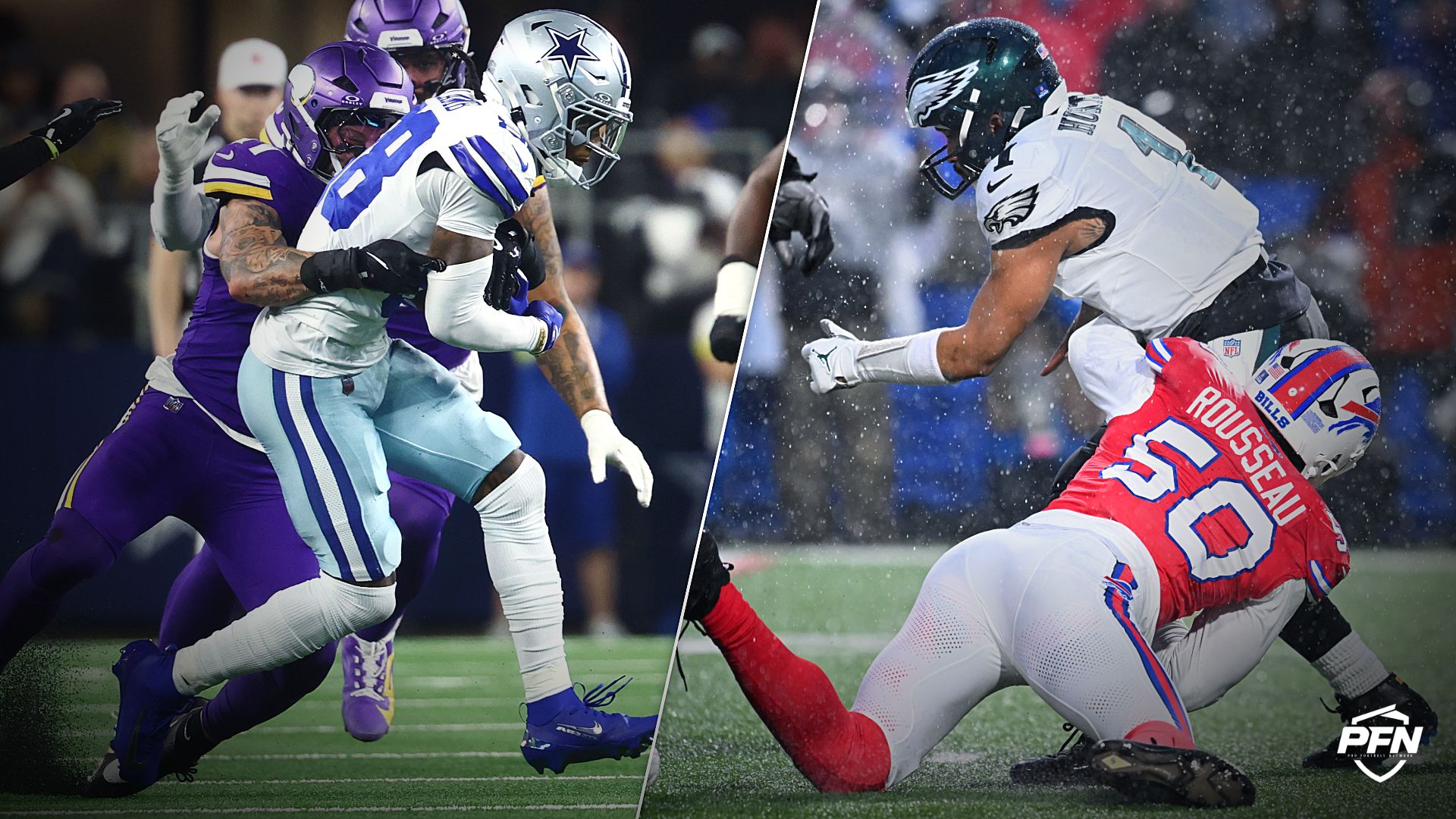
A fantasy football bust isn’t necessarily a player who should be cut loose, but rather one who I don’t believe is positioned to return the value expected based on his average cost. In theory, there is a “buying point” for every player in the league, but it would take a serious change of perception across the industry for me to ever land on the players below.
Fantasy Football Busts: Jalen Hurts, QB, Philadelphia Eagles
This is going to be a league-by-league situation, but if your draft room is treating Hurts as if he has a real shot to finish as the QB3 (it’s currently a very tightly packed group of four quarterbacks for that honor at ESPN), letting someone else take him might eliminate one opponent on draft day.
Hurts is fine, and I think the Eagles are going to win plenty of games, but that doesn’t matter for us. The Bengals, Commanders, and Patriots have a direct path to fantasy success this season, and it funnels directly through their ultra-talented quarterbacks. Philadelphia could certainly win at a high level if Hurts has an MVP season, but the Eagles don’t need him to carry the offense in the same way those other teams do. That lack of sheer necessity is what has me unwilling to pay up for his services.
Since 2023, Hurts is tied for 15th in 300-yard passing games, tied with the retired Derek Carr and two behind backup Joe Flacco. He’s not asked to put up massive passing volume, and that’s fine, but his passing floor lowered this offseason with the departure of A.J. Brown. Furthermore, I’m not confident his rushing production will continue to operate as the saving grace it has been in years past.
First-Down Rush Rate (Fewer Than 3 Yards to Move Chains/Score)
- 2023: 86.4%
- 2024: 77.1%
- 2025: 67.9%
This is a tiering problem within the industry more than a raw ranking issue. Some draft platforms have Hurts ranked as the QB6 this season, and I can get behind that, but not if it’s going to cost you a fifth-round pick. His profile is trending in the wrong direction, and even if he can overcome it, are we sure he’s going to be at his fantasy best when his best is required?
Home games against the stingy Seahawks and tenacious Texans await in Weeks 15–16, contests that will carry weather concerns on top of everything that comes with facing an elite defense.
I think Hurts has a far better chance of being the reason you lose your league this season than the reason you win it, and that’s simply not a sentence I want associated with any player I’m drafting in the first half of the proceedings.
Cam Skattebo, RB, New York Giants
Betting on the G-Men is something that early fantasy football drafters have been happy to do, and while I’m not here to shut down that general idea (the next draft I leave without Isaiah Likely will be my first, and we discussed the league-winning potential of Jaxson Dart on the live stream), their backfield isn’t a path of comfort for me.
We can’t assume injury for anyone, and I’m certainly not a doctor, but there is no denying that this is a live-by/die-by situation. The same aggressive running style that makes Skatts a viable fantasy option is what could make missed time nearly inevitable. He’s out to win the battle on every carry, while we are out to win the war of the fantasy season; that conflict of interest has me looking at running backs whom I view as much safer (such as D’Andre Swift and David Montgomery) in this ADP range.
I’m also not fully sold that a big season for this offense hinges on him having the type of year that makes him a difference-maker in our space. Malik Nabers is going to soak up a massive amount of usage, and we know that Dart isn’t shy about calling his own number. The complementary receivers aren’t the most consistent options in the world, but when Darius Slayton or Darnell Mooney hit on a deep ball, the drive ends with a quick score, leaving less opportunity for Skattebo to do his thing.
Something I don’t believe is being factored in enough here is the depth of this backfield. I’ve got Skattebo atop the depth chart without much question, but Tyrone Tracy Jr. (16.7% of his career touches have come via receptions) and Devin Singletary (130+ touches in all seven of his NFL seasons) are going to be involved.
As a rookie, Skattebo ranked as RB40 in our RB Impact grading. That puts him, talent-wise, in the Tyler Allgeier/Tony Pollard bucket, not the Josh Jacobs/Travis Etienne range where his ADP currently lies.
Some players on this list have the potential to single-handedly lose you your league. I’m not sure that’s the case here, but the opportunity cost is far too high for a player who I think enters this season with more question marks and risk than most are assuming.
CeeDee Lamb, WR, Dallas Cowboys
Lamb came out of the gates with a pair of 110-yard performances last season (cumulative: 16 catches on 24 targets for 222 yards), proving that he was still to be viewed as “the guy” in Big D, even with George Pickens joining the mix. In those contests, the Cowboys totaled 60 points, and the incumbent WR1 had more catches than the newcomer had targets.
That disparity didn’t last.
Lamb did get banged up in Week 3, which needs to be noted, but as the Dak Prescott–Pickens connection gained reps, it became clear that the role of “primary target” was no longer guaranteed for Lamb.
Now, the upside remained. In the second half of the season, he ripped off three straight 110+ yard games, and that was with Pickens on a run of his own (18 catches for 290 yards and two touchdowns in the two games prior to Lamb’s surge).
And therein lies the problem.
Of the 13 healthy games they played together, Lamb led Pickens in PPR points seven times, and the week-to-week swings have the potential to be dramatic. When looking at the percentage of total fantasy points Lamb scored between that duo, here is his 2025 recap by game (starting with Week 1):
Lamb’s Share of WR Duo Fantasy Points (Weeks 1–13 Healthy Sample)
- 75.0%
- 53.2%
- 64.3%
- 49.7%
- 52.7%
- 37.4%
- 28.0%
- 59.0%
- 67.5%
- 73.1%
- 29.9%
- 44.9%
- 42.4%
In total, his numbers were fine, and that’s very likely to be the case moving forward. But can you rely on him enough week in and week out to make him a first-round selection?
Looking to practice? Our FREE Fantasy Football Mock Draft Simulator guides you through an entire draft, in any format, so you can dominate on draft day!
It depends on your willingness to take on risk. Lamb’s year-end numbers could very well land where you expect, but if he gets there the way he did last season (peaks and valleys), you’re going to be left wanting more.
The red flags from 2025 were real. We could write off his career-low touchdown total to variance, but it was more than that when you dig into the profile.
His 25% red-zone target rate was down from 29.2% over the two seasons prior. Extend the range on the field, and you’ll notice a similar trend (a 25.9% target rate in enemy territory, down from 30.1% in 2024). The targets he has earned on the plus side of the field? Well, those have been dipping in value for a while now, and we have no real reason to think that changes in 2026.
Fantasy Points Per Target in Opponent Territory
- 2022: 2.54
- 2023: 2.23
- 2024: 1.57
- 2025: 1.31
Lamb remains a high-end talent, but fantasy is as much a game of situation as it is anything else, and in researching this profile extensively, the situational red flags are simply too significant to ignore at a Round 1 price tag.
Alec Pierce, WR, Indianapolis Colts
I’m generally fine with the “follow the money” train of thought, and the price tag isn’t too bad at the moment, but this is a point in the draft where I’m finding value anywhere *except* the receiver position.
Both onesie positions are very much on my radar in the Round 7–8 range (with players like Trevor Lawrence and Tucker Kraft), and there are some reasonable-floor running backs in this neighborhood (such as Chuba Hubbard and Rhamondre Stevenson). If we are being honest, Pierce isn’t even my favorite Colt in the middle rounds, as Josh Downs is going roughly a round later.
We aren’t 100% sure of the quarterback play in Indy this season, and given my confidence in both Tyler Warren and the aforementioned Downs to soak up the efficient targets, drafting Pierce feels a lot like paying a richer price tag for the exact same boom-or-bust player we’ve already seen.
For his career, he owns a 17.7-yard average depth of target (aDOT) and has averaged 29.5 yards per touchdown reception. Those are great paths to upside when everything is going right; I’m just not sold on that happening often enough for him to pay off his ADP.
MORE: Fantasy Football Sleepers Include Tank Dell, Isiah Pacheco, and Other Underrated Assets
Over the past five seasons, there hasn’t been a single receiver to post an aDOT over 13.5 yards while averaging 18 PPR points per game. No one is projecting that level of production from Pierce, but that stat includes every wideout in the NFL. If the elite can’t put up elite numbers when relying solely on deep passes, I’m happy to bet against an average receiver putting up average numbers in such a role.
The Colts ranked sixth in red-zone rush rate a season ago, and moving on from Michael Pittman Jr. certainly does not suggest they plan on pivoting away from a run-heavy script when in scoring position.
This is a classic situation where his year-end stat line will likely look more valuable than he actually was on a week-to-week basis, and I generally don’t spend mid-round picks on that sort of profile.