
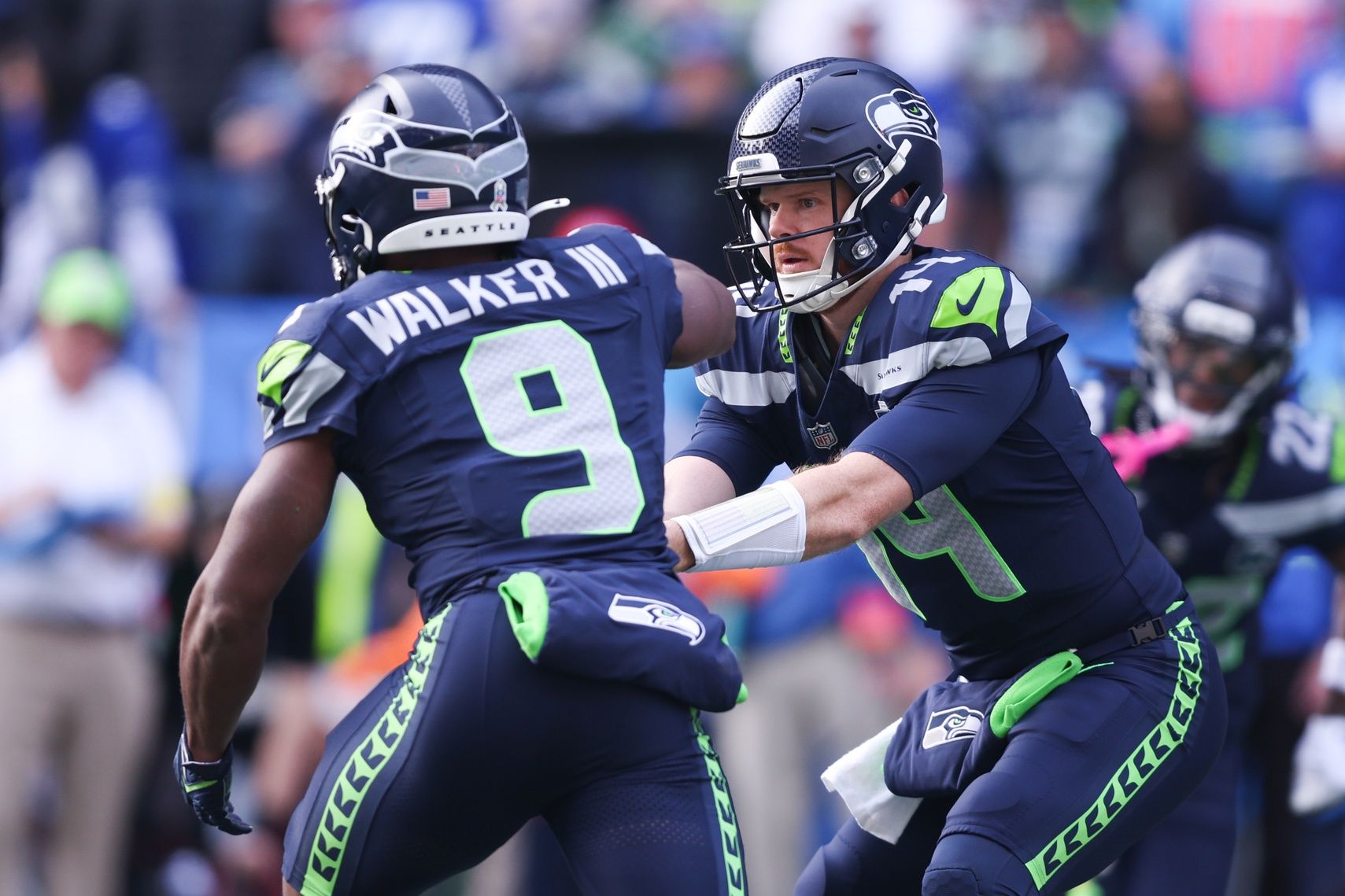
The fantasy football landscape shifts each week, bringing fresh opportunities and unexpected challenges that separate the prepared from the pretenders. Savvy managers know that last week’s performance tells only part of the story, and diving deeper into the underlying metrics reveals the accurate picture.
This week presents some intriguing decisions. Here’s insight about key Seattle Seahawks players heading into their matchup with the San Francisco 49ers to help you craft a winning lineup.
Sam Darnold, QB
This is a prime example of trusting the process and not the results.
There was a point during the first half of this season where Sam Darnold was viable. By the end of Week 9, he had a pair of four-TD games, a run of four multi-TD pass games in a five-game stretch, and just a general targeting of Jaxon Smith-Njigba that elevated his floor due to the special abilities of his WR1.
He was making this low-volume, slow-moving offense fantasy-friendly.
That’s a dangerous line to walk: we chase volume for a reason.
Darnold has thrown over 30 passes in just two of his past six games and has just six total TDs over his past five. Without rushing upside or attempting stability, this was always a profile that was destined to fail over time.
That time has come. This is a highly successful team that requires minimal fantasy production from the quarterback position. I don’t expect that to change this week or next season.
MORE: Free Fantasy Start/Sit Lineup Optimizer
Roster pieces of this offense, but not the man in charge of steering the ship.
Kenneth Walker III, RB
The Seahawks have looked into extending Kenneth Walker’s role a bit during the second half of this season, but his production has been spotty, and even with that goal, he has two red zone touches over his past three games despite handling 41 touches.
First Quarter Playing Time (Week 8 Bye)
- Weeks 1-7: Walker (51.9%) and Charbonnet (44.9%)
- Weeks 9-17: Walker (71%) and Charbonnet (26.2%)
He’ll be an interesting player to watch as an unrestricted free agent this summer. On one hand, he’s a 25-year-old who has picked up 10+ yards on 14.1% of his carries this season and is in scoring position whenever he touches the ball.
On the other, he has a sub-80% career gain rate and struggles with consistency quarter-to-quarter, nevermind game-to-game. Unless he goes nuts this week, this is going to be his worst season in terms of touchdowns and targets per game. If we get as steep a discount as I think is possible, I’ll be re-upping in 2026 if the landing spot is average.
Zach Charbonnet, RB
Zach Charbonnet is coming off a great game that saw him post his first 100-yard game in 385 days and get six of Seattle’s seven RB red zone touches.
For the season, he has 14 more red-zone opportunities than Kenneth Walker despite appearing in one fewer game, and he even held a 35-31 snap edge on Sunday, something that works against the recent trends.
This season, Charbonnet’s average touchdown rush length has been 4.1 yards. He has scored 11 times and has been fortunate to have received so many opportunities. But he’s made the best of his role, and with Walker being a UFA this summer (Charbonnet has one more year left on his deal), a role extension is certainly possible in his age-25 season.
This is a situation to monitor: as a committee, this backfield has been annoying, but as a single entity, we could be looking at a top-15 option.
Cooper Kupp, WR
The target earnings and touchdown savvy have been removed from this profile. That doesn’t mean Cooper Kupp can’t pick up a big third down in a playoff game or even convert a red-zone look into points, but if Seattle had any confidence in him as part of this offense that lacks pass-catching depth, we would have seen it by now.
I don’t trust what teams say, but I do trust their actions, and those have sent a clear message all season long. For that matter, we could have trusted the Rams’ actions by not bringing him back to a must-win team.
Davante Adams replaced Kupp, and he’s obviously had a great season, so blindly fading these moving veterans isn’t the approach. That said, route technicians who lose a step can fall off our map rather quickly, while these wideouts who weaponize their size can hang onto value a bit longer by way of touchdown count, even if the ability to earn targets fades.
Jaxon Smith-Njigba, WR
The Panthers held Jaxon Smith-Njigba without a 20-yard catch, his second such game this season, and kept him out of the end zone. His yards per route were 37.6% below his season average, and he was held under 100 air yards.
That all sounds good, right?
The man earned a dozen targets, caught nine of them, and made three impactful plays during Seattle’s first fourth-quarter drive that allowed them to push their advantage to two scores.
If this is “stopping” him, then I wish the 49ers the best of luck. He caught nine passes for 124 yards against them in Week 1, and that feels like a reasonable projection for this week. I don’t think he has the same game-breaking upside as Ja’Marr Chase, and Justin Jefferson still has Triple Crown potential if the quarterback position in Minnesota is settled. Still, after that, JSN has as good a case for a first-round grade as any receiver.
Would you prefer him to Puka Nacua if Matthew Stafford were to retire? What about Nico Collins if the recent version of CJ Stroud is here to stay? Malik Nabers with Jaxson Dart?
READ MORE: Kyle Soppe’s Fantasy Football Week 18 Start ‘Em Sit ‘Em: Playoff Edition
How the second tier of receivers pans out this summer will be enjoyable, and I envision myself not hesitating to double-tap the position if I’m picking at the turn of a snake draft.
Rashid Shaheed, WR
Rashid Shaheed left early Sunday with a concussion, but he’s been unable to carve out a role in an offense that saw Sam Darnold functioning at the peak of his powers, and that has me treating him no differently than in years past.
In a perfect world, this offense picks up the pace, and we get some additional target-earning opportunities. Shaheed clearly sits atop my list of all-or-nothing types at the position, and if given the chance, it wouldn’t shock me to see him have a run at some point next season, like what Quentin Johnston did in the first half of this year.
In 2026, we will be looking at a 28-year-old receiver who could still be seeking his first 60 catch season (currently sitting on 58) and averages 14.7 yards per catch. We saw him average nearly five catches per game with the Saints early in the season, but that was an offense structured in complete contrast to Seattle’s.
As he enters free agency, my ranking of him is very situation-dependent. If we are looking at an average, or better, team in terms of offensive plays per game, he’ll garner a flex ranking from me, but we’ve seen enough with the Seahawks to think that a slow-moving scheme that has an alpha WR1 isn’t a fantasy-friendly spot for him.
AJ Barner, TE
He’s not going to soar up the ranks, but AJ Barner was an efficient player as a rookie, took on a larger role this season, and has remained as such despite the QB play.
Maybe he’s just #good?
MORE: Fantasy Football Trade Analyzer
His target share has more than doubled from 2024, while all of his per-opportunity metrics have stayed the same. His yards per route run have spiked under Sam Darnold (up 31.9%), and while he’s added a little depth to his route-running profile, he remains more of a chain-moving/short-yardage option.
I’m fine with that, and I think you should be, too, given how this offense is set up.
Half of his touchdowns this season have come from 15+ yards out. There’s some upside to chase as the end zone comes into focus, but that’s not the selling point. He’s caught 3-4 passes in five straight games and is part of a pass-catching core that serves to give JSN space.
The upside isn’t high, but when you’re among the last in your league to address the position, you’re not asking it to be. Barner is to be viewed as a nice, high-floor tight end for 2026 and should be identified as a late-round target if you don’t want to pay up for the tight ends that can swing weeks.