
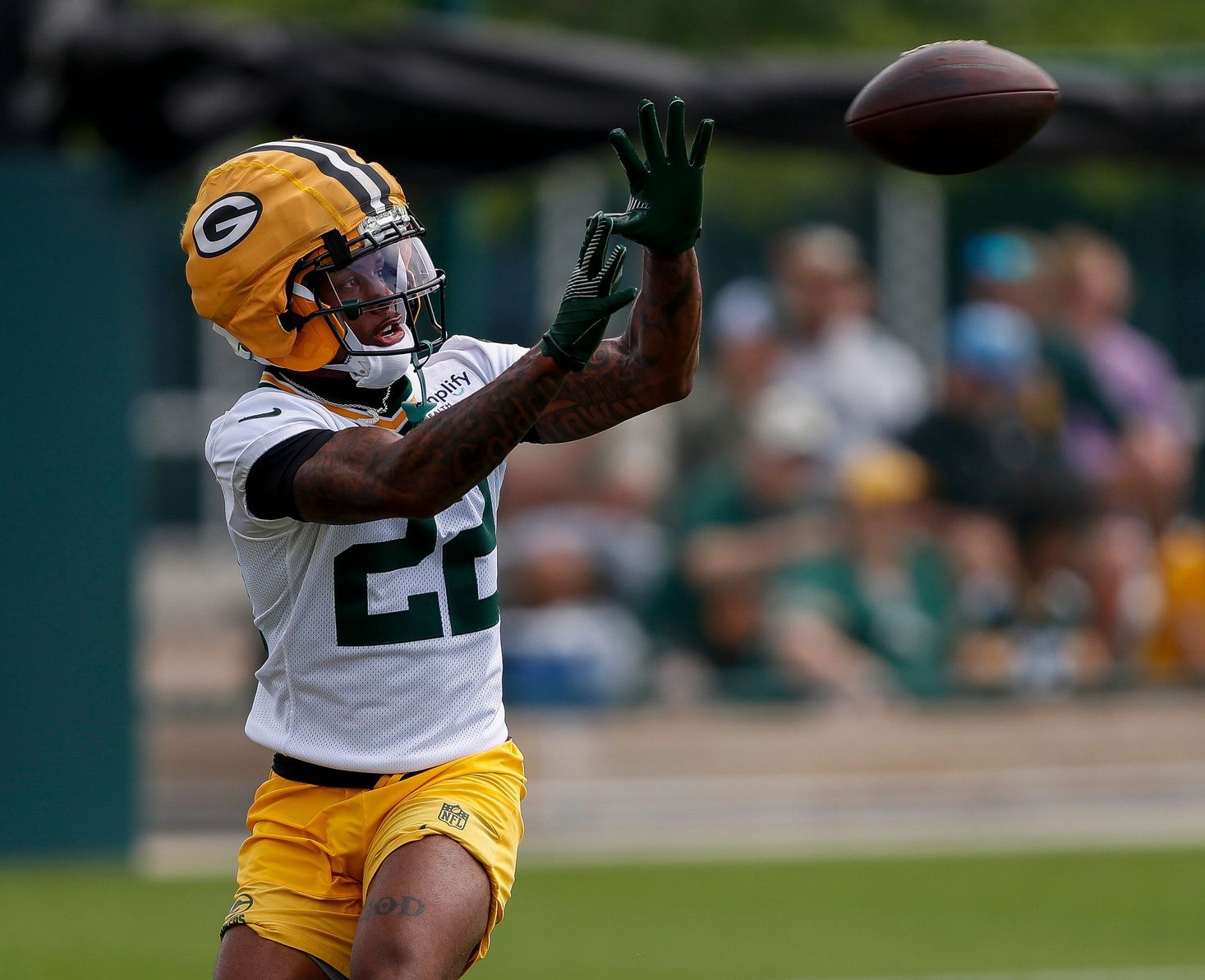
If you asked any NFL Draft analyst about Matthew Golden’s chances of going in the first round before the 2024 season, they would’ve said it was close to zero. The Texas product played his way into being the fourth WR off the board, going to the Green Bay Packers with the 23rd overall pick. While the Packers may be excited about Golden, I am not. Here’s why fantasy football managers should fade Golden in both redraft and dynasty leagues.


First Round Busts Happen Every Year
We know the best NFL players come from the first round. There’s a reason every prospect ever to get drafted in Round 1 was able to achieve that feat. None of these players are devoid of talent (well…almost none).
While we should trust that NFL scouts and front offices have access to a lot more information and data than we do, that doesn’t make them impervious to failure. Every first round in football history has had several busts, and the 2025 draft class will be no different. The challenge we face as fantasy managers regarding skill position players is identifying where the NFL has gone wrong.
Since 2010, 61 wide receivers have heard their name called in the first round of the NFL Draft. Some of the best WRs of all time are included in this list. There have also been some colossal busts. Roughly one-third of them were never fantasy-relevant. Another eight or so were mediocre, at best. That’s already half of our sample size that never really panned out. In reality, it’s more than that because we can’t really render verdicts on the 2023 or 2024 guys just yet.
All of this is to say that you shouldn’t let anyone defend a guy like Matthew Golden simply because an NFL team deemed him worthy of being a first-round selection.
Matthew Golden Has All The Makings of a Bust
It’s astounding that Golden managed to work his way into the first round. He is an early declare, which is a checkmark in his favor. But there are so many red flags.
Golden was a late breakout, failing to make any meaningful impact until his junior year at Texas, after transferring from Houston. More specifically, though, Golden really didn’t do much until his teammate Isaiah Bond went down.
This is all Matthew Golden has. He’s not even a one-year wonder; he’s a four-game wonder. And those games all came with Isaiah Bond was hurt.
When Isaiah Bond was healthy, he was the true WR1 of the team https://t.co/3XAxMrCAIB pic.twitter.com/1ODyVyfwos
— Scott Barrett (@ScottBarrettDFB) April 2, 2025
To be clear, we shouldn’t discredit what Golden was able to do in those four games without Bond. However, we do need to ask ourselves why Golden barely produced when Bond was healthy?
Off-the-field issues definitely factored in, but as a reminder, Bond is currently not on an NFL roster. He went undrafted. This is the player that Golden could not overtake in college.
The most predictive indicator of NFL production is college production. Golden averaged 61.7 receiving yards per game in his final season at Texas. In what will be a bit of a theme, look at the company he keeps.
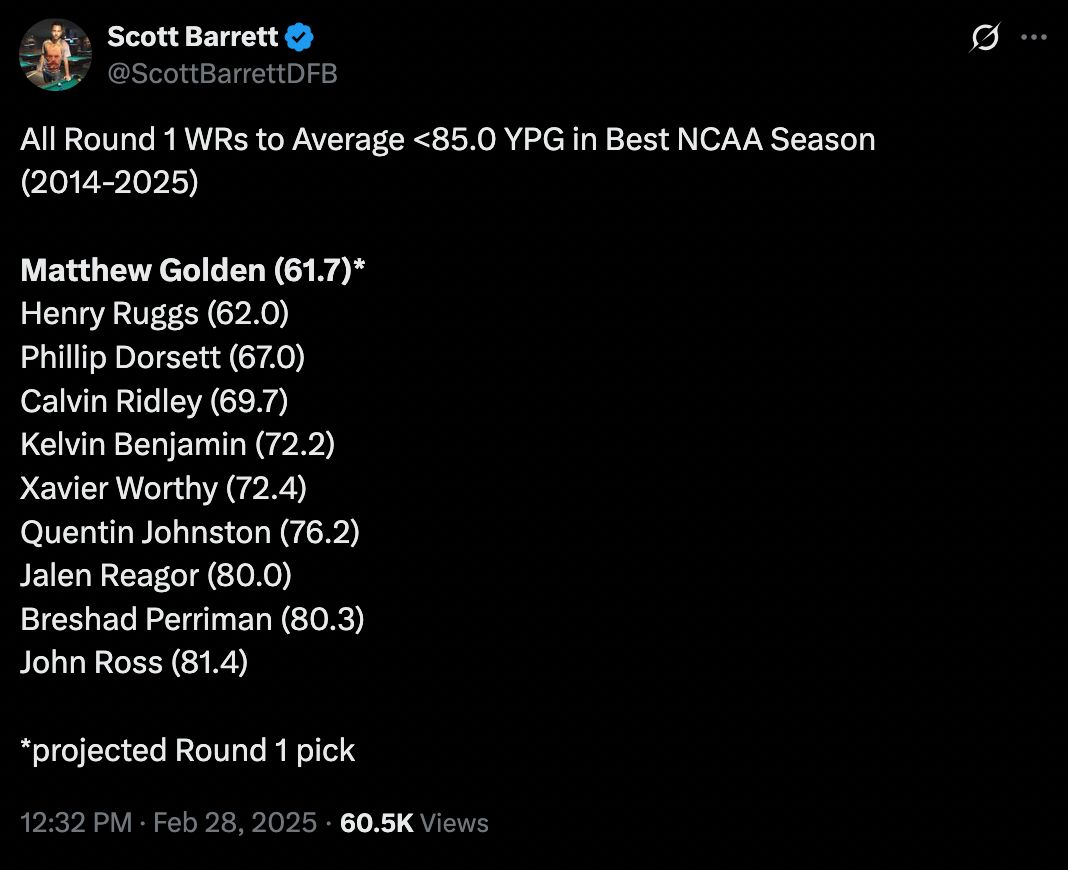
The best wide receiver in this group is Calvin Ridley. It’s too early to draw conclusions on Xavier Worthy, and as much as I want to call Quentin Johnston a bust, we need to wait one more year to be sure. The rest of them are unequivocally busts.
If Golden succeeds, he will be an outlier. To be fair, fantasy football is won and lost by betting on outliers. However, the outliers we want to bet on are not supposed to be expensive first-rounders.
Matthew Golden Is Fast…Too Fast
We’ve all heard the phrase, “Speed kills.” It does. But not in the way you might think.
Conventional wisdom suggests being fast is a good thing. The list of successful NFL players who are unathletic (from an NFL standpoint — these guys are all super athletes relative to the average person) is very small. We notice the Antonio Browns and Keenan Allens of the world, but there are hundreds of others who never made it because they were too slow.
At wide receiver, speed helps, but it isn’t overly important. We really just need wide receivers to hit a minimum threshold required to play at a professional level. If a player can merely get to a 4.65 40-time, that’s good enough. Their technical receiving ability can take it from there.
Among Round 1-3 WRs since 2000 who ran a 4.55 40-time or slower are Davante Adams, Michael Thomas, DeAndre Hopkins, Keenan Allen, Plaxico Burress, Allen Robinson, Cooper Kupp, Jarvis Landry, and Anquan Boldin. That’s a lot of hits.
What about at the top, though? Surely, faster is better…right?
Golden ran a 4.29 40-time, which puts his speed score in the 91st percentile. While Golden’s draft stock was rising before the NFL Combine, it was his 40-time that really pushed him into the first round. NFL teams continue to overweight speed at wide receiver even though history suggests not only that they shouldn’t, but that it may actually be a negative.
Here is every wide receiver to run a 4.31 40-time or faster since 2000. Notice anything?
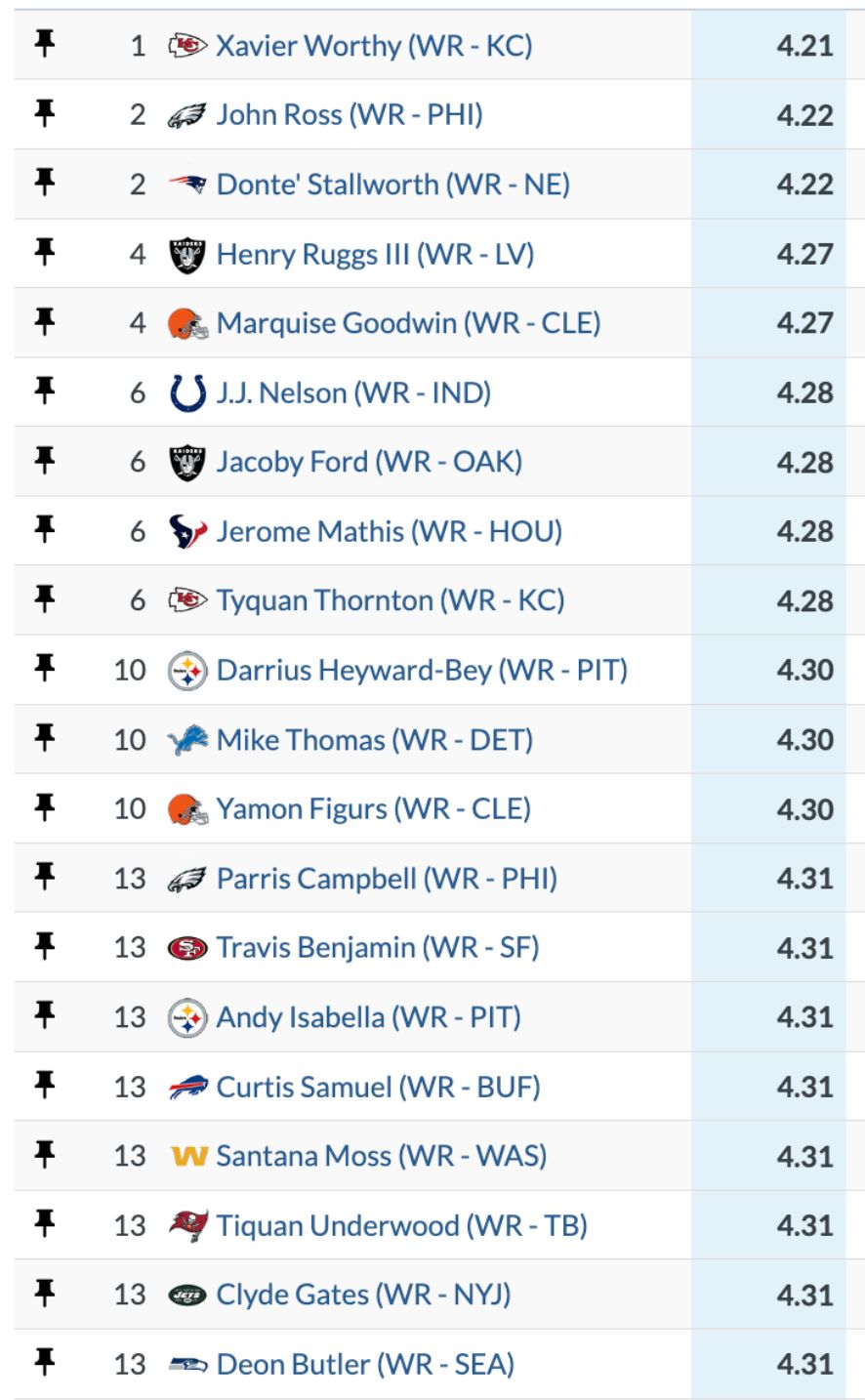
Worthy had a strong close to his rookie season and is trending toward being very good. Donte Stallworth had four seasons ranging from 11.2 to 12.8 fantasy points per game. Not terrible, but certainly a bust by Round 1 WR standards. Curtis Samuel has had a solid career, but nothing spectacular. Santana Moss is the only one who is indisputably a hit. Every other super-fast wide receiver did not even come close to producing fantasy-relevant numbers.
We can gamble that Golden will buck the trend. He landed in a great spot in Green Bay. They have a talented young QB in Jordan Love. Their wide receiver room is deep, but it lacks a clear top option. Golden could absolutely be that guy. He can also be that guy for the Packers while still not being a reliable fantasy producer.
Golden has all the makings of a better in real life than fantasy guy, if he’s even that much.
If you blanket wrote off every 4.31 or faster wide receiver in fantasy, you’d have about a 94% success rate. If that means missing out on the roughly 6% that end up hitting, I am perfectly fine with that. Therefore, I won’t be targeting Golden in dynasty or redraft this year.
