
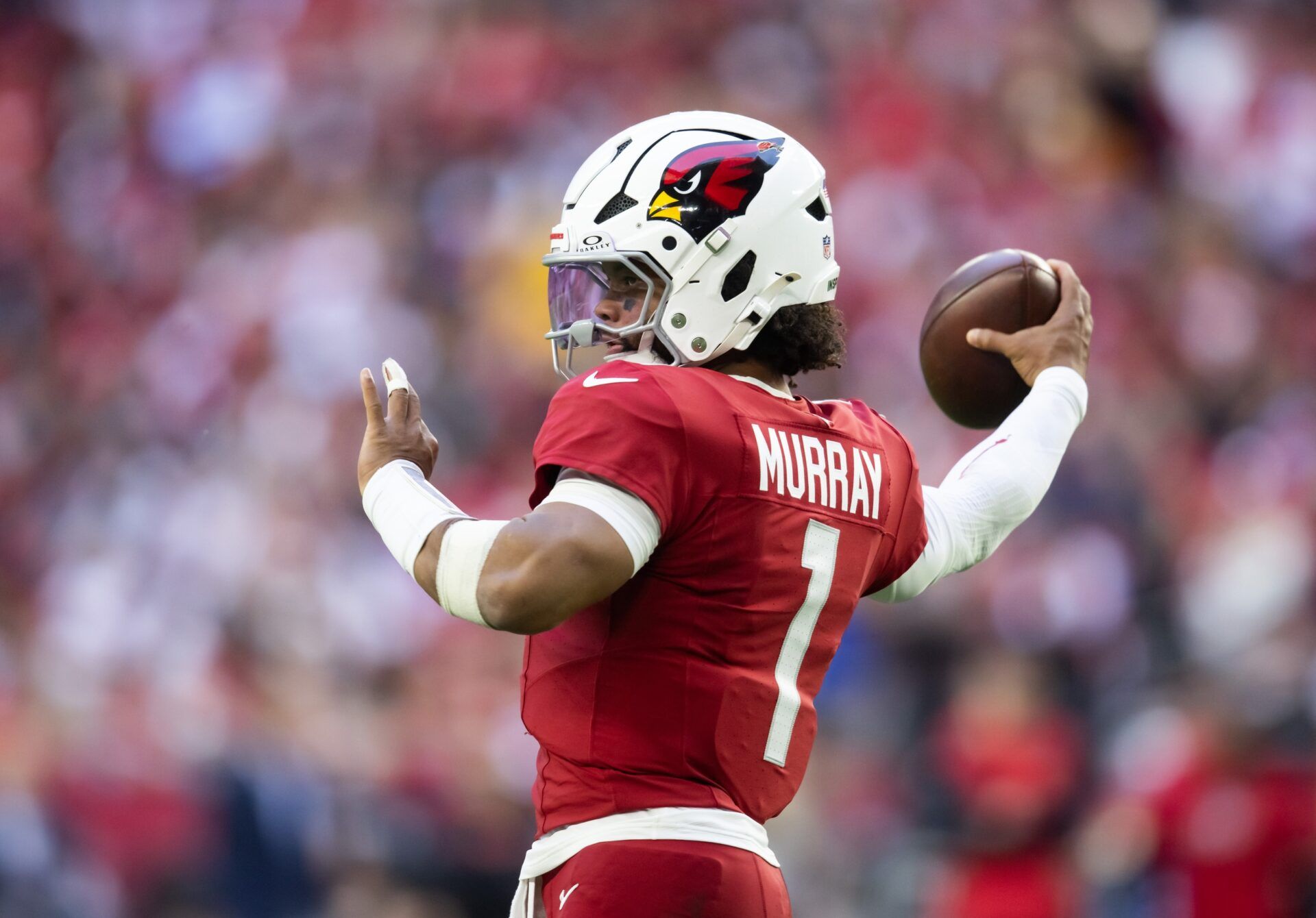
The fantasy football community has officially soured on Kyler Murray. The Arizona Cardinals quarterback who once seemed destined for superstardom is now being treated like damaged goods in trade markets. Murray made PFSN’s NFL Top 100 list, but fantasy users aren’t as sold on Arizona’s star. Murray was acquired in 55% of deals in which he was included back in June, but that rate has tanked to 33.7% thus far in July through the PFSN Trade Analyzer.
When two-thirds of fantasy managers are actively avoiding a quarterback who’s never finished outside the top 12, something is seriously wrong. The question isn’t whether Murray will be decent. It’s whether he’ll ever be special again.

The Reliable Floor That No One Wants Anymore
Let’s start with what Murray does well: he doesn’t lose you weeks. The 28-year-old has never averaged fewer than 18.1 fantasy points per game and has never finished outside the top 12 quarterbacks. In 2024, he finished as QB12 despite missing significant time in previous seasons.
Murray’s rushing ability remains his saving grace. He ran for 572 yards and five touchdowns last season, ranking fourth among quarterbacks in rushing yards. His dual-threat capability provides a consistent floor that pocket passers can’t match, and he’s already stated he wants to run more in 2025.
But here’s the problem: fantasy managers don’t want a reliable QB10-12. They want upside. They want game-breaking performances that can single-handedly win weeks. Murray hasn’t provided that in years.
Kyler Murray completed 68.8% of his passes for 3,851 yards, 21 TDs and 11 INTs in 2024. But his fantasy managers want more explosive plays and consistency under pressure. pic.twitter.com/xyz123
— Arizona Cardinals (@AZCardinals) January 17, 2025
The Development That Never Happened
The hope for any quarterback is to grow and develop with time, but it’s fair to question that with Murray. In 2024, his sixth professional season, Murray posted his worst touchdown rate (2.4%, career: 3.6%) and second worst interception rate (5.6%, career: 3.8%) when under duress.
Think about that for a moment. After six years in the NFL, Murray is getting worse under pressure, not better. His QBR under pressure plummeted from 85 through Week 10 to just 10 over the final three games of the season. When elite quarterbacks face adversity, they typically improve with experience. Murray has regressed.
His completion percentage dropped to 39% and he averaged just 3.7 yards per attempt when pressured during Arizona’s late-season collapse. That’s not the profile of a quarterback ready to take the next step. That’s the profile of a player whose limitations are being exposed.
The Missing Explosiveness
Where are the game-breaking plays that made Murray special early in his career? Murray’s last run gaining more than 20 yards came in the middle of October, and he didn’t record a 45-yard completion after Week 2 of last season. He had six rushes of 20+ and looking at his game log, explosive plays became increasingly rare as the season progressed.
The Cardinals averaged 7.1 yards per attempt in 2024, ranking 21st in the NFL, while Murray’s average target depth was just 7.1 yards. He completed just three passes of 40 or more yards all season. When you’re a dual-threat quarterback who isn’t threatening defenses deep or breaking off long runs, you’re just a slightly more mobile pocket passer.
The Same Problems, Same Solutions
Here’s where things get frustrating for fantasy managers: what exactly is going to change in 2025? The Cardinals have the same head coach in Jonathan Gannon. They have the same offensive coordinator in Drew Petzing. The same play-calling issues that hampered the offense in 2024 remain unchanged.
The problem with Marvin Harrison Jr. as a rookie wasn’t the wide receiver. Harrison was utilized primarily as a vertical “X” receiver despite being more effective on horizontal routes. He recorded a separation score of just 0.005 on vertically breaking routes, ranking 83rd out of 106 receivers. Murray’s struggles with downfield throwing compounded the issue.
Harrison managed just 62 catches for 885 yards and eight touchdowns, numbers that both he and the team considered disappointing. The rookie himself said he wouldn’t call it success, despite playing all 17 games. When your first-round receiver is openly critical of his production, that says something about the offense’s ability to maximize talent.
The Coaching Staff That Isn’t Changing
Drew Petzing has received praise for his adaptability, ranking 12th among play-callers entering 2024. But the results speak for themselves. The Cardinals ranked 12th in scoring and 11th in total yards, decent numbers that mask underlying efficiency issues.
While Trey McBride hints at a “saucier” offense with more motions and complex play designs, the fundamental problems remain. Murray’s deep ball accuracy hasn’t improved, and the play-calling philosophy that limited Harrison Jr.’s effectiveness is unlikely to change.
The Cardinals’ offense is projected to improve in 2025, with some metrics ranking them in the top five. But projections based on talent don’t account for coaching limitations and quarterback regression under pressure.
The Value Proposition Problem
Fantasy managers are recognizing there’s little value in a quarterback like Murray. If you’re not paying up for one of the big four (Josh Allen, Lamar Jackson, Jayden Daniels, Jalen Hurts), then you might as well tier down to the medley of low QB1s/high QB2s that have mid-QB1 upside.
Players like Drake Maye, Caleb Williams, Dak Prescott, Jordan Love, and JJ McCarthy offer similar floors with potentially higher ceilings. Murray’s track record of consistency is nice, but it doesn’t justify his draft position when younger quarterbacks with more upside are available later.
Murray won’t fail fantasy managers, but he won’t win them championships either. He’s the definition of replacement-level production at a position where upside matters more than consistency. The explosive plays that once made him special have vanished, and there’s no indication they’re coming back.
At 28 years old, Murray should be entering his prime. Instead, he’s showing signs of stagnation in an offense that hasn’t maximized his or his receivers’ talents. While he’ll continue to provide QB1 production thanks to his rushing ability, the days of Murray being a difference-maker appear to either be over or potentially in the distant future. That doesn’t help fantasy managers in 2025.
