
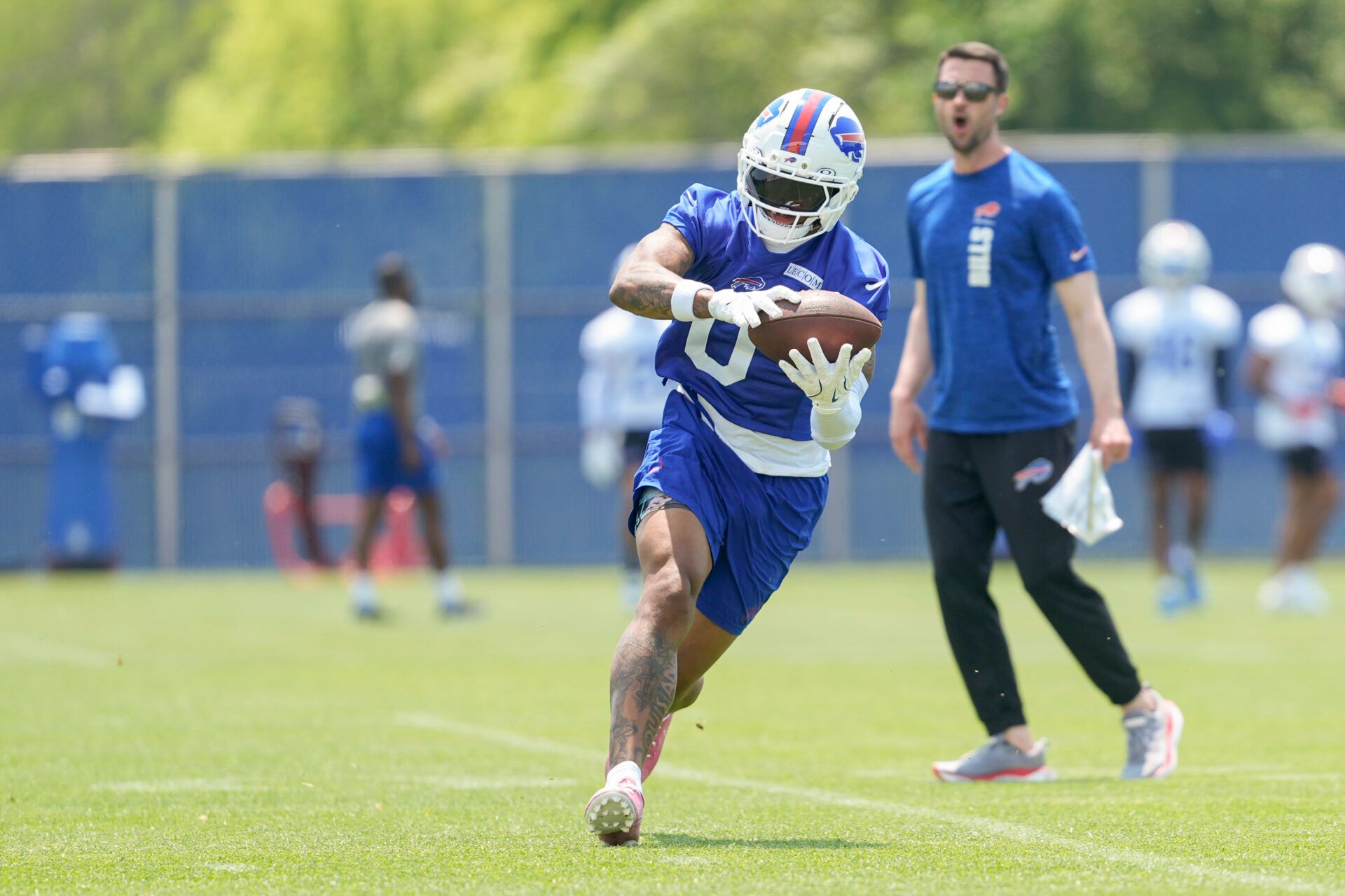
In the ever-evolving landscape of fantasy football, savvy managers are always on the hunt for undervalued assets poised to break out. Keon Coleman’s name is buzzing in trade circles, not because he dominated as a rookie, but because the data suggests a significant leap in value may be just around the corner.
With Amari Cooper’s departure and a year of NFL experience under his belt, Coleman stands at the crossroads of opportunity and uncertainty. What does the data say about his potential, and why should fantasy managers care?

Keon Coleman’s Market Movement and Year 2 Outlook
Coleman’s presence in fantasy trade talks is undeniable. He has been acquired in 58.3% of deals involving him in the PFSN Trade Analyzer, making him the 12th most frequently traded player in the league. This level of activity signals a consensus among managers that Coleman is more than just a roster filler. He is a player with both risk and reward written into his profile.
Coleman’s rookie season was marked by inconsistency and growing pains, but those same challenges could be the foundation for a breakout sophomore campaign.
A closer look at Coleman’s 2024 season reveals a player whose production was directly tied to opportunity. When on the field for at least 75% of Buffalo’s offensive snaps, Coleman averaged 23.4% more PPR points per game than in contests where he failed to reach that threshold. This is a crucial insight for fantasy managers evaluating his ceiling.
With Cooper now out of the picture and journeyman Joshua Palmer the only free agent acquisition of note, Coleman is positioned to absorb a larger share of the Bills’ receiving volume, a shift that could unlock his statistical upside.
Keon Coleman pic.twitter.com/OeCpXZm93p
— Ian Hartitz (@Ihartitz) March 28, 2025
The Challenge of Defensive Adjustments and Efficiency
Despite the optimism, Coleman’s rookie year was not without its pitfalls. After a promising start, NFL defenses began to adjust to his role within the Bills’ offense, particularly after the first month of the season.
This led to a noticeable drop in efficiency, as Coleman struggled to produce at the same level once opponents keyed in on his tendencies. The question for 2025 is whether the Bills’ coaching staff and quarterback Josh Allen can counter these adjustments to keep Coleman productive.
One area of concern is Coleman’s performance on deep targets. From Weeks 5 through 18, Coleman managed just 6 catches on 19 targets, with zero touchdowns.
In comparison, the combination of Cooper and Mack Hollins recorded 12 catches on 26 targets with 2 touchdowns. This disparity highlights a potential weakness in Coleman’s game, but it also underscores the importance of context.
Cooper’s absence means Coleman will have more opportunities to prove himself as a downfield threat, provided the coaching staff can scheme him open and Allen can deliver accurate passes.
Why Coleman’s Value Matters for Fantasy Managers
Coleman’s situation is a classic example of a player whose value is shaped by both his own development and the changing dynamics of his team.
For fantasy managers, this creates a unique buying opportunity. The data shows that Coleman is already a hot commodity in trades, but his actual production has yet to match the hype. This gap between perception and reality is where savvy managers can find an edge.
The key to unlocking Coleman’s value lies in understanding the factors that limited him as a rookie and the changes that could propel him forward in 2025. His increased role in the offense, combined with the potential for improved efficiency if the Bills adjust their scheme, makes him a compelling target.
While there are no guarantees in fantasy football, the numbers suggest that Coleman is a player worth monitoring closely as the season approaches.
Looking Ahead: What to Watch for in 2025
As training camps open and preseason action gets underway, fantasy managers should pay close attention to how Coleman is being utilized in the Bills’ offense.
Reports of increased snaps with the first team, positive chemistry with Allen, and a more diverse route tree would all be encouraging signs. Conversely, any indication that Buffalo plans to limit his role or spread the ball around more evenly would be cause for caution.
Ultimately, Coleman’s value will be determined by his ability to capitalize on his expanded opportunities and overcome the defensive adjustments that stymied him as a rookie.
For fantasy managers willing to take a calculated risk, Coleman offers the potential for significant returns at a relatively modest cost.
The data is clear: he is a player on the rise, and those who act early could reap the rewards.
In the end, Coleman’s story is one of potential waiting to be realized. The numbers paint a picture of a player with room to grow, but also one whose value could skyrocket if the pieces fall into place. For fantasy managers, that’s an opportunity worth pursuing.
