
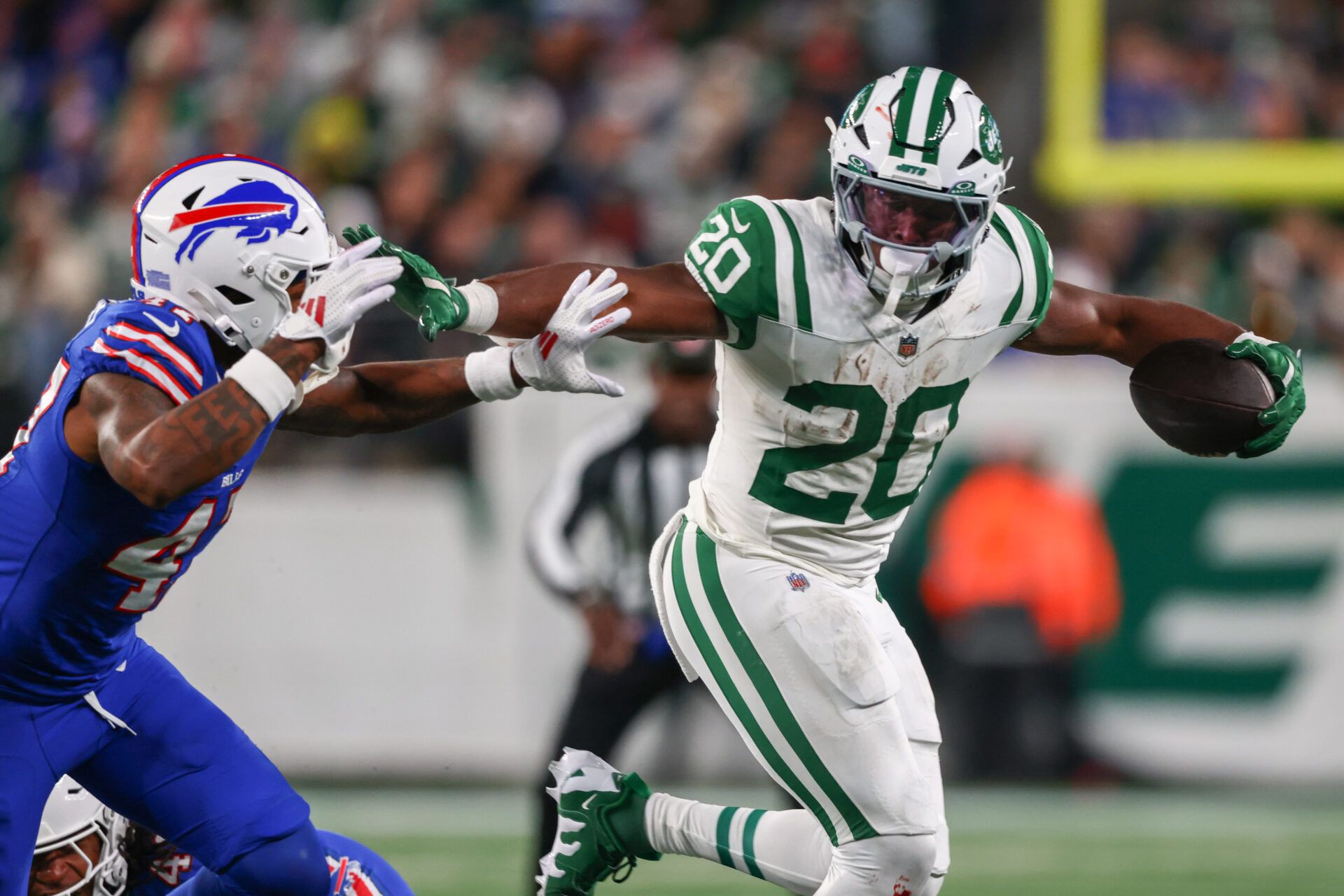
The New York Jets’ backfield situation has fantasy football managers hitting the panic button. Breece Hall, once considered a lock for RB1 production, is generating unprecedented trade activity with over 80 daily transactions throughout August, according to PFSN’s Fantasy Football Trade Analyzer.
That level of movement signals serious concerns about his third-round price tag, and rightfully so.

The Numbers Tell a Troubling Story
Hall’s declining efficiency paints a concerning picture for fantasy investors. After posting an impressive 1.18 PPR points per touch during his promising rookie campaign, that rate dropped to 0.97 in 2023 before falling further to 0.92 last season. For a running back being drafted as a weekly starter, this downward trajectory raises legitimate questions about his ceiling.
The emergence of Braelon Allen adds another layer of complexity. While Allen’s rookie season appeared underwhelming on the surface, a deeper dive reveals promise. The Wisconsin product averaged 5.9 yards per carry across three college seasons, and 78.8% of his NFL rushing yards came after contact, suggesting the Jets’ offensive line struggles hampered his production more than any deficiency in his game.
New York addressed that weakness by selecting offensive lineman Armand Membou with the seventh overall pick, potentially unlocking Allen’s college production at the professional level.
Recent training camp footage shows the Jets experimenting with both backs on the field simultaneously, hinting at creative offensive packages that could further limit Hall’s touches.
Breece Hall scores the Jets’ first touchdown of the season 🔥pic.twitter.com/dxBbkF8810
— ClutchPoints (@ClutchPoints) September 10, 2024
The Justin Fields Factor
Adding Justin Fields to the equation complicates Hall’s outlook even more. Fields brings dual-threat capability that naturally reduces running back opportunities, particularly in the red zone, where Hall previously thrived. With a mobile quarterback who can create rushing yards independently, the Jets possess multiple avenues to move the football without leaning heavily on their primary back.
Fantasy managers drafting Hall in the third round are essentially betting that his efficiency rebounds while his touch share remains stable. Both assumptions carry significant risk given the current roster construction and Allen’s expanding role.
The Verdict on Hall
Hall remains talented enough to produce RB1 numbers when everything clicks, but the margin for error has shrunk considerably. His declining per-touch efficiency, combined with legitimate backfield competition and a mobile quarterback, creates too many variables for a third-round investment.
Competent fantasy managers should view Hall as a prime trade candidate rather than a foundation piece. His name recognition still commands respect, making this the ideal time to move him for more reliable production. Sometimes the best fantasy decision is recognizing when circumstances have shifted against a previously reliable asset.
